

A cat adopted at 10 weeks may share your life for 15-18 years. Some will reach 20. A few extraordinary individuals have exceeded 25. Understanding typical lifespans by breed helps potential owners make informed commitments — and helps existing owners recognize that quality of care shapes lifespan as much as genetics does. Before selecting a breed, how to choose the right cat breed covers the full matching framework so that longevity is one factor among several considered together.
The numbers below represent typical ranges for well-cared-for cats with regular veterinary access. Individual variation is significant. For context in the full breed landscape, the cat breed categories guide covers the full picture.
Typically Long-Lived Breeds (15+ Years Common)
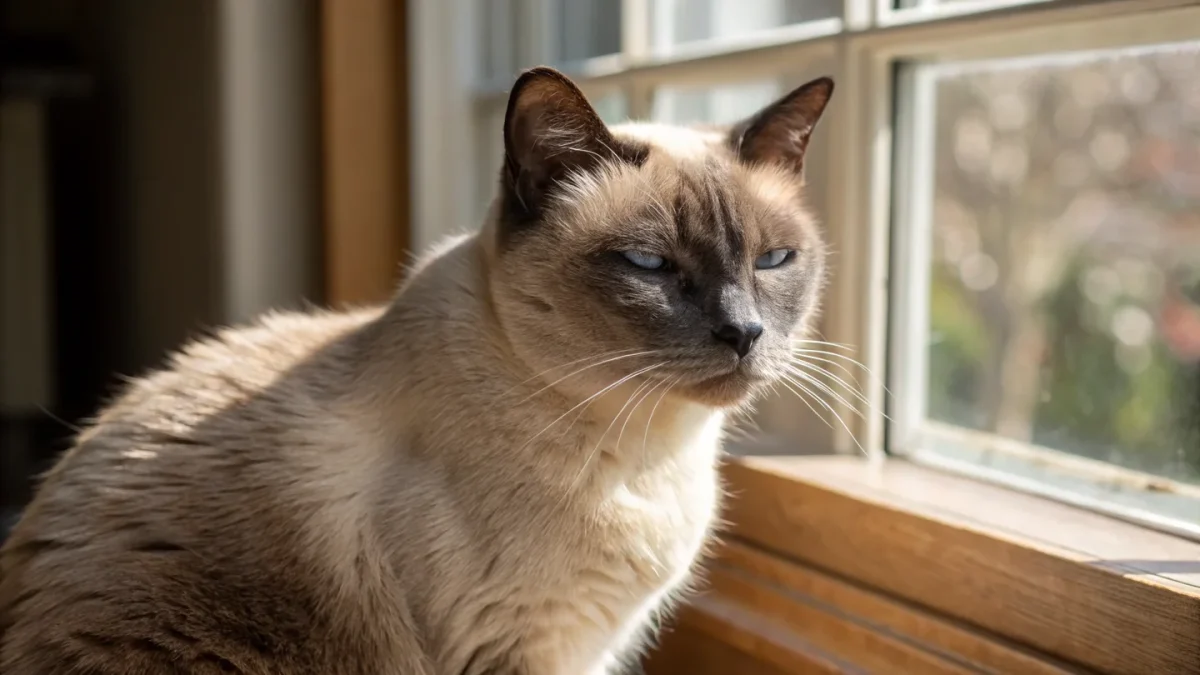
Siamese: One of the most consistently long-lived breeds. A landmark 2024 study by the Royal Veterinary College and National Chung Hsing University — analyzing nearly 8,000 cats under primary veterinary care in the UK — found the Siamese had a life expectancy from birth of approximately 11.7 years, broadly in line with the overall cat population average. Breed enthusiast data and registry observations suggest well-cared-for individuals regularly reach 15+ years, with 20+ documented with some frequency. The gap between population-level epidemiological data and reported maxima likely reflects the difference between an average across all cats (including those with early illness) and the lifespan achievable under excellent care.
Burmese: The same 2024 RVC/NCSU study found the Burmese had the greatest life expectancy of all breeds studied, at an average of 14.4 years from birth — the longest of any breed in the dataset. Western Burmese (the more common type outside Southeast Asia) consistently rank among the longest-lived purebreds, with individuals reaching 16-18 years not unusual.
Balinese: As the longhaired Siamese, shares the Siamese's general health profile and longevity.
Tonkinese: Siamese-Burmese cross, widely reported by breed organizations and veterinary sources to benefit from the hybrid vigor typical of deliberate cross-breed development. Most breed profiles cite 12–16 years as a typical range, with well-cared-for individuals commonly reaching into their mid-to-late teens. No dedicated peer-reviewed lifespan study exists specifically for Tonkinese, but the two parent breeds rank among the longest-lived — the Burmese leading breed-level data — which supports the Tonkinese's reputation for longevity.
Average-Lived Breeds (12-16 Years Typical)
Maine Coon: Typically 12-15 years. Larger breeds often have slightly shorter lifespans than smaller breeds, though the difference in cats is less pronounced than in dogs. HCM (hypertrophic cardiomyopathy) screening is important in this breed.
Ragdoll: 12-17 years is the commonly cited range. Generally healthy with HCM screening an important consideration.
Abyssinian: 12-15 years typically. Generally robust breed with good genetic diversity from natural origins.
Norwegian Forest Cat: 14-16 years typically. A natural breed with generally good health.
Siberian: 11-15 years. Generally robust.
British Shorthair: 12-17 years. Generally sturdy and healthy.
American Shorthair: 15-20 years is the consistently cited range across veterinary breed references for well-cared-for indoor cats, making them one of the longer-lived shorthaired breeds. A dedicated peer-reviewed study specifically on American Shorthair longevity hasn't been published, but the breed's generally robust genetic diversity and absence of extreme physical conformation support this range.
Cornish Rex: 12-16 years typically.
Devon Rex: 12-15 years typically.
Breeds with Health Considerations Affecting Lifespan
Persian: Typically 10-15 years, though quality of care for the flat-face health issues significantly affects this range. Dental problems, eye discharge, and in extreme conformations, breathing difficulties all affect quality of life and potentially longevity.
Scottish Fold: Osteochondrodysplasia, the progressive joint condition inherent to the breed, affects all Scottish Folds to varying degrees — research confirms that even heterozygous individuals (one copy of the fold mutation) develop progressive arthritis in multiple limbs, typically manifesting later in life than in homozygous cats. Its specific effect on overall lifespan compared to British Shorthairs hasn't been quantified in a dedicated comparative study, but the condition's progressive nature and the welfare interventions it often requires are well-documented concerns in the veterinary literature. The University of Edinburgh's Royal (Dick) School of Veterinary Studies and animal welfare organizations including the RSPCA have raised formal concerns about the breed's welfare.
Bengal: Generally healthy. The hybrid origin contributes genetic diversity. Typical lifespan 12-16 years.
The Mixed-Breed Advantage
Domestic mixed-breed cats (moggies) do live longer on average than purebred cats. A study published in BMC Veterinary Research using UK veterinary data found that crossbred cats outlived purebred cats by approximately 0.6 years after adjusting for sex, bodyweight, and neuter status — and purebred cats were found to be 1.83 times more likely to die before age 3 than mixed-breed cats, reflecting the concentrated genetic disease burden in some narrow-gene-pool breeds.
The oldest reliably documented domestic cat was Creme Puff, a mixed tabby domestic cat from Austin, Texas, who lived to 38 years and 3 days — born August 3, 1967, and died August 6, 2005. Her record is certified by Guinness World Records. Exceptional individual longevity of this magnitude consistently appears in mixed-breed cats rather than purebreds.
FAQ
Does spaying/neutering affect lifespan?
Yes, measurably. A study published in PLOS One in 2022 analyzing necropsy records from over 3,000 cats found that neutered males lived a median of 11.8 years versus 9.4 years for intact males; spayed females lived 13.2 years versus 10.9 years for intact females. A separate 2025 study in PeerJ Life & Environment analyzing UK veterinary records from 7,708 cats confirmed the same pattern. The difference reflects reduced rates of reproductive cancers, elimination of pyometra risk in females, and lower rates of the roaming, fighting, and trauma that intact outdoor males are disproportionately exposed to.
What can I do to maximize my cat's lifespan?
Regular veterinary care (annual well-cat exams, prompt attention to behavioral or physical changes), appropriate nutrition, dental care, safe indoor environment (or supervised outdoor access), and maintaining a healthy weight are the most consistently supported interventions. This is a veterinary question rather than a breed-selection one.