

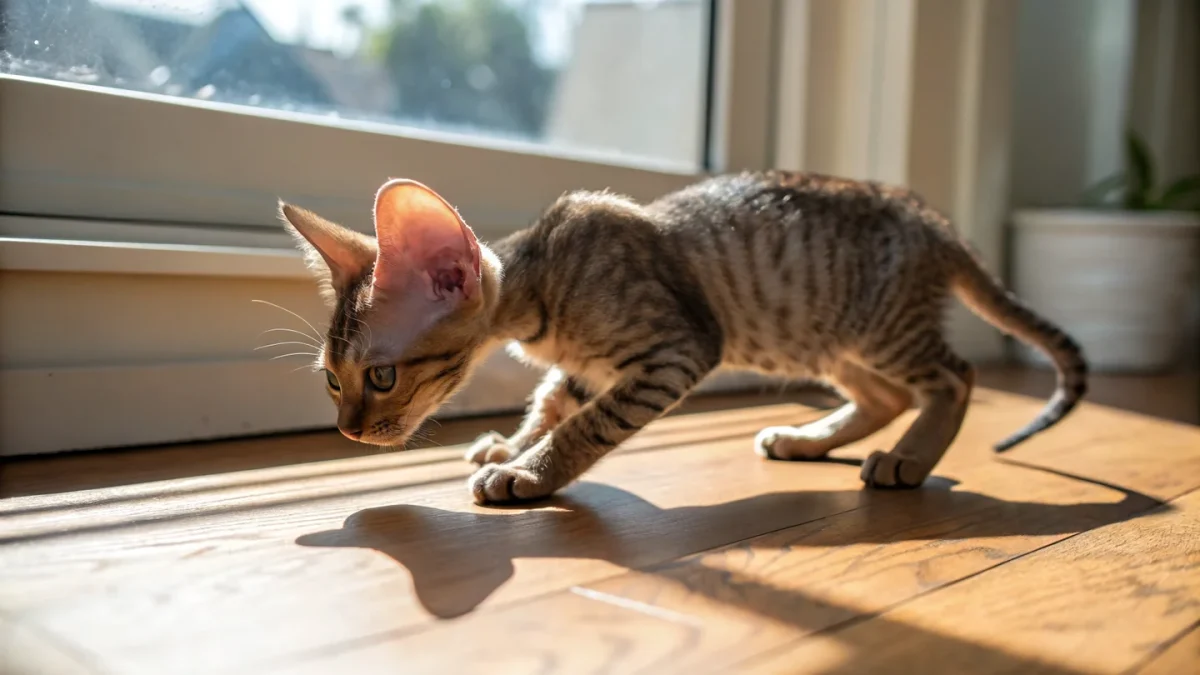
A Cornish Rex kitten is basically a tornado with ears. The athletic body is present from the beginning — even at eight weeks, a Cornish Rex kitten moves with that distinctive arched-back gallop, scales things it shouldn't, and regards every object in its environment as a potential toy. What you do (and don't do) in the first months shapes how this energy gets channeled for the next fifteen years.
This guide covers the practical first-year priorities. For background on the breed itself, the full Cornish Rex breed guide gives the complete picture of adult personality and care.
Warmth: The First Priority
The first thing Cornish Rex kittens need that differs from most is warmth. The single-layer coat doesn't insulate. Kittens, with their smaller bodies and even less coat density, feel cold more quickly and have less ability to regulate temperature than adults.
Keep the kitten's living area warm — at least 20°C (68°F) comfortably, warmer is better. Provide a warm bed: self-warming beds, snuggle pads, or simply a fleece-lined bed in a draft-free corner. Many Cornish Rex kittens seek contact warmth constantly, which looks like affection (it partly is) but also has a real thermoregulatory component.
Introducing Bathing Early
The Cornish Rex will need periodic baths throughout its life due to oil buildup in the reduced coat. The single best thing you can do for your future self is introduce bathing early and make it unremarkable.
Start in the first weeks at home. First, simply bring the kitten into the bathroom and let it explore with no bath happening. Several sessions of this. Then introduce the sound of running water. Then a shallow amount of warm water in a sink or tub — just enough to wet the paws. Build up gradually over several weeks. By the time you do the first full bath, the kitten should treat it as a slightly boring routine rather than a crisis.
For specific bathing technique and frequency, Cornish Rex coat care and bathing covers the full process.
Enrichment and Play
The energy is real. A Cornish Rex kitten not given appropriate outlets will create its own program, and the program may involve your curtains, your houseplants, and a 3 a.m. sprint across your face.
Set up the environment before bringing the kitten home:
- Vertical space: cat trees, wall-mounted shelves, and climbing structures. This breed uses vertical space constantly.
- Interactive toys for unsupervised play: track balls, crinkle tunnels, puzzle feeders.
- Interactive toys for supervised sessions: wand toys, small retrievable items for early fetch training.
Daily interactive play is not optional — it's basic care. Two sessions of fifteen to twenty minutes each is a reasonable goal for a kitten. The breed's play drive often means the kitten initiates these sessions anyway; the point is to channel it constructively rather than reactively.
Socialization Windows
The socialization window in kittens is roughly two to seven weeks, but exposure and positive experiences in the early weeks at home continue to shape confidence and adaptability. Introduce the kitten to:
- Different people, including children if relevant to your household
- Other animals, appropriately supervised
- Common household sounds (vacuum cleaner, music, television)
- Being handled — paws touched, ears examined, wrapped in a towel
Cornish Rex kittens are naturally curious and typically accept new things readily. Taking advantage of this openness builds an adult cat that is confident and adaptable rather than reactive.
First Year Milestones
Weeks 8-12: Primary kitten vaccines (your vet will guide the protocol), early introduction to bathing and handling routines, environmental enrichment setup.
Months 3-6: High activity peak. The kitten is fully mobile and using all of it. This period calls for maximum enrichment and the most consistent play investment.
Month 6: Typical age for spay/neuter surgery (your vet will advise timing).
Months 6-12: Energy remains high but the kitten begins to map the household's rhythms. Habits formed earlier become stable patterns.
Year 1: The Cornish Rex is now technically an adult, which means almost nothing in terms of personality. The activity level stays high. The play drive stays active. What you have is a slightly more predictable version of the kitten — the chaos has shape now.