
If there's one place where stay training consistently breaks down, it's when people try to add duration and distance at the same time.
"Stay while I walk to the other side of the room" is actually two separate challenges collapsed into one: stay for 10 seconds AND stay while I'm 20 feet away. Each of those is a distinct skill. Trying to build both simultaneously produces a stay that breaks unpredictably and is hard to diagnose.
Here's how to build them separately and then combine them properly.
Duration First
Duration means: hold this position for progressively longer periods of time, with me right here next to you.
How to build it:
Start with a sit-stay or down-stay with you standing next to your dog. Count one second. Mark and treat — while they're still in position. Don't release them and then give the treat; give the treat while they're holding.
Next rep: two seconds. Then five. Then ten. Then twenty.
Any time they break: reset to the position, and drop back to a duration you know is solid. Don't stay at the level that's failing.
Markers for duration: For single behaviors, you can use a regular marker (yes/click) during duration work. Some trainers use an event marker that means "you're doing great, keep going" — a calm "good" or "yes" without releasing — and reserve the final reward marker for the end. Experiment to see what communicates clearly to your dog.
Target: Before adding distance, aim for a 60-90 second solid hold with you right next to your dog.
Distance Second
Distance means: maintain position while I move away from you.
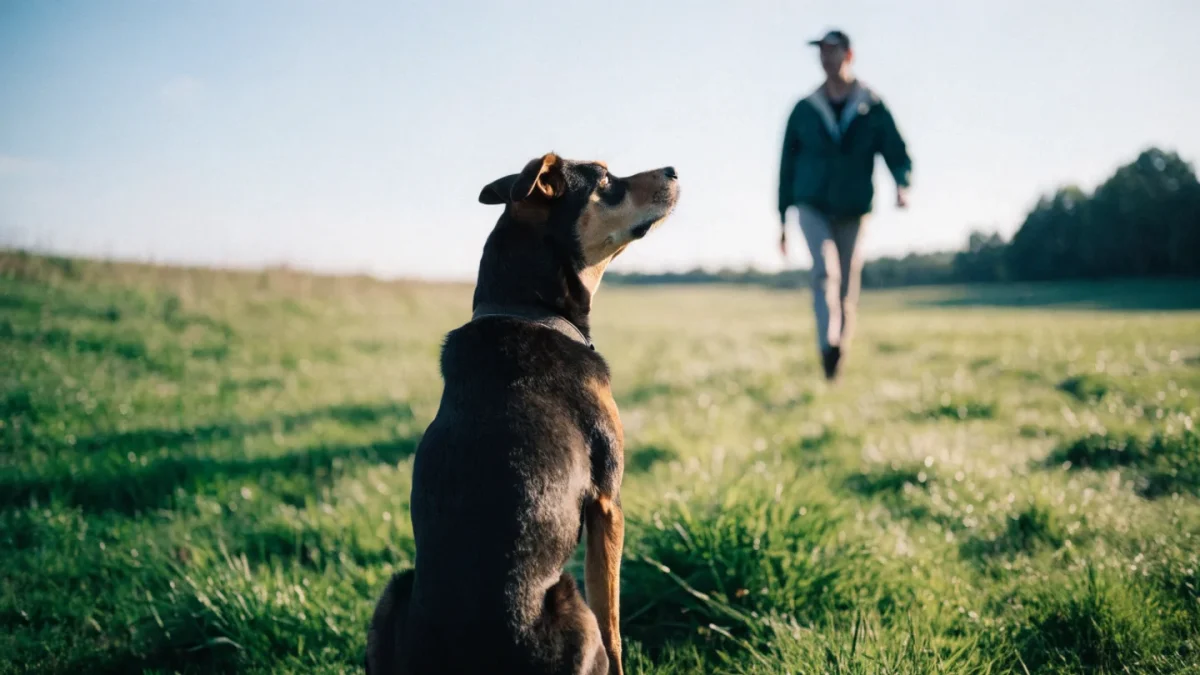
Start with one step. Literally one step. Step back, and immediately step back forward. If your dog held position: mark and reward them in position (go to them, don't call them to you). If they broke: reset, try again with a shorter step.
One step at a time. Backward. Sideways. At angles. Build until you can walk 10 feet away and back.
The critical rule: Return to your dog to reward. Don't release them from position and then treat. Don't call them to you and then treat. Go to them, reward in position, then release.
If you release them from a stay to give a treat, you're accidentally teaching them that the end of stay = reward comes. This creates a dog that anticipates the end of stay and breaks early.
Combining Duration and Distance
Once you can hold 90 seconds with you at your dog's side, and you can walk 20 feet away and back with a few seconds of distance, you're ready to combine.
Start conservatively: 5 feet of distance for 10 seconds. That's well within what each individual skill can do. Add time and distance incrementally.
The general principle: when you increase one variable, briefly reduce the other. Adding more distance? Shorten the duration temporarily. Extending duration? Reduce distance first.
Out-of-Sight Stays
Out-of-sight stays are the advanced version — your dog holds position while you disappear from their view entirely. This is harder than it sounds.
Build it by "disappearing" briefly: step behind a door frame and immediately return. Then step out of sight for two seconds. Then five. Then ten.
The dog must learn that out-of-sight doesn't mean gone forever. It means you'll come back and reward them for holding.
What Makes Stays Break
Anticipation: The dog starts to sense when the stay is about to end (you shift your weight, look at them, reach for a treat) and breaks preemptively. Vary your signals — sometimes reward early, sometimes extend. Keep them guessing.
Duration fatigue: Stays that are held for too long without reinforcement will fade. For long stays in real life (30+ minutes), deliver periodic rewards while the dog holds position. (See also: distraction training.)
Environmental variables: A stay that holds in your living room may break in the backyard, especially in the presence of distractions. Every new environment requires rebuilding the stay somewhat.
This week: build a 60-second sit-stay with you right next to your dog before adding any distance. Just duration. Ten sessions, adding a few seconds each time. Once you have 60 solid seconds, distance training begins.