

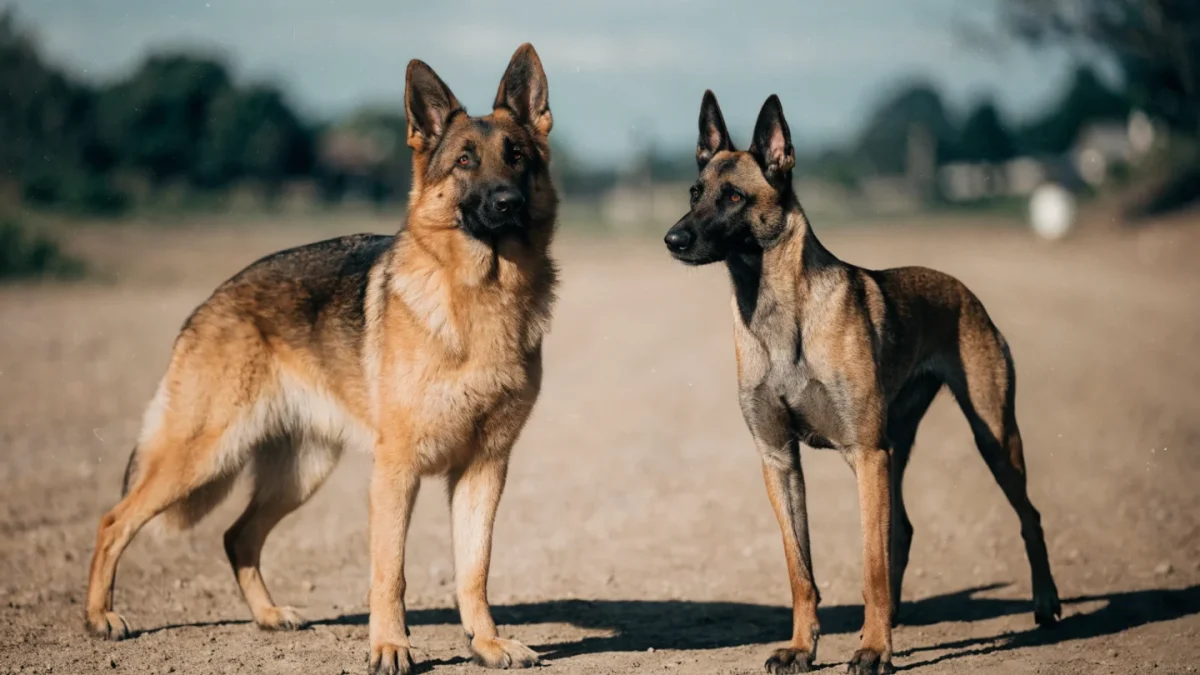
The German Shepherd was the default working dog of the twentieth century. The Belgian Malinois is rapidly becoming the default of the twenty-first. Military and police units worldwide have increasingly transitioned from GSDs to Malinois over the past two decades, and that shift has made the Malinois suddenly visible to pet owners who think "working dog" means a dog that works well in a family home. That's a dangerous misunderstanding.
Both breeds deserve an honest comparison. If you're working through which breed fits your situation, the comparison framework here covers the core criteria.
Size and Build
| Trait | German Shepherd | Belgian Malinois |
|---|---|---|
| Height (male) | 60–65 cm | 61–66 cm |
| Height (female) | 55–60 cm | 56–61 cm |
| Weight (male) | 30–40 kg | 25–30 kg |
| Weight (female) | 22–32 kg | 20–25 kg |
| Build | Heavy-boned, sloped back (show lines) or straighter (working lines) | Lean, square, athletic |
The Malinois is noticeably lighter — sometimes 10+ kg lighter than a GSD of the same height. That lower weight-to-muscle ratio gives Malinois their explosive speed and jumping ability. A fit Malinois can clear a 1.8 m wall from a standing position.
Temperament
This is where the comparison gets serious.
German Shepherds are confident, steady, and adaptable. A well-bred, well-socialized GSD settles in the house, engages when work is required, and reads situations with measured intelligence. They bond deeply with their family and are naturally protective without being hair-trigger reactive.
Belgian Malinois live at a different RPM. They are intense, reactive, always scanning, always ready. A Malinois doesn't settle — it waits. The breed's low reactivity threshold means they notice and respond to stimuli that a GSD would ignore. In working environments, this is an asset. In a suburban living room, it's often a liability.
The Malinois has earned the nickname "Maligator" in training circles for good reason. They bite — in play, in frustration, in excitement. Managing that mouthy drive requires experience and consistency that most first-time working-dog owners simply don't have.
Exercise and Mental Demands
Both breeds need substantial daily exercise. The GSD does well with 60 to 90 minutes of structured activity. The Malinois needs that as a minimum, and the work must be mentally taxing — obedience drills, tracking, bite work, agility at speed. A jog around the block does not register as exercise for a Malinois.
German Shepherds can decompress. Malinois struggle to. That difference shapes the entire experience of living with each breed.
Grooming
German Shepherds have a thick double coat that sheds heavily, especially during biannual coat blows. The Malinois has a shorter, tighter double coat that still sheds but requires less brushing. Neither breed is low-maintenance in the grooming department, but the GSD demands more time with a brush.
Health
| Health Factor | German Shepherd | Belgian Malinois |
|---|---|---|
| Top concern | Hip/elbow dysplasia, degenerative myelopathy | Hip dysplasia, epilepsy |
| Lifespan | 9–13 years | 12–14 years |
| Joint issues | Very common, especially show lines | Less common |
| Bloat risk | Moderate to high | Moderate |
GSDs, particularly from show lines with extreme rear angulation, suffer disproportionately from hip and elbow dysplasia. Working-line GSDs tend to have better structural health. The Malinois generally has fewer orthopedic issues and a longer lifespan. Idiopathic epilepsy is a documented hereditary condition across Belgian Shepherd varieties — a study published in Acta Veterinaria Scandinavica found that Belgian Shepherd Groenendael and Tervuren were at higher risk of epilepsy than the general dog population, and the condition is recognized in Malinois lines as well.
Which Fits Your Life?
Choose the German Shepherd if you want a protective, intelligent companion that can transition between work mode and family mode. GSDs are more forgiving of handler mistakes and more adaptable to typical household routines. They're still a serious working breed — not a beginner's dog — but they're manageable for dedicated owners.
Choose the Belgian Malinois if you have professional or competitive working-dog experience, can provide structured mental and physical work daily, and understand that this dog doesn't have an "off" switch. The Malinois is not a pet for most people. It's a working partner that lives in your house.
If you're also considering other guardian breeds, the Rottweiler vs Doberman comparison covers a different segment of the protection-dog spectrum. For a full profile of the Malinois on its own terms, the Belgian Malinois complete breed guide covers everything from its working history to health predispositions. For a comprehensive profile of the German Shepherd — including working versus show line distinctions and Max von Stephanitz's founding standard — see the German Shepherd complete breed guide.