
Dogs are naturally more visual than we give them credit for. A lot of people discover this accidentally — they give a hand signal while asking for sit, then one day ask for sit without the hand movement and nothing happens. The dog was following the hand, not the word.
This is actually useful information. It means you have two channels to communicate: voice and body. Teaching deliberate hand signals alongside verbal cues gives you both, and a dog that responds to either is a more versatile dog.
Why Hand Signals Matter
Distance work: Voice fades with distance. A clear hand signal works at 30 feet when your voice might not.
Noisy environments: Busy dog parks, city streets, windy days — verbal cues get lost. A hand signal is still visible.
Hearing loss: As dogs age, hearing often degrades. A dog that knows hand signals can still be communicated with reliably even if verbal cues stop working.
Calm communication: Some dogs are calmer and more responsive to quiet signals than repeated verbal cues. Silence plus signal can be more effective than repeated words.
Common Hand Signals
There's no universal standard — what matters is that you pick a signal, use it consistently, and that it's visually distinct from your other signals. Here are common choices that work well:
Sit: Open hand, palm up, moved upward from waist level. Mirrors the treat movement used in lure training.
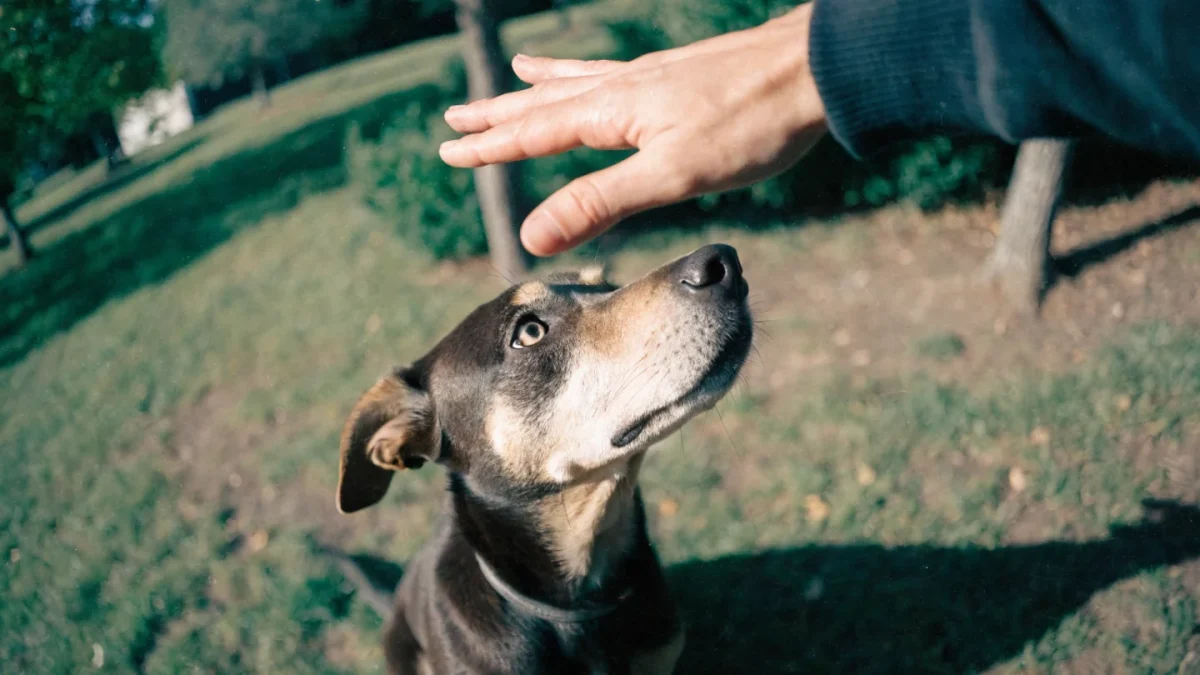
Down: Open hand, palm down, moved downward from chest level to hip level.
Stay: Open hand, palm facing the dog (like a stop signal), held steady.
Come: Open arms wide, sweeping gesture toward yourself, or a single hand moving from extended position toward your chest.
Leave it: Quick lateral hand wave near the object, or a finger point followed by hand pull-back.
Heel/Let's go: Pat your left thigh twice (if heeling on left side).
These are suggestions, not rules. What you do consistently becomes your dog's language.
How to Teach Hand Signals to a Dog That Knows Verbal Cues
If your dog already knows verbal commands, adding hand signals is straightforward:
- Give the hand signal first.
- Give the verbal cue one second later.
- Mark and reward the correct response.
After several sessions of signal-then-word, start using the signal alone. Your dog will start responding to the signal independently.
Over time, the signal becomes the primary cue — the word is backup. Or keep both active; there's no rule that says you can only use one. (See also: positive reinforcement dog training.)
Teaching Hand Signals Simultaneously From the Start
If you're teaching a new behavior, introduce the hand signal at the same time as the verbal cue. The lure motion is often already a hand movement — channel that into a deliberate signal.
For sit: the treat-moving-backward motion becomes a palm-up-lifting signal. Mark and treat the sit, and you're building both the verbal and visual cue simultaneously.
Consistency is Everything
The signal has to look the same every time. If your "down" signal varies between a flat palm and a pointing finger, your dog can't predict what comes next.
Film yourself giving signals. Watch for inconsistency. Standardize. If you have multiple people working with the dog, make sure everyone uses the same signals.
Testing the Signals
Once you've built hand signals alongside verbal cues, test whether the signal works alone. Give the hand signal without saying anything. If the dog responds correctly, the signal is working. If they wait for the verbal, continue pairing them. (See also: how to teach a dog to sit.)
Distance test: stand 10 feet away and give a hand signal. What happens? This is where you see whether the signal generalizes beyond close range.
Choose one signal to work on this week: the sit signal (palm up, moving upward). Give it before your verbal "sit" cue for every rep this week. By the end of the week, try the signal alone. You'll likely be surprised how quickly your dog picks it up.