

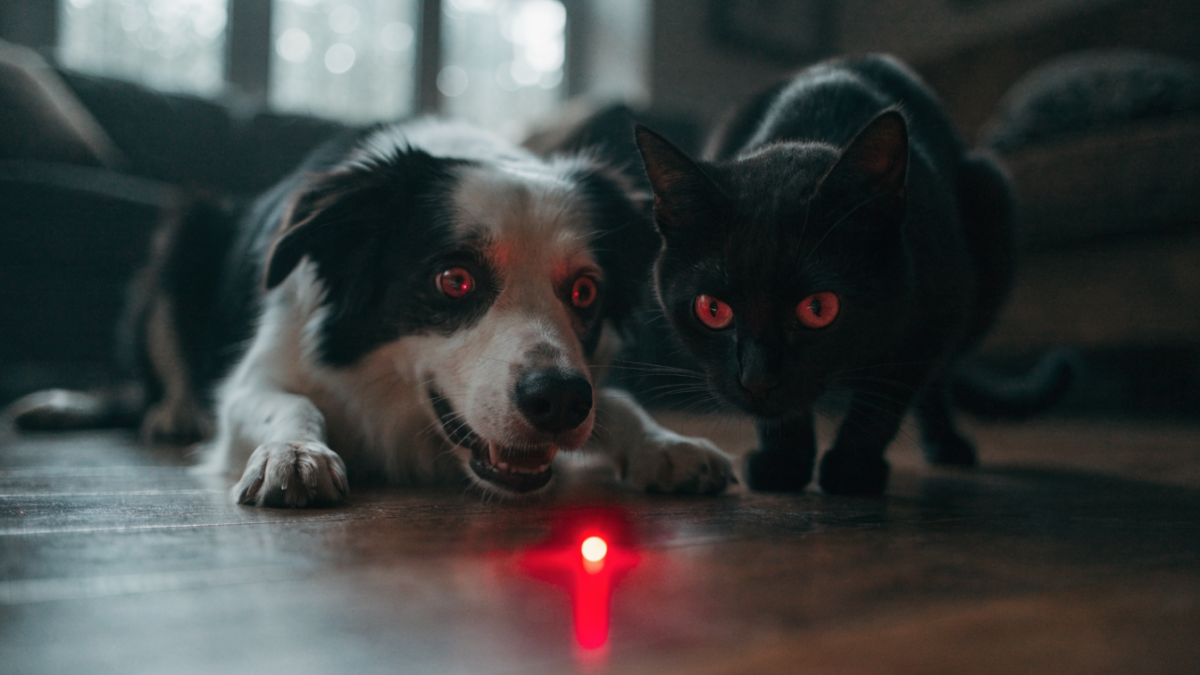
There’s a sound every dog owner knows. That little click of a laser pointer, and suddenly your dog snaps to attention like someone flipped a switch. Their pupils dilate. Their body goes rigid. Then that red dot hits the floor, and they’re off — sliding across hardwood, throwing themselves into corners, crashing into coffee tables with zero self-preservation. It’s hilarious. You can find millions of these videos online, and for years, that’s exactly what I thought it was: harmless fun.
Then I worked with a Border Collie named Maven.
Maven’s owners brought her to me because she’d started staring at the ceiling for hours. Not at a bug, not at a sound — just staring, mouth slightly open, completely zoned out. She’d also begun lunging at reflections from passing cars and attacking shadows on the kitchen floor. Turns out, they’d been using a laser pointer to tire her out every evening for about three months. It worked great, at first. Then it broke her brain a little. And once I started digging into the research, I realized Maven wasn’t some rare, unlucky case. She was textbook.
The Hunt That Never Ends
To understand why a tiny red dot can wreak so much havoc, you have to understand what’s actually happening in your pet’s head when they chase it.
Dogs and cats are predators. Their brains are hardwired for a specific behavioral sequence that, in the wild, ends with dinner. Ethologists break the predatory sequence into stages:
- Orient — notice the prey, lock on
- Eye/Stalk — slow, deliberate approach
- Chase — pursuit, often at full speed
- Grab/Bite — the catch
- Dissect/Consume — the payoff
A laser pointer takes your pet through the first three stages with the intensity of a full-blown hunt. Heart rate spikes, adrenaline floods the system, every muscle fires. But stages four and five never come. There’s nothing to grab. Nothing to bite. No taste of success. The hunt just… stops. And all that neurological momentum has nowhere to go.
Think about it like this: imagine someone told you there was a million dollars hidden in your house. You tear the place apart for an hour. Then they say, “Just kidding,” and leave. No money. No closure. Now do that every single night. That’s what laser play feels like to your pet’s brain — an arousal spike with zero resolution. It doesn’t tire them out. It winds them up and leaves them there.
“Laser Pointer Syndrome” Is a Real Thing
I used to think “Laser Pointer Syndrome” was just internet shorthand for “my dog really likes the laser.” It’s not. It’s a recognized behavioral pattern, and the scientific community is taking it seriously.
A 2021 study published in the NIH’s PubMed Central archive by researcher L.R. Kogan examined the direct relationship between laser pointer play and abnormal repetitive behaviors in companion cats. The findings were striking: cats regularly exposed to laser pointers showed significantly higher rates of compulsive behaviors — excessive grooming, persistent searching behaviors, and fixation on lights and reflections — compared to cats who weren’t. The study has been cited over two dozen times, which tells you it resonated with the broader animal behavior field.
What LPS Actually Looks Like
Laser Pointer Syndrome isn’t a formal clinical diagnosis, but behaviorists use the term to describe a cluster of symptoms that show up after repeated laser play. Here’s what to watch for:
- Perpetual scanning: Your pet constantly searches floors, walls, and ceilings for the dot, even when the pointer is put away
- Light and shadow fixation: They become obsessed with reflections, glints of sunlight, flashlight beams, even moving shadows from ceiling fans
- Inability to settle: They pace, circle, or remain on high alert instead of relaxing
- Increased anxiety: General restlessness, whining, or destructive behaviors that weren’t there before
- Frantic behavior at the sight of any pointer-like object: Pens, remote controls, anything that resembles the laser
The thing that hits people hardest is the generalization. It’s not just the laser anymore. It’s everything. I’ve seen dogs who can’t walk past a window because of passing headlights. Cats who spend their entire day staring at the spot on the wall where the dot used to land. The brain has been primed to hunt something it can never catch, and it starts projecting that need onto anything that moves.
Why Cats Get Hit Harder — But Dogs Suffer Differently
Cats are specialist predators. Their entire evolutionary strategy is built around the stalk-and-pounce sequence. When you remove the pounce payoff, you’re short-circuiting a deeply ingrained behavioral need. This is why feline compulsive behaviors tend to develop quickly with laser play. Cats will sit and stare at the last place they saw the dot for literally hours. Some start over-grooming as a displacement behavior — the anxiety has to go somewhere, and for cats, it often goes to their coat.
Dogs, on the other hand, tend to generalize the obsession outward. Where a cat fixates on the location, a dog starts seeing the laser everywhere. I worked with a German Shorthaired Pointer who began attacking reflections from his owner’s wristwatch. Another client’s Australian Shepherd started compulsively chasing dust motes in sunbeams. Herding and sporting breeds seem especially vulnerable, possibly because their prey drive is already running hot — they were bred to pursue, and the laser cranks that dial to eleven with no off switch.
The Breed Factor
High-drive working breeds — Border Collies, Australian Shepherds, Jack Russell Terriers, Belgian Malinois, German Shorthaired Pointers — tend to develop laser-related compulsions faster than lower-drive breeds. That doesn’t mean a Basset Hound is immune. It means that if you have a dog who was literally designed to pursue things all day, you’re playing with fire.
The Big Debate: Convenience Versus Cost
Let’s be honest about why laser pointers are popular. They’re effortless. You can sit on the couch after a long day and exhaust your high-energy pet with minimal physical effort. For people with indoor cats, especially in apartments, they feel like a godsend. And for owners with mobility issues, they can seem like the only viable option.
I’m not here to judge anyone who’s used one. I’ve used them myself, years ago, before I knew better. The point isn’t to shame anyone — it’s to be real about the tradeoff.
Animal behaviorists and veterinarians argue that the psychological cost of laser play — the anxiety, the compulsive behaviors, the erosion of mental well-being — far outweighs the convenience. Once a compulsive behavior pattern takes root, it can take months of behavior modification to undo. Some pets never fully recover. That’s a steep price for twenty minutes of easy entertainment.
Can You Use Them Safely?
Here’s where the debate gets nuanced. Some behaviorists advocate for an outright ban on laser pointers in homes with pets. Others argue that if you absolutely must use one, you should immediately follow the session by giving your pet something physical to “catch” — a treat-dispensing toy, a tug toy, a stuffed animal they can grab and shake. The idea is to complete the predatory sequence and provide closure.
I lean toward caution. The redirection strategy can work for some pets, but in my experience, the risk of fixation still outweighs the benefit, especially for animals who already show obsessive tendencies. There are simply better options that don’t carry the same baggage.
What to Do Instead
The goal of play isn’t just physical exhaustion. Good play satisfies the whole predatory sequence — including the catch. Here’s what actually works:
Flirt poles. Essentially a giant cat wand for dogs. You can move a lure on a string in ways that trigger the chase, and then your dog gets to catch and grab it at the end. It’s the closest thing to a real hunt without live prey.
Tug toys and rope pulls. Tug satisfies the grab and bite stages beautifully. It’s interactive, it builds engagement with you, and it has a natural beginning and end.
Treat-dispensing toys. Puzzle feeders, snuffle mats, and rolling treat balls engage your pet’s brain and provide a real payoff. For cats, try food puzzles that require batting and fishing.
Robotic mice and battery-operated toys. These give cats something physical to stalk and catch. The key is that there’s an actual object to grab at the end.
Hide-and-seek games. Scatter kibble in the grass, hide treats around the house, or play find-it with a favorite toy. These satisfy the search and discovery part of the predatory brain without the unfulfilled chase.
For indoor cats specifically, rotating through different wand toys with different lure types — feathers, fabric strips, crinkle attachments — keeps play fresh and provides that critical catch moment. End every play session with a clear signal: the toy gets caught, maybe a small treat follows, and the hunt is officially over.
Here’s the bottom line. Play should leave your pet satisfied, not strung out. If you’re using a laser pointer and your dog or cat seems calmer afterward, great — but watch closely over the following days and weeks. If you start seeing the scanning, the shadow-chasing, the inability to settle, stop immediately. The red dot is a gamble, and the house doesn’t always win. Your pet’s mental health is worth the extra effort of picking up a real toy and actually playing with them.