

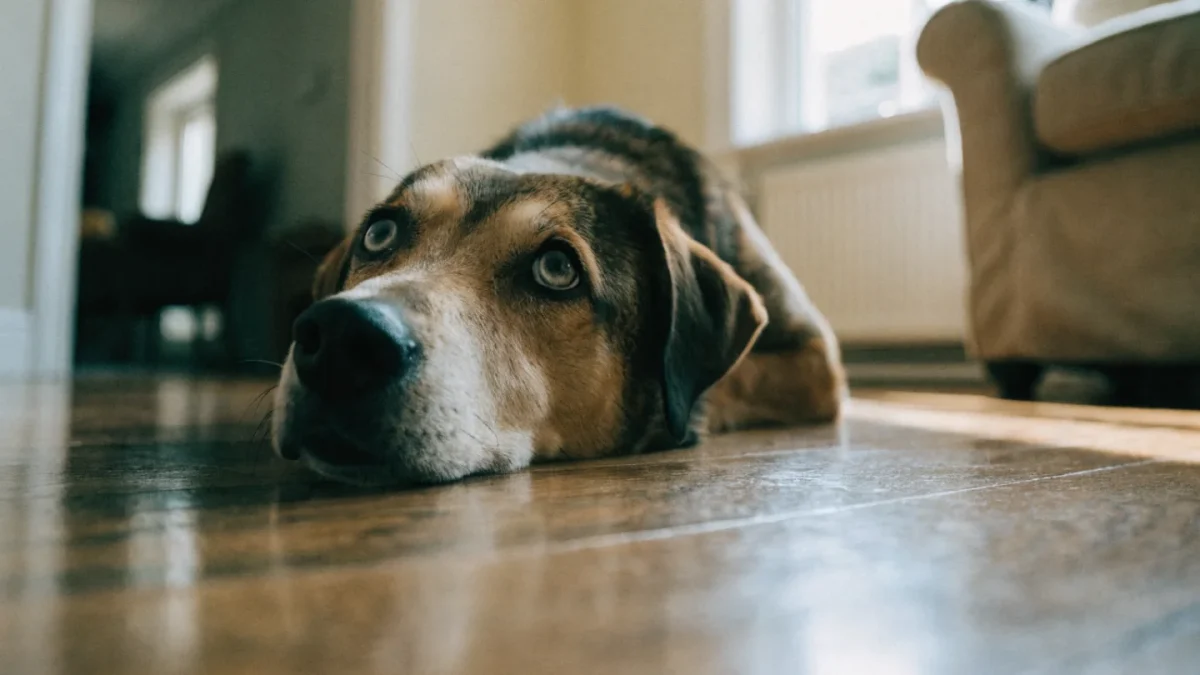
Every veterinarian has a version of this conversation. Learn more about pet mental health: understanding here. The owner comes in and says something like "he's just not himself." They can't always pinpoint what's different. The dog still eats. Still goes outside. But something is off — a flatness, a hesitation, an absence of the usual enthusiasm. And they're right to notice it, because animals who lose their spark are usually trying to tell us something.
I had a Border Collie patient named Jett who was, by his owner's description, "the most annoying dog alive" — always moving, always demanding a ball throw, never settling. When Jett spent an entire Saturday lying on the couch without pestering anyone, his owner called me. "Something's really wrong," she said. "He hasn't asked me to play once." Blood work revealed a dangerously low platelet count from an immune-mediated condition. Jett wasn't being calm. He was in serious trouble.
Lethargy and behavior changes in pets are diagnostic clues. The challenge is distinguishing the pet who had a long day at the dog park from the pet whose body is fighting something internal.
Tired Versus Lethargic: The Clinical Distinction
Tiredness is proportional. A dog who ran hard at the park and sleeps deeply afterward is tired. That's recovery. A cat who played with a feather toy for twenty minutes and then naps for an hour is recharging. The key feature of normal tiredness is that it resolves with rest, and the pet responds normally to stimuli they care about — food, the leash, a treat, their name.
Lethargy is different. A lethargic pet may not lift their head when you walk in. They don't greet you at the door. They show no interest in food they normally inhale. They may move only when absolutely necessary — to urinate, to find water — and even then with visible reluctance. The difference is often a quality of disengagement, like the pet has checked out of their own life.
Between those two extremes sits a gray zone. A pet who's slightly less energetic than usual, still eating but with less enthusiasm, still walking but dragging a bit. This gray zone is where most of my early-disease diagnoses happen, because it's where subtle illness lives.
Medical Causes That Drain Energy
Infection. Bacterial infections, viral infections, tick-borne diseases — all produce lethargy as the immune system diverts energy toward fighting the pathogen. Fever accompanies most infections, and fever alone can make a pet profoundly tired. A rectal temperature above 103.5°F in a lethargic pet is diagnostic confirmation that something infectious or inflammatory is happening.
Pain. This is the one I wish more owners recognized. Pets in chronic pain don't always cry or whimper. Instead, they slow down. They move less. They sleep more. They stop doing things that used to bring them joy — jumping onto the bed, chasing a toy, greeting guests. Arthritis in dogs over eight is incredibly common, and the behavioral shift is so gradual that many owners attribute it to "just getting old." Some of it is age. Much of it is treatable pain.
Anemia. Without enough red blood cells carrying oxygen, everything becomes exhausting. A pet with anemia may pant at rest, tire on short walks, and have pale gums. Anemia itself isn't a diagnosis — it's a finding that demands investigation. The causes range from blood loss (internal bleeding, parasites) to immune-mediated destruction of red blood cells to bone marrow failure.
Organ dysfunction. Kidney disease, liver disease, heart failure — all reduce a pet's energy as the body struggles to compensate for declining organ function. These conditions develop insidiously over months to years, which is why the lethargy creeps in rather than arriving suddenly.
Endocrine disease. Hypothyroidism in dogs causes lethargy, weight gain, cold intolerance, and skin changes. Addison's disease (hypoadrenocorticism) can cause episodic lethargy that waxes and wanes — the pet seems fine for weeks, then crashes. Addison's is one of the great diagnostic mimics; I've seen it masquerade as a GI issue, a behavioral problem, and simple "stress."
Toxin exposure. A pet who was fine this morning and is profoundly lethargic by evening may have ingested something toxic — medications, plants, chemicals, contaminated food. The acute onset is the distinguishing feature.
Behavior Changes Beyond Lethargy
Energy level isn't the only behavioral signal worth tracking.
Sudden aggression or irritability. A dog who snaps when touched in a specific area is likely guarding a painful spot. Ear infections, tooth root abscesses, spinal disc disease — all cause localized pain that manifests as defensive aggression. I had a client whose gentle Lab started growling when his kids hugged him. MRI showed a herniated disc pressing on a nerve root. After treatment, the dog was back to his tolerant self.
Withdrawal and hiding. Cats do this instinctively when they feel vulnerable. A cat who retreats under the bed and stays there for more than a day, especially one who normally seeks human company, is probably unwell. Dogs hide less obviously — they might choose a corner, a closet, or a spot under a desk — but the impulse is the same.
Restlessness and pacing. The opposite of lethargy, and equally concerning. A pet who paces, can't settle, shifts positions constantly, or pants at rest may be in acute discomfort. Abdominal pain from bloat, pancreatitis, or a foreign body obstruction causes this restless, can't-get-comfortable behavior. So does urinary pain.
Confusion or disorientation. A pet who seems lost in familiar surroundings, stares at walls, gets stuck in corners, or forgets routines they've known for years may have cognitive dysfunction (the pet equivalent of dementia) — or may have a brain lesion, liver encephalopathy, or a metabolic crisis. The key question is onset speed: gradual over months suggests cognitive decline; sudden suggests an acute medical event.
The 24-Hour Rule (and Its Exceptions)
For an otherwise healthy adult pet who seems mildly lethargic with no other symptoms — still eating, still drinking, no vomiting, normal gums — I'm comfortable with a 24-hour observation period. Rest, monitor, and reassess.
The exceptions to that rule:
Puppies and kittens. Young animals decompensate fast. A lethargic puppy could also show appetite and weight changes and might be hypoglycemic, septic, or have parvovirus. Don't wait 24 hours on a lethargic puppy.
Senior pets with known conditions. An older cat with kidney disease who becomes lethargic may be having a crisis. The existing condition narrows the buffer.
Any lethargy combined with: not eating, vomiting, diarrhea, pale or yellow gums, labored breathing, fever, swollen abdomen, collapse, or seizures. These combinations skip the observation period entirely.
And if lethargy persists past 48 hours even without other symptoms, that itself is your signal. Healthy pets bounce back. Sick ones don't.
What to Tell Your Vet
When you call or come in, the most useful information you can provide is: when the change started (as precisely as possible), what normal looks like for this pet, what's different now, and what else you've noticed (even if it seems unrelated). "He's been dragging since Thursday, he ate half his dinner last night but nothing this morning, and I think he might be drinking more water than usual" gives me a starting framework. It points me toward specific tests rather than a shotgun approach.
Knowing your pet's baseline is the diagnostic superpower no blood test can replace. You're the one who sees the 2 a.m. behavior, the subtle shifts, the thing that's just… off. Trust that observation. I'd rather see a pet whose owner was worried over nothing than miss the pet whose owner waited too long because the symptoms didn't seem dramatic enough.
Frequently Asked Questions
Can weather changes make my pet lethargic?
Mild decreases in activity during extreme heat or cold are normal adaptations. Dogs pant more and move less in high temperatures to avoid overheating. Cats sleep more in winter. But weather doesn't cause true clinical lethargy — if your pet won't eat, won't engage, or seems unwell during weather changes, the weather may have unmasked a subclinical problem rather than caused it. Heatstroke is a separate emergency that goes well beyond simple lethargy.
My pet gets sluggish after vaccinations — is that normal?
Yes. Mild lethargy, decreased appetite, and low-grade fever for 24-48 hours after vaccination is a normal immune response. The body is responding to the vaccine, which is exactly what it should do. If the lethargy is severe, lasts beyond 48 hours, or is accompanied by facial swelling, vomiting, or difficulty breathing, that's a vaccine reaction and needs immediate attention.
How do I know if my pet's slowdown is just aging?
Age-related slowdowns are gradual, symmetrical, and don't come with other warning signs like appetite loss, weight changes, or other warning signs that signal illness. A 12-year-old dog who naps more and walks shorter distances but still enjoys both is probably showing normal aging. A 12-year-old dog who stopped going upstairs, won't jump in the car anymore, and seems stiff in the mornings likely has arthritis — treatable, not inevitable. I push back hard against the idea that slowing down is just what old pets do. Sometimes it is. Often it's pain.
Should I let my lethargic pet sleep it off?
Rest is appropriate if you're within that 24-hour observation window for a mild presentation. Make sure they have access to water, offer small amounts of bland food, and check on them every few hours. What you're watching for is improvement — some return of interest, some willingness to move, some appetite. If 24 hours passes and they're the same or worse, that's your answer.