

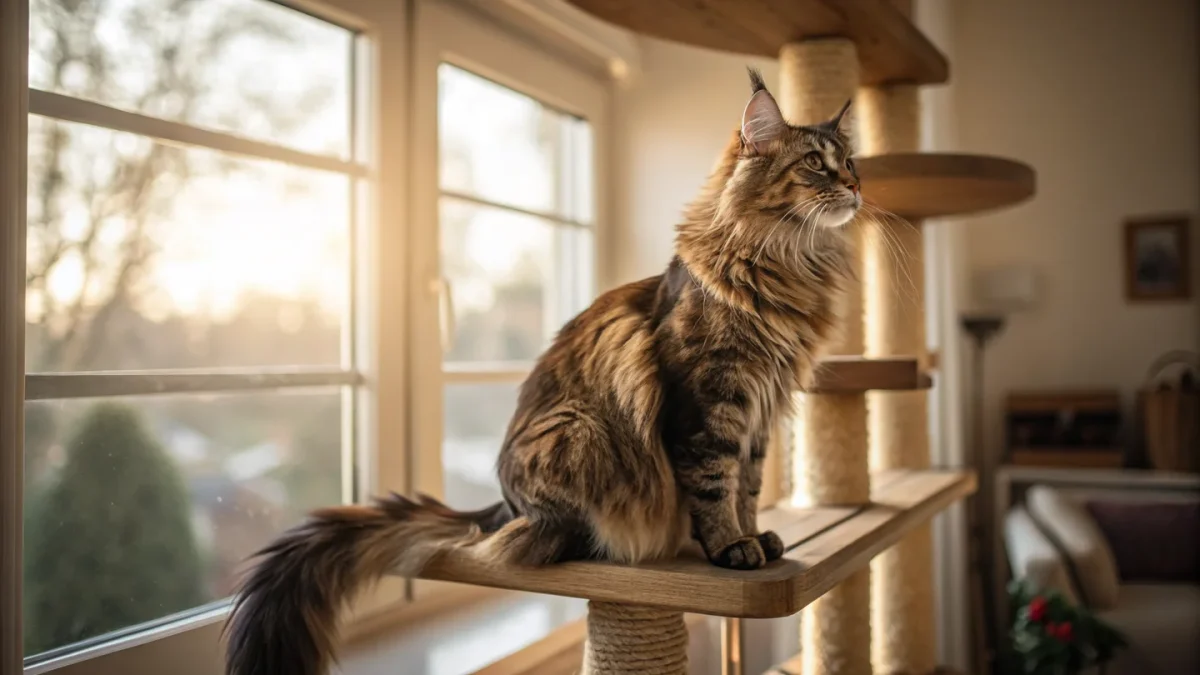
Maine Coons are one of the most written-about domestic cat breeds, which has not, unfortunately, prevented some genuinely durable myths from circulating. Some of these misconceptions lead to failed adoptions. Others just annoy people who know the breed well. All of them are worth addressing directly.
For the complete picture of the breed, see the complete Maine Coon breed guide and the breakdown of Maine Coon temperament.
1. Maine Coons Are Part Raccoon
This is the most persistent myth about the breed and one of the more scientifically wrong things people believe about domestic cats. The theory — that Maine Coons descend from cat-raccoon crosses — is genetically impossible. Cats (family Felidae) and raccoons (family Procyonidae) are not closely enough related for interbreeding to occur. They cannot produce viable offspring.
The myth exists because Maine Coons have ringed tails and tufted ears that superficially resemble raccoon features. This is convergent evolution — unrelated lineages developing similar traits for similar reasons — not shared ancestry. Dense, waterproofed coats, large frames, and tufted extremities are adaptations to cold, wet climates. Both Maine Coons and raccoons evolved them, independently, because both lived in the same unforgiving New England environment.
The name "Coon" in Maine Coon is most likely derived from either the folk story about a Captain Coon who kept longhaired cats aboard his ship, or from the historical use of "coon cat" as a regional New England term for longhaired cats that appears in 19th-century records — both plausible derivations, neither conclusively proven.
2. Their Coat Is Self-Maintaining
The logic is understandable: the silky texture mats less readily than a Persian coat, so some people assume a Maine Coon essentially takes care of its own fur. The logic is wrong.
A Maine Coon's coat requires brushing 2-3 times per week under normal conditions, and daily during shedding seasons. The silky texture is more forgiving than a Persian's, yes — mats develop more slowly and resolve more easily. But "more forgiving" is a range between "high maintenance" and "medium maintenance," not between "medium maintenance" and "maintenance-free."
The areas where Maine Coon coats mat reliably: behind the ears, in the armpits, and on the belly. These areas can develop tight mats within a couple of weeks of neglected grooming. Regular attention prevents this entirely.
3. They're Too Big for Apartments
Maine Coons are large cats — that's true. The assumption that size directly correlates with space requirement doesn't hold. What Maine Coons need is vertical space and enrichment, not square footage specifically.
A Maine Coon in a well-enriched smaller home — with cat trees, wall shelves, window access, interactive toys, and regular play — is more content than a Maine Coon in a large empty home with nothing to do. The relevant variable is enrichment, not room count.
Maine Coons have been successfully kept in apartments for as long as apartment-dwelling has been common in cities. The cats in those situations do fine. The cats in large homes with no enrichment do less well.
4. Their Friendly Nature Makes Them Suitable for Long Isolation
This is the misconception that causes the most real harm to actual Maine Coons. The breed's calm, adaptable temperament leads some people to assume that because the cat doesn't cause obvious problems when left alone, it's thriving.
Maine Coons are social animals. Extended daily isolation — 10+ hours, consistently — produces cats that are less engaged, less playful, and less themselves. Veterinary behavioral research documents the signs of chronic stress in cats as including prolonged hiding, reduced engagement with household members, changes in eating behavior, and reduced activity — a behavioral profile distinct from normal age-related mellowing. A Maine Coon that was curious and interactive at 1 year and then shows persistent withdrawal, reduced play interest, and muted responsiveness at 3 isn't just "calming down with age" — those are recognized signs of a cat not thriving in its environment.
The solution is either a consistent human presence or a companion animal. A second cat, or a calm dog, provides the social context Maine Coons need during human absence. This matters more for this breed than for more independently-oriented cats.
5. They're a Modern Designer Breed
Maine Coons are sometimes grouped with newer "hybrid" or designer breeds by people unfamiliar with cat breed history. They're the opposite: one of the oldest naturally developed domestic breeds in North America, with documented show appearances in the 1860s and a history that almost certainly extends centuries earlier.
The breed nearly disappeared in the early 20th century as imported European breeds — particularly Persians — dominated American cat shows. The Central Maine Cat Club, founded in the early 1950s by Ethylin Whittemore, Alta Smith, and Ruby Dyer, began the formal revival; the Maine Coon Breeders and Fanciers Association formed in 1968, and the Cat Fanciers' Association granted Championship status in 1976. Modern Maine Coons carry that history. They're not a product of recent hybridization or trendy selective breeding — they're the result of several hundred years of natural selection in a specific environment, followed by careful stewardship.