

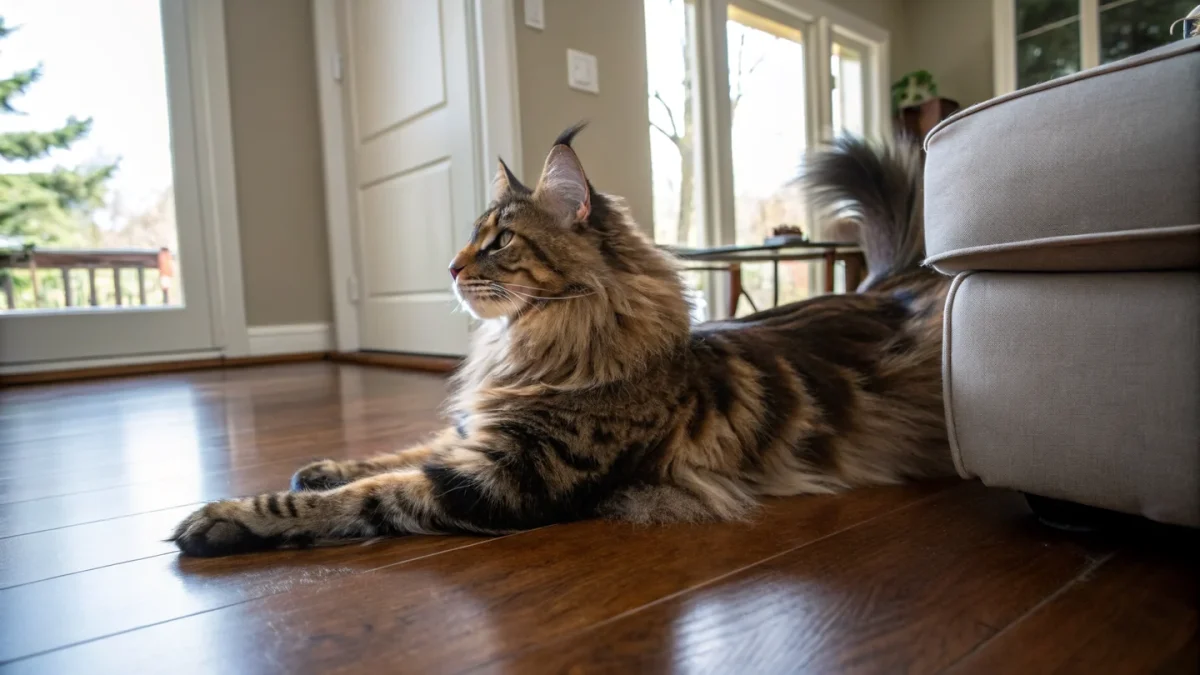
The first thing visitors say when they see a large Maine Coon in person, almost without variation, is "that's not a real cat." Then they reach out to touch the fur, half-expecting some kind of trick.
Maine Coons are genuinely among the largest domestic cats — not large for a cat breed, but large by the objective standards of household mammal size. Understanding what that size means in practice, how it develops, and what factors influence it helps set realistic expectations for people considering the breed.
For the full breed profile, including temperament and grooming, see the complete Maine Coon breed guide.
Typical Adult Size
Males: 13–18 pounds on average, with some individuals reaching 20+ pounds — weight ranges consistent with TICA's published breed standard. Body length varies widely across individuals; record-holding cats have exceeded 45 inches from nose to tail tip, but typical representatives are considerably more modest.
Females: 8–12 pounds on average. Noticeably smaller than males — the sexual dimorphism in Maine Coons is more pronounced than in most domestic cat breeds.
These are the realistic, common figures. "Up to 25 pounds" and similar claims appear frequently in Maine Coon coverage, and while cats of that size do exist, they're at the outer extreme — the equivalent of quoting Michael Jordan when someone asks how tall basketball players are.
A Maine Coon at 14 pounds is a completely typical, well-sized representative of the breed. Exceptional size gets photographed and shared extensively, which skews perception of what an average Maine Coon looks like.
Growth Timeline
Maine Coons grow slowly. Most domestic cats reach full size by 1 year. Maine Coons continue growing until 3-5 years old. This is one of the breed's most reliably surprising characteristics for new owners.
0-6 months: Growth is rapid but not unusual-looking. The kitten is larger than average for its age but doesn't yet look like anything other than a large kitten.
6-12 months: Growth continues at a strong pace. Paws are notably large relative to body size — the classic "big feet, still growing" indicator. The ruff and tail fur become noticeably fuller.
12-24 months: Many owners assume their Maine Coon has stopped growing. It hasn't. The frame continues filling out, and males in particular put on significant muscle mass and chest depth in the second and third year.
3-5 years: Full adult size is reached. A 4-year-old Maine Coon will look noticeably different from the same cat at 18 months.
What Affects Size
Sex. Males are substantially larger than females as a consistent, predictable pattern in Maine Coons. If size is a priority, a male is the more reliable choice. If a more moderately sized cat is preferable, a female will typically be considerably smaller. For comparison, the Norwegian Forest Cat occupies a similar size range with a similarly dense coat — often confused with the Maine Coon, and worth comparing if large, long-haired cats appeal.
Genetics. Parent size is the best predictor of offspring size. A reputable breeder can show you both parents and give a reasonable estimate of where the kitten is likely to land. Lines bred specifically for size will produce larger cats; show-focused lines may prioritize structure and proportion over absolute size.
Neutering. Cats neutered before sexual maturity often grow slightly larger than intact cats of the same sex. Sex hormones — both estrogen and testosterone — accelerate growth-plate closure by promoting calcium deposits at the growth plates, so removing that hormonal signal before the plates close allows bones to continue growing for longer. The effect isn't dramatic, but it's documented and widely observed in the breed.
Diet. Overfeeding doesn't make a Maine Coon grow larger — it makes it fat. Appropriate nutrition for the growth stage supports proper development; excess calories don't extend the growth period or produce more cat.
Record-Breaking Cats
The Guinness World Record for longest domestic cat has been held by Maine Coons multiple times. Stewie, a male Maine Coon from Nevada, measured 123 cm (48.5 inches) nose to tail in 2010. The current living record holder, Barivel of Italy, measured 120 cm (47.2 inches) in 2018. These record-holders are not typical Maine Coons — they're outliers selected specifically because of their unusual size.
The record-chasing aspect of Maine Coon ownership, while understandable given the breed's impressive scale, occasionally leads to management choices (overfeeding, for instance) that prioritize size over health. A well-proportioned Maine Coon at a healthy weight is not served by being pushed toward exceptional size.
Practical Size Implications
Everything for a Maine Coon should be sized for a large cat from the start: extra-large litter box, food dishes that accommodate a broad face, and a cat tree rated for heavy cats (inexpensive lightweight trees aren't structurally adequate for a 16-pound animal jumping from height).
Travel carriers should be sized for adult dimensions before the cat reaches them. A carrier that fits a 10-pound cat will not fit a 17-pound cat, and retraining an adult Maine Coon to accept a new carrier is more work than buying the right one initially.
None of this is a hardship, but the planning is worth doing early. At the extreme end of domestic cat size, the Savannah cat — a hybrid with serval ancestry — can exceed even the largest Maine Coons in height, though the two breeds are otherwise quite different in temperament and origin.