

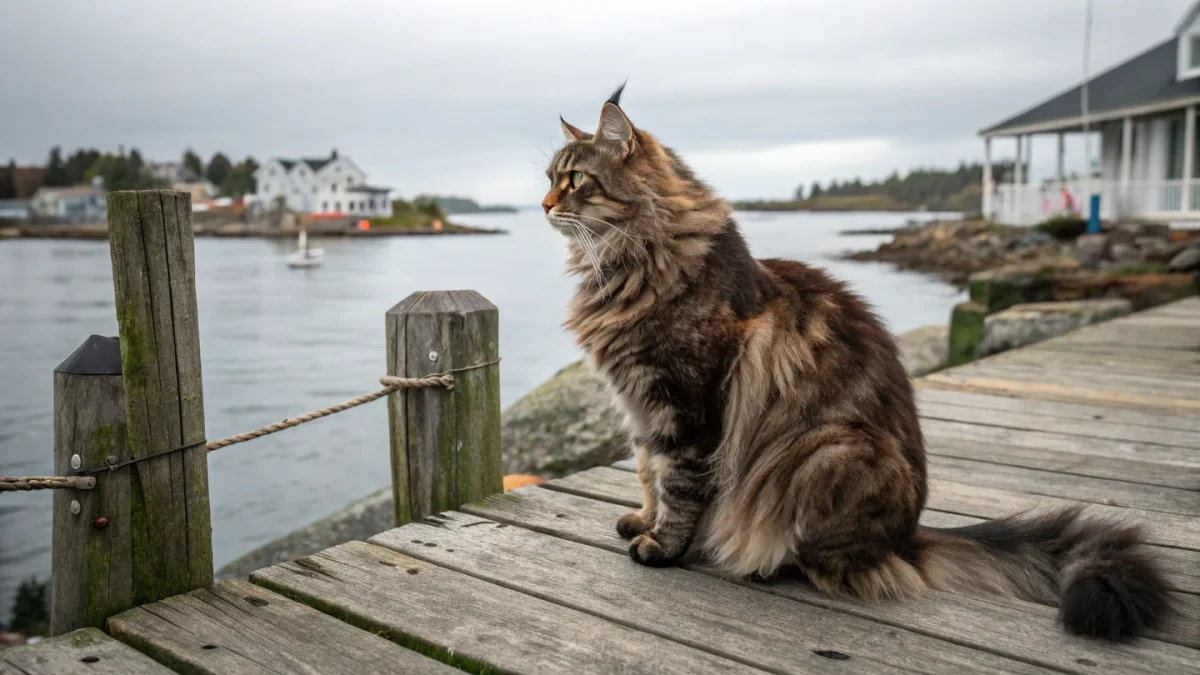
Every breed has a creation myth. Some are true, some are embroidered, and some are plainly invented. The Maine Coon has a particularly rich collection of competing origin theories, ranging from the scientifically plausible to the genetically impossible, with several entertaining stops in between.
The truth — as is usually the case with cat breed history — is less dramatic than the stories but arguably more interesting. For the complete breed overview including temperament and care, see the complete Maine Coon breed guide. For a broader look at Maine Coon myths, see common Maine Coon misconceptions.
The Raccoon Theory
Start with the most wrong theory because it's the most persistent. Maine Coons, according to this folk explanation, are descended from crosses between domestic cats and raccoons — accounting for the ringed tail, the tufted ears, and the dense, water-resistant coat.
This is genetically impossible. Cats belong to the family Felidae; raccoons belong to Procyonidae. These are not closely related families. They cannot produce viable offspring. Full stop.
The superficial similarities between Maine Coon features and raccoon features exist because both species evolved in the same environment — cold, wet New England — and developed similar physical solutions to that environment independently. Ringed tails and tufted extremities are adaptations that appear across multiple unrelated species precisely because they're useful, not because the species share recent ancestry.
The myth almost certainly originated from the name itself. "Maine Coon" sounds like it could reference raccoon ancestry, and once that association is planted, the visual similarities reinforce it. But the name's "Coon" component is more plausibly connected to the Captain Coon folk story or simply to the historical use of "coon cat" as a regional name for the longhaired cats found in Maine — a usage that appears in 19th-century New England records before it was formalized as a breed designation.
Captain Coon and His Ship Cats
This is the most romantically satisfying origin story, and like the best folk histories, it's possible — just impossible to verify.
Captain Charles Coon was, according to this account, a 19th-century sea captain who kept long-haired cats aboard his vessels for rodent control. When his ship docked in Maine ports, cats would come ashore and interbreed with local cats. The long-haired kittens that appeared in the area were called "Coon's cats" and eventually "Maine Coons."
A sea captain by that name appears in regional historical records of the era. Whether he kept longhaired cats aboard his vessel, and whether those cats contributed to the modern breed, is not documented in any surviving record that historians have been able to verify.
The story is plausible in its framework. Maritime cats were common — ships carried them for pest control, and there's ample historical documentation of longhaired cats arriving in American ports from European ships throughout the 17th through 19th centuries. What's unproven is the specific Captain Coon connection.
The Marie Antoinette Theory
This is the most elaborate origin story and, perhaps fittingly for a story involving the French monarchy, the most theatrically implausible.
The theory: when Marie Antoinette was planning her escape from France before her execution during the French Revolution, she arranged to ship several of her Turkish Angora cats to Wiscasset, Maine, where she hoped to follow. She never made it. Her cats allegedly did, and their offspring became the foundation of the Maine Coon breed.
The story references a genuine historical figure — Captain Samuel Clough, who was reportedly involved in plans to assist the French royal family — and Wiscasset was a prosperous Maine port town in that era. But the cats themselves leave no historical trail; no contemporary account, ship manifest, or correspondence documents their arrival in Maine.
Even accepting the premise, the timeline is difficult. The French Revolution was in the 1790s. Maine Coon-type cats appear in New England records considerably earlier, suggesting the breed (or its direct ancestors) predates this story by decades.
The Natural Selection Explanation
Strip away the mythology, and the most evidence-consistent account of the Maine Coon's origin is mundane by folk history standards but interesting by evolutionary ones.
European settlers brought cats to New England from the early 1600s onward. Those cats included both shorthaired and longhaired varieties — the latter common in parts of Europe, particularly from colder northern regions. These cats interbred with each other over generations.
In the harsh New England climate — brutal winters, wet conditions, demanding outdoor rodent-hunting work — specific traits conferred survival advantages: dense, water-resistant coats. Large, tufted paws for navigating snow. Heavy frames for heat retention. Tufted ears that shed water. These traits were selected for, generation after generation, because cats with them lived and reproduced more successfully than cats without them. Maine Coon authorities consistently note the parallels to the Norwegian Forest Cat and Siberian, both of which independently evolved similar features in their own cold, wet environments — a textbook example of convergent evolution rather than shared ancestry.
The result, over several centuries, was a genetically distinct regional type: the longhaired, large-bodied, hardy working cat of New England. By the mid-1800s, this type was identifiable enough to compete in agricultural fair competitions, where "Maine Coon" references appear in records from that era.
The breed was formalized in the late 19th century as cat shows became fashionable. The standards that emerged codified what had been developing naturally for generations.
What the DNA Says
Modern genetic analysis of domestic cat populations has given historians better tools than they had before. A landmark study on cat breed genetics published in Genomics (Lipinski et al., 2008) found that domestic cats in North America are most closely related to cats from Western Europe — not from Turkey or the Middle East specifically — consistent with the natural-selection-from-European-imports story.
The polydactyly (extra toes) that appears at higher rates in Maine Coons than in most breeds is genetically documented in historical New England cat populations, and the geographic distribution of polydactyl cats in northeastern North America — higher rates in the Atlantic coastal regions, decreasing inland — correlates with the dates when various ports first established shipping trade with Boston. This is one of the more interesting concrete genetic threads in the breed's origin story, and it's backed by documented patterns in published population genetics literature.
The genetic evidence doesn't support a single founder event (like Captain Coon's cats) but rather a gradual development from a broad European domestic cat population. Which is, frankly, what the natural selection theory predicts.
Why the Myths Persist
Origin myths serve a purpose beyond factual accuracy: they give a breed an identity narrative. The raccoon story gives Maine Coons a wild, distinctly American origin. The ship cat story gives them maritime romance. The Marie Antoinette story gives them aristocratic European connection.
The actual story — cold-adapted European working cats selected over centuries by New England winters — is less narrative but more true. It's also arguably more fitting for a breed that has always been fundamentally practical: not a fashion object, not a royal accessory, but a tough, intelligent, working animal that happened to also be wonderful company.