

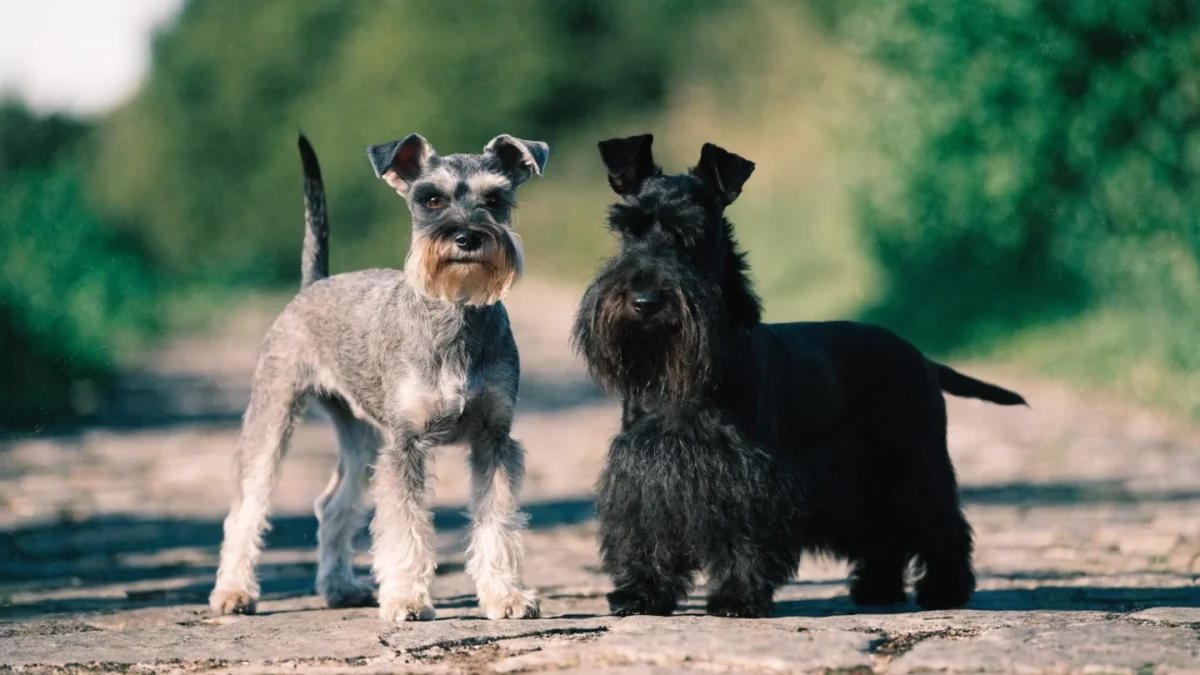
The Miniature Schnauzer was bred down from Standard Schnauzers in Germany during the late 1800s, likely by crossing with Affenpinschers and small Poodles, to create a compact farm ratter. The Scottish Terrier's history runs much deeper into the British Isles — references to earth dogs matching the Scottie's description appear in Scottish records from the 1400s, and the breed was formalized in the 1870s after decades of dispute about which Highland terrier deserved the name. Both were vermin hunters. But the German farm ratter and the Highland earth dog developed different approaches to the same job — and those approaches still define each breed's personality.
Size and Build
| Trait | Miniature Schnauzer | Scottish Terrier |
|---|---|---|
| Height | 30-36 cm | 25-28 cm |
| Weight | 5-9 kg | 8-10 kg |
| Build | Square, sturdy, longer legs relative to body | Low-slung, heavy-boned, compact |
| Coat | Wiry double coat, distinctive beard | Harsh wiry outer coat, dense undercoat |
The Scottie is built closer to the ground and denser for its height — a design that served digging into rock-strewn dens. The Mini Schnauzer is more upright and proportionate, built for speed and agility on the farm floor.
Temperament
Miniature Schnauzers are the extroverts of the terrier world. They want to be involved in everything, they alert-bark at anything they consider noteworthy (which is everything), and they're genuinely friendly with people and other dogs when properly socialized. They're enthusiastic trainees — not necessarily obedient, but engaged. A Mini Schnauzer learning a new trick is clearly having a good time.
Scottish Terriers operate on a different frequency entirely. They're often described as "the thinker" among terriers. Scotties assess situations before engaging, they're reserved with unfamiliar people, and they carry themselves with a dignified self-possession that can look like aloofness. It's not disinterest — it's selective engagement. A Scottie decides who's worth its attention. You don't get to choose for it.
Both breeds have terrier stubbornness. Training requires patience and consistency. The difference is that the Mini Schnauzer's stubbornness comes with enthusiasm — it'll argue with you cheerfully. The Scottie's stubbornness is quieter and more immovable. You don't cajole a Scottie; you negotiate.
With children, Mini Schnauzers are typically good companions for kids old enough to interact respectfully. Scotties can be less tolerant of unpredictable child behavior — they prefer calm, predictable interactions and may snap if persistently provoked.
Grooming
Both breeds have wiry coats that require either hand-stripping (pulling out dead outer coat to maintain texture) or clipping every six to eight weeks. Hand-stripping preserves the correct harsh coat texture. Clipping is easier but softens the coat over time and can dull the color — a cosmetic difference, not a health concern.
Mini Schnauzers need their signature beard cleaned regularly. Food and water get trapped in the facial furnishings, and a dirty beard becomes a hygiene issue quickly.
Scotties need regular trimming around the legs, underbody, and head to maintain their distinctive silhouette. The eyebrows and beard are hallmarks of the breed and require regular shaping.
Neither breed sheds heavily. Both are considered low-shedding, which makes them more compatible with allergy sufferers than many breeds — though no dog is truly non-allergenic.
Health Concerns
Miniature Schnauzers are predisposed to pancreatitis (the breed has a known sensitivity to dietary fat), urinary stones (calcium oxalate and struvite), hyperlipidemia, cataracts, and progressive retinal atrophy. Diabetes mellitus occurs at elevated rates. The pancreatitis risk means dietary management matters more for this breed than many — high-fat treats and table scraps are genuine health hazards, not just a weight concern. Average lifespan: 12 to 15 years.
Scottish Terriers face a disproportionate risk of bladder cancer (transitional cell carcinoma). Research published in the Journal of the American Veterinary Medical Association has documented that Scotties develop this cancer at rates roughly 18 to 20 times higher than the average for all breeds. Von Willebrand's disease, Scottie cramp (a breed-specific movement disorder triggered by excitement or exercise), hypothyroidism, and joint problems round out the major concerns. Average lifespan: 11 to 13 years.
The Scottie's bladder cancer predisposition is serious enough that some veterinary oncologists recommend screening in older Scotties even without symptoms.
Exercise Needs
Mini Schnauzers need 45 to 60 minutes daily. They enjoy walks, fetch, agility, and any activity that lets them use their mind and body together. They adapt well to varied exercise routines and are enthusiastic participants.
Scotties need 30 to 45 minutes. They're not couch potatoes, but they don't demand the sustained intensity that Mini Schnauzers do. Moderate walks and yard play satisfy most Scotties. They enjoy digging — providing a designated digging area saves your garden.
Living Situation
Both breeds adapt well to apartment living. The Mini Schnauzer's primary apartment challenge is barking — they're vocal dogs, and that voice carries. Scotties are generally quieter, barking with purpose rather than commentary.
Mini Schnauzers integrate well into multi-pet and multi-person households. Scotties prefer calmer environments and can be selective about which other animals they tolerate. Introducing a Scottie to a resident cat or dog requires patience and supervised gradual introduction.
Who's the Right Fit
The Mini Schnauzer suits families and individuals who want a spirited, social terrier that participates in daily life with visible enthusiasm. You'll need to manage barking and maintain a low-fat diet, but in return you get a genuinely fun, engaging companion.
The Scottish Terrier suits someone who respects independence in a dog, prefers quiet dignity over boisterous energy, and can commit to cancer screening as the dog ages. Scotties reward owners who let them be themselves rather than trying to reshape them into something more outgoing.
Both are terriers to the core — confident, opinionated, and completely sure they're in charge. For more matchups, see our breed comparisons guide. For dedicated breed profiles, the Miniature Schnauzer complete breed guide covers the breed's German farm origins and health predispositions in full. For another small terrier with a long British history, see the Yorkshire Terrier complete breed guide.