

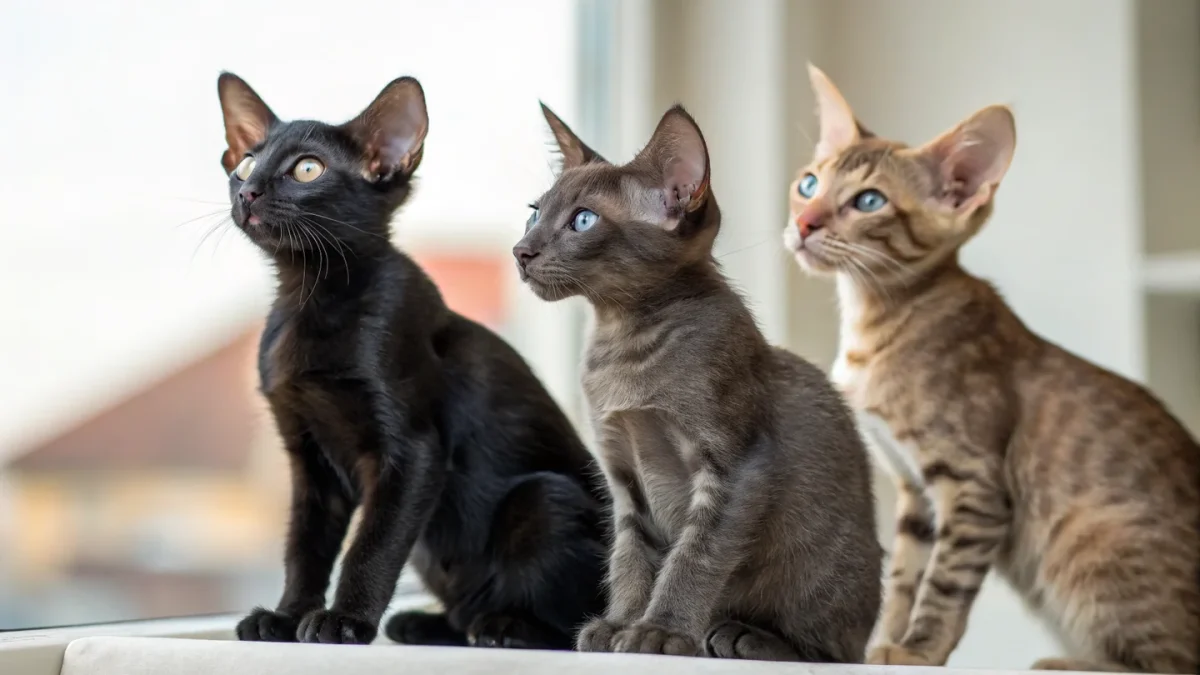
When the Cat Fanciers' Association recognized the Oriental Shorthair in 1977, they made a deliberate structural decision: the breed standard would permit any genetically possible coat color and pattern that the cat's genetics could produce, subject to the single-coat type requirement. The result is the most color-diverse pedigreed cat in existence.
The Oriental Shorthair's history as a deliberately color-expanded Siamese is described in detail in the Oriental Shorthair's history and breed development. What concerns us here is the color range itself — what exists, how the genetics produce it, and which combinations are the most distinctive.
Why So Many Colors?
The Siamese — the Oriental Shorthair's closest relative — is restricted to four color point patterns. The color restriction is part of the Siamese standard: the body must be pale, the points (face mask, ears, paws, tail) must be a specific dark color, and the color must be temperature-dependent (the enzyme that produces pigment is heat-sensitive, which is why cooler body extremities are darker).
The Oriental Shorthair was specifically developed to remove that restriction. By crossing Siamese with domestic shorthairs, Russian Blues, and other breeds beginning in the 1950s, breeders introduced the full range of feline color genetics into a Siamese-bodied cat. Every color and pattern gene available in the domestic cat population became potentially available in the Oriental Shorthair.
The Color Categories
Solid colors: The simplest genetic expression. One color across the entire coat, with no pattern. The most recognized Oriental Shorthair solid colors:
- Ebony — jet black, one of the most striking examples of the breed's angularity
- Blue — diluted black, a steel-gray tone
- Chestnut — a warm, reddish-brown
- Lavender — diluted chestnut, producing a faint pinkish-gray
- Cinnamon — light, warm brown
- Fawn — diluted cinnamon
- Red — orange-red, similar to "ginger" in other breeds
- Cream — diluted red
- White — the absence of pigment expression (requires specific genetic combination)
Tabby patterns: Four recognized tabby variants appear in Oriental Shorthairs:
- Classic tabby — bold, swirling blotched patterns
- Mackerel tabby — thin parallel stripes running vertically
- Spotted tabby — spots rather than stripes
- Ticked tabby — agouti banding on individual hairs with minimal visible striping; the coat has a salt-and-pepper quality
All four patterns can appear in any of the base colors listed above, which is where the combination count begins climbing rapidly.
Smoke and shaded: Smoke patterns occur when a cat has a white undercoat with dark tips. In motion, a smoke Oriental Shorthair's coat reveals flashes of the white base color. Shaded patterns are similar but with less dramatic tipping — a lighter effect.
Bicolor and parti-color: White combined with any color, and tortoiseshell (intermingled red and black, occurring only in females genetically) combinations.
Genetics at Work
The Oriental Shorthair's color range is produced by several independently-assorted gene systems working in combination:
The B locus controls black pigment production. The dominant B allele produces black. The recessive b allele produces chocolate (chestnut). A second recessive allele produces cinnamon. Each diluted variant (blue from black, lavender from chestnut, fawn from cinnamon) results from a separate dilution gene (the D locus).
The agouti gene (A locus) determines whether tabby patterning is expressed. Non-agouti (solid) cats carry two recessive alleles at this locus, suppressing pattern. Agouti cats express tabby patterns.
The extension gene and related loci control red/yellow pigment versus black/brown pigment expression.
The white-spotting gene and dominant white control the presence and extent of white in the coat.
The combinatorial math produces the 300+ figure quickly. When you multiply the possible base colors by the possible patterns by the possible white/tipping variations, you get a number that no other breed approaches.
Eye Color Correlation
In most Oriental Shorthair colors, vivid green is the standard eye color — and well-bred individuals have eyes that are genuinely intense, not a washed-out yellow-green. White-coated Orientals may carry blue eyes, amber eyes, or the odd-eyed combination (one of each), with the same genetic mechanism as white cats in other breeds.
Red and cream Orientals sometimes carry amber or gold eyes rather than green. The genetic relationship between coat pigment genes and eye pigment genes accounts for these variations.
What This Means Practically
The color diversity means that a prospective owner specifically attracted to a particular coat type — an ebony black Oriental with green eyes, or a lavender tabby — has a reasonable chance of finding one through a dedicated breeder. The breed isn't restricted to a few standard appearances.
It also means that Oriental Shorthair litters can produce significant color variety even between similarly-colored parents, depending on the heterozygosity of the breeding pair. A single litter might include a solid blue, a cinnamon tabby, and a cream bicolor — all from the same parents — if both parents carry recessive color alleles.
The temperament, structure, and voice are consistent regardless of color. What varies is purely aesthetic. And aesthetically, the Oriental Shorthair's range is unlike anything else in the pedigreed cat world.