

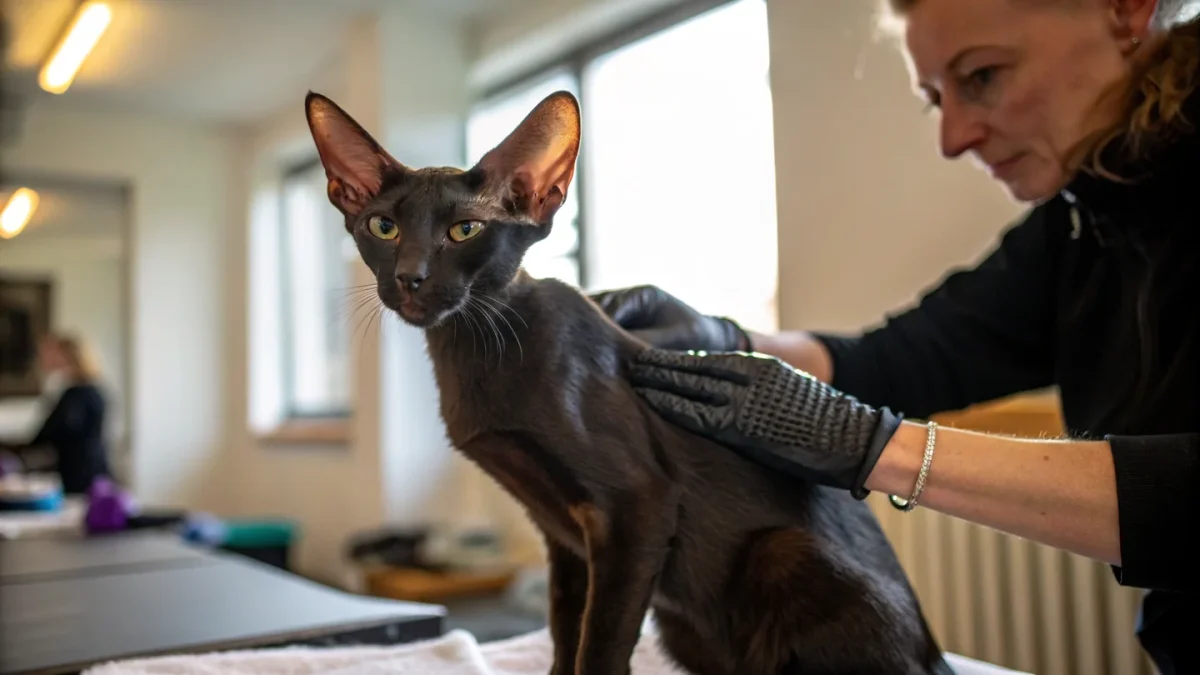
The Oriental Shorthair's coat is one of the more forgiving in the cat world: short, fine, and with almost no undercoat to mat or shed heavily. The complete Oriental Shorthair breed guide covers the full picture of the breed. This article is specifically about what the regular care routine looks like and what actually matters.
The honest summary: the coat is not where you'll spend your time with this breed. Their ears are.
Coat Care: Minimal but Consistent
The Oriental Shorthair's single short coat sheds modestly throughout the year, with slight increases during seasonal transitions. Without a dense undercoat, there's no matting risk and no need for detangling work.
Brushing frequency: Once weekly is sufficient for most coats. During the mild spring transition, twice a week removes the slightly increased loose hair before it accumulates on surfaces.
Best tools: A rubber grooming glove is ideal — the soft nubs catch loose hair without applying excess pressure to the fine coat, and most Oriental Shorthairs enjoy the sensation. A chamois cloth drawn over the coat achieves a similar effect and adds a slight polish to the coat's natural sheen. Avoid wire brushes or stiff-bristle tools; they're unnecessary for this coat type and can scratch the skin through the thin coat.
Technique: Work with the coat's natural direction, from neck to tail. The short coat on an Oriental Shorthair takes only a few minutes to groom thoroughly — this is not a time-intensive routine.
Ear Care: The Weekly Priority
The Oriental Shorthair's most prominent physical feature — those enormous, wide-set ears — is also the main grooming focus. Large, open ears are efficient at capturing airborne debris, and the warm ear canal accumulates wax readily.
Weekly routine: Use a soft cotton ball lightly moistened with a gentle ear cleaner. Wipe the visible ear surfaces and the outer ear canal — everything you can see without probing. This removes wax buildup and any debris before it can create an environment for yeast or bacterial growth.
Never probe deeply into the ear canal with cotton swabs. You can see the first portion of the canal; beyond that, leave it to a veterinarian.
If you notice dark brown or black discharge, strong odor, head-shaking, or the cat scratching at an ear persistently, these are veterinary signs rather than grooming issues.
Dental Care: Worth the Effort
The Oriental Shorthair's narrow jaw creates more dental crowding than most cats experience, which means tartar accumulates faster and periodontal disease is a real risk over the cat's lifespan. Dental care matters more here than in cobby-faced breeds with more jaw space.
Introducing tooth brushing as a kitten habit — using cat-appropriate toothpaste and a soft brush — is dramatically easier than starting with an adult who has never experienced it. If daily brushing isn't practical, dental rinses and water additives formulated for cats provide supplementary support between professional cleanings.
Eyes, Nails, Body Condition
Eyes: The Oriental Shorthair's large almond-shaped eyes occasionally accumulate minor discharge at the inner corners. A quick gentle wipe with a soft, damp cloth during grooming sessions manages this. Unlike flat-faced breeds, they don't have structural tearing issues requiring daily attention.
Nails: Every two weeks. Oriental Shorthairs are active climbers, and overgrown nails snag on surfaces and create discomfort.
Weight monitoring: The lean body type can mask gradual weight changes that would be obvious on a rounder-bodied cat. Weigh your Oriental Shorthair monthly and adjust feeding accordingly. An overweight Oriental Shorthair doesn't look obviously heavy — it just looks like a somewhat rounder Oriental Shorthair — but the cardiovascular and joint effects are real.
Temperature Awareness
The near-absent undercoat that makes grooming so simple also means the Oriental Shorthair is genuinely cold-sensitive. During grooming sessions, which typically involve the cat sitting still for a few minutes, ensure the environment is warm. These cats seek heated spots actively and should have access to warm bedding in any room they regularly occupy.
For guidance on whether an Oriental Shorthair fits your lifestyle, the temperature sensitivity is part of a larger picture of the breed's practical requirements.