

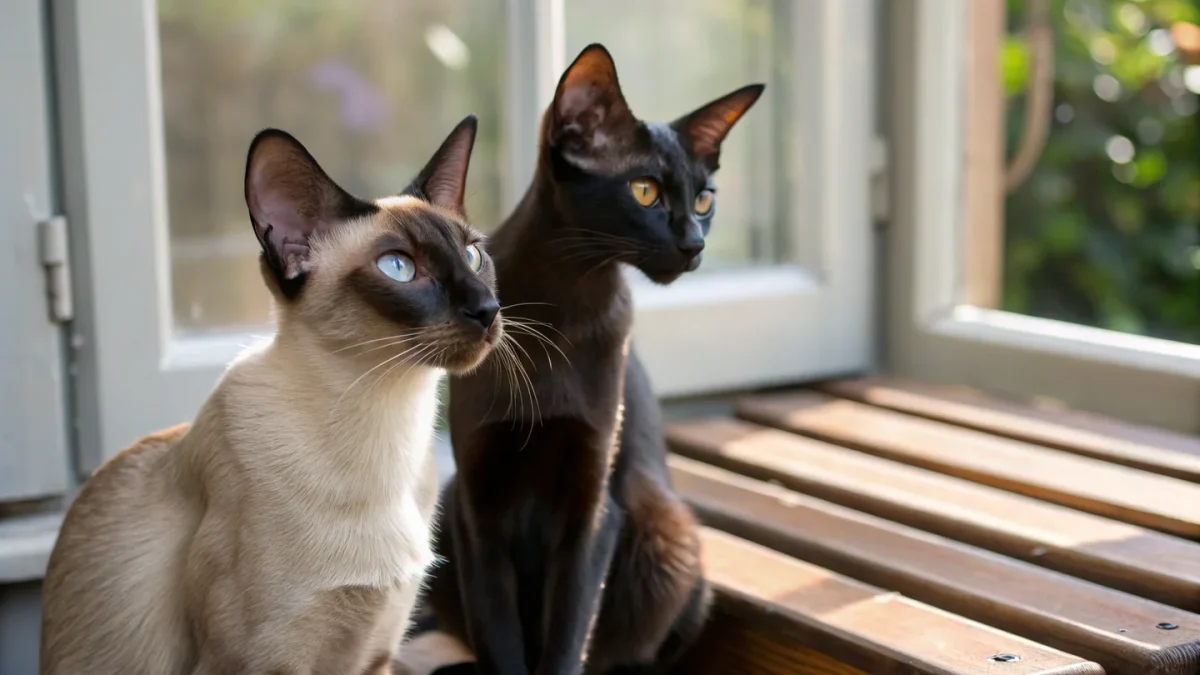
Ask anyone who has lived with both a Siamese and an Oriental Shorthair what the difference is, and the most honest answer is: the coat color and not much else. The breeds share so much genetic heritage, physical structure, and temperament that calling them distinct is more an administrative decision than a biological one — and even that administrative decision comes with asterisks, since the two breeds are still regularly outcrossed.
For the full background on the Oriental Shorthair's development as a breed, the Oriental Shorthair's full breed history covers it comprehensively. This article focuses specifically on the comparison.
The Shared Foundation
Both breeds trace their ancestry to the cats of Thailand (formerly Siam), where the angular, large-eared, vocal cat we now call "Oriental type" has been documented since at least the 14th century. When these cats arrived in Europe and North America through diplomatic gifts and later through selective importation, they formed the genetic foundation for both the Siamese and, later, the Oriental Shorthair.
The body type is identical: long and tubular, with fine bones and surprising musculature. The head structure is the same: wedge-shaped with a long flat profile, large ears set wide on the skull, almond-shaped eyes set at a slant. The coat texture is the same: short, fine, and lying very close to the body with minimal undercoat. The voice is the same family — loud, melodic, and frequent.
The One Real Difference: Color Restriction
The Siamese is defined by its color-point pattern. The gene responsible — a temperature-sensitive mutation in the tyrosinase enzyme gene — restricts dark pigment to the body's cooler extremities (face mask, ears, paws, tail), leaving the warmer body pale. Siamese come in four recognized point colors: seal (dark brown), blue (steel gray), chocolate (lighter brown), and lilac (pale lavender-gray).
That's four options. The Oriental Shorthair was specifically developed to remove this restriction, introducing the full range of domestic cat color genetics into the same body type. Over 300 color and pattern combinations result.
If you want a Siamese-bodied, Siamese-voiced, Siamese-dispositioned cat in a solid ebony coat, a blue tabby, a cinnamon tortoiseshell, or a lavender smoke — that's an Oriental Shorthair.
Temperament: Effectively the Same
There are breeders who will tell you the Siamese is slightly more intense or slightly more vocal than the Oriental Shorthair, and there are breeders who will tell you the opposite. These are individual and line differences, not meaningful breed differences. Both are among the most vocal, interactive, social cat breeds available. Both form deep attachments to their people. Both demand more interaction than average. Both do poorly with extended solitude.
The idea that choosing one over the other will produce a meaningfully calmer or quieter cat is not supported by any systematic evidence. If you want a quieter, less demanding cat, both breeds are the wrong choice, and the right choice is a completely different breed.
The Outcrossing Reality
The Siamese and Oriental Shorthair are not genetically isolated populations. Outcrossing between them (and with the Balinese and Oriental Longhair) is permitted and regularly practiced by responsible breeders to maintain genetic diversity and structural health. This means that litters periodically produce individuals that could be registered as either Siamese or Oriental Shorthair depending on coat color expression.
A kitten from two Oriental Shorthair parents that happens to express color-point patterning would typically be registered as a Siamese (or Colorpoint Shorthair in some associations). A kitten from Siamese parents that expresses a non-pointed coat would be an Oriental Shorthair. The breed distinction is enforced at the registration level; the genetic boundary is genuinely permeable.
Which Should You Choose?
If you're drawn to one of the four Siamese point colors (seal, blue, chocolate, lilac), and you want the historical weight of the Siamese breed and the established show presence that comes with it, the Siamese is the obvious choice.
If you want the same cat in a different color — or if the specific color combination you have in mind isn't available in the Siamese palette — the Oriental Shorthair gives you access to the full color range in the same package.
The practical decision factors are: appearance preference, breeder availability in your area, and whether you intend to show (different associations handle the breeds differently in competition).
The cat itself, day to day, in the household, in your lap at midnight, demanding your attention at 7 AM — is effectively the same.
| Feature | Siamese | Oriental Shorthair |
|---|---|---|
| Body type | Wedge-shaped, tubular | Identical |
| Coat colors | 4 point patterns only | 300+ combinations |
| Voice | Loud, frequent | Identical |
| Temperament | Highly social, demanding | Effectively identical |
| Coat texture | Short, fine, close-lying | Identical |
| Lifespan | 12-15 years | 12-15 years |
| Recognized since | Long-established | CFA recognized 1977 |
| Outcrossing | With Orientals/Balinese | With Siamese/Balinese |