

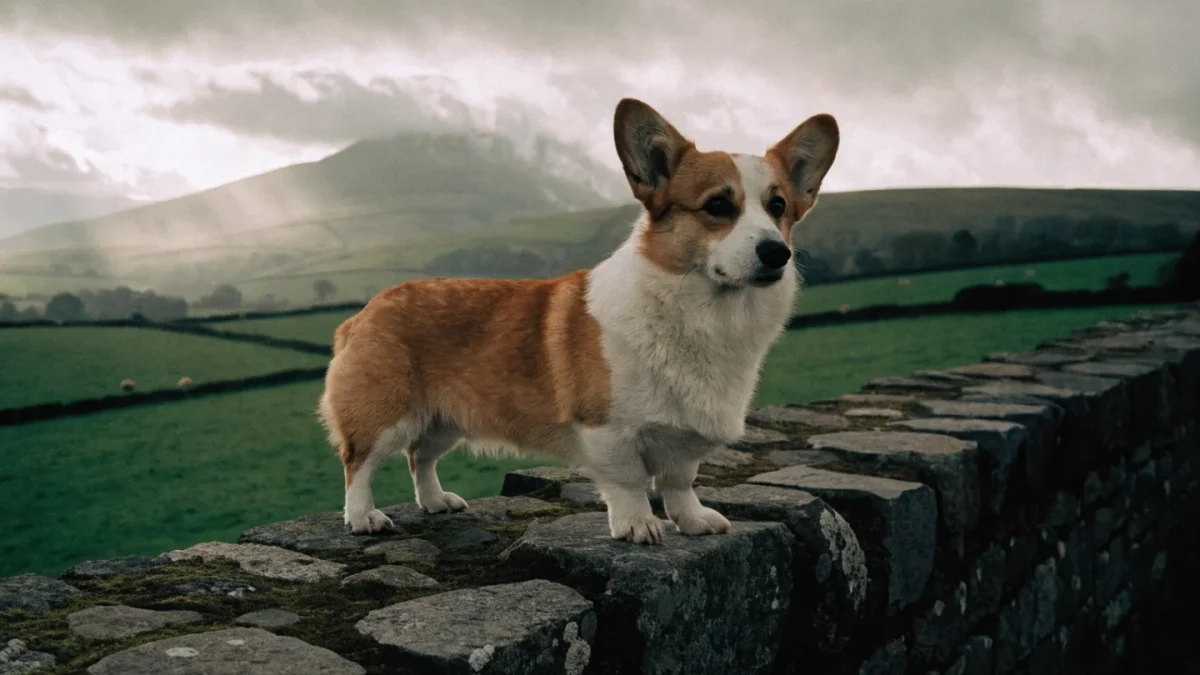
In 1107 CE, Henry I of England invited a community of skilled Flemish weavers to settle in the southwestern corner of Wales — a region called Pembrokeshire. They brought their looms, their craft, and their dogs. Those dogs, compact Spitz-type herders bred for generations in what is now Belgium and the Netherlands, would become the foundation stock for one of the most recognizable breeds on earth. The Pembroke Welsh Corgi exists because a medieval king wanted better textiles.
That single historical detail — foreign artisans importing foreign dogs to a specific Welsh county at a documented point in time — is the anchor point for the Pembroke Welsh Corgi history origins story. Everything that followed, from centuries of anonymous farm work to global celebrity through a queen's devotion, builds from that arrival.
The Flemish Connection
The weavers who settled in Pembrokeshire brought dogs that were already purpose-bred for livestock management. These were northern European Spitz-type dogs — prick-eared, double-coated, compact, and agile. Their closest modern relatives in terms of ancestral type include the Swedish Vallhund, the Finnish Spitz, and the Schipperke, all of which share the Pembroke's Spitz characteristics to varying degrees.
The connection between Pembrokes and Swedish Vallhunds is particularly debated among breed historians. Vallhunds are also short-legged herding dogs with Spitz features, and they date to the Viking era in Scandinavia. Whether Vikings brought Vallhund-type dogs to Wales (the "Viking herder" theory referenced in this article's title), or whether Welsh dogs were exported to Scandinavia, or whether both breeds simply descend from common Spitz ancestors remains unresolved among breed historians — and here's the thing, the genetics don't settle it either. A 2017 genome-wide clade analysis published in Cell Reports, one of the largest breed-relatedness studies ever run, put Corgis in a modern "herding clade" alongside breeds like Collies, not clustered with the Vallhund's Nordic Spitz lineage. That doesn't kill the Viking theory outright, but it means the shared-ancestry story breeders have told for decades is more folklore than confirmed pedigree.
What's clear is that by the 12th century, Pembrokeshire farmers had access to small, low-built herding dogs that excelled at cattle work — and those dogs were distinct from the herding dogs used in neighboring Cardiganshire.
The Working Centuries
For roughly 800 years, the Pembroke Welsh Corgi existed without a breed name, a breed standard, or anyone particularly interested in documenting its development. It was a working farm dog. Its value was measured in cattle moved, not in show ribbons won.
The Pembroke's job was specific and demanding. Welsh farmers ran cattle on common grazing land, and the dogs needed to drive the farmer's herd to the best pasture, keep them together, and move them back home. The low body was essential — a dog that stands 25 to 30 cm tall passes cleanly under the kick zone of a cow's hind legs. The bold temperament was equally essential. A dog that hesitates when facing down a 600 kg steer is useless as a herder.
This centuries-long period of functional selection — where breeding decisions were made by farmers based purely on working ability — produced the herding temperament that defines them today. Every trait that modern owners find charming or challenging in a Pembroke — the confidence, the bossiness, the alertness, the vocal nature, the heel-nipping — was shaped during these unrecorded centuries of pasture work.
The dogs also served secondary roles. They were vermin controllers, keeping rats and other pests away from grain stores. They were alert dogs, barking to warn of approaching strangers or predators. And they were general-purpose farm dogs, adaptable and hardy enough to earn their keep in the modest agricultural economy of rural Wales.
Pembroke and Cardigan: The Separation
The Pembroke and Cardigan Welsh Corgis developed in adjacent counties — Pembrokeshire and Cardiganshire — from different ancestral stock, yet for decades they were treated as a single breed by the dog fancy. Understanding how and why they were separated is central to the Pembroke's breed history.
Cardigans are the older breed, descending from the Teckel family of dogs (the same lineage that produced the Dachshund). They arrived in Wales around 1200 BCE with Celtic tribes — nearly two thousand years before the Flemish weavers brought the Pembroke's ancestors. The two breeds are related by geography and occupation, not by blood.
Despite their different origins, cross-breeding between Pembrokes and Cardigans occurred for generations, particularly in areas where Pembrokeshire and Cardiganshire border each other. When organized dog showing began to include "Welsh Corgis" in the early 20th century, both types were shown together and judged against the same standard.
The Welsh Corgi Club was formed in 1925 in Carmarthen, and early shows grouped both varieties under one umbrella. Predictably, this created conflict. Pembroke and Cardigan breeders had different visions for their dogs, and judges struggled to evaluate two structurally distinct types against a single standard. The Cardigan is larger, heavier, longer-bodied, and always retains its long tail. The Pembroke is more compact, lighter-boned, and most carry the natural bobtail.
The Kennel Club in Britain granted separate breed status in 1934, recognizing the Pembroke Welsh Corgi and the Cardigan Welsh Corgi as distinct breeds with their own standards. This was a pivotal moment. From 1934 onward, the two breeds developed along separate trajectories, and cross-breeding between them became unacceptable in the show ring.
The Royal Era
No discussion of Pembroke Welsh Corgi history is complete without addressing the breed's most famous patron. In 1933, King George VI (then the Duke of York) brought a Pembroke Welsh Corgi named Dookie into the royal household. His daughter, the future Queen Elizabeth II, was seven years old. It was the beginning of a bond that would last nearly 90 years and transform the breed's global visibility.
Elizabeth received her own Pembroke, Susan, as an 18th birthday gift in 1944. Susan accompanied her on her honeymoon in 1947 — smuggled under a rug in the royal carriage, according to multiple historical accounts. From Susan descended a line of royal corgis that Elizabeth maintained throughout her entire reign. She is estimated to have owned more than 30 Pembrokes during her lifetime, and she personally supervised their breeding and care.
The royal association elevated the Pembroke from a regional Welsh farm dog to a global symbol. Photographs of the Queen with her corgis became iconic, and the breed's popularity surged in Britain and beyond. The Queen's final corgi, Willow — a 14th-generation descendant of Susan — died in April 2018. Elizabeth herself died in September 2022, ending a 78-year personal association with the breed.
The royal connection was a double-edged sword. It brought the Pembroke unprecedented fame and ensured the breed's survival during periods when many working farm breeds declined. It also attracted buyers who wanted a "royal dog" without understanding that the regal-looking animal in press photographs was, at its core, a cattle-herding dog bred to nip, bark, and boss things around.
Breed Recognition and Development
The Pembroke's show career accelerated after the 1934 Kennel Club separation. The breed quickly gained popularity in British show rings, bolstered significantly by royal patronage. The breed standard emphasized the Pembroke's working heritage while codifying the physical type: low-set, strong, alert, with a foxlike head and a bold but kindly expression.
The American Kennel Club recognized the Pembroke Welsh Corgi in 1934 — the same year the British Kennel Club separated the two corgi breeds. Early American breeding stock was imported from Wales and England, and the Pembroke Welsh Corgi Club of America was established in 1936.
For decades, the Pembroke maintained a steady but moderate level of popularity in North America. It was a respected breed in herding and conformation circles but never a mainstream choice. That changed dramatically in the 2010s.
The Internet Era
The Pembroke Welsh Corgi's second popularity explosion began around 2012 to 2014, driven almost entirely by social media. The breed's photogenic qualities — short legs, expressive face, fluffy rear end — proved irresistible on platforms built for sharing images and short videos. "Corgi butts" became a meme. Corgi meetups drew hundreds of dogs and thousands of spectators. The breed's AKC registration ranking climbed from 24th in 2011 to 11th by 2019.
This viral popularity created a demand surge that the responsible breeding community couldn't meet without compromising health testing and selection standards. The predictable result: increased breeding by people prioritizing profit over health, more puppies entering homes unprepared for the breed's actual temperament, and more Pembrokes ending up in rescue when the reality didn't match the social media fantasy.
The breed's current position is one of sustained high demand. Global recognition remains strong, registration numbers are healthy, and the Pembroke is firmly established as one of the most popular herding breeds worldwide. The challenge going forward is ensuring that popularity doesn't erode the working character and health that made the breed worth preserving in the first place.
From Pasture to Popularity
The arc of Pembroke Welsh Corgi history spans roughly 900 years, from unmarked Flemish arrival to global recognition. For most of that time, the breed existed in functional anonymity — valued by farmers, shaped by work, and unknown outside southwestern Wales. The last century has been a dramatic acceleration: kennel recognition, royal patronage, show ring success, and viral fame, each wave bringing new owners and new pressures.
What makes the Pembroke's story compelling is that the core of the breed hasn't changed. The dog that patrols your living room, barks at the mail carrier, and nips your child's heels is running the same software as the dog that worked cattle on Welsh hills nine centuries ago. The context has changed completely. The dog has not.
For the full picture of what that means for daily life with a Pembroke, see the Pembroke Welsh Corgi breed guide.