

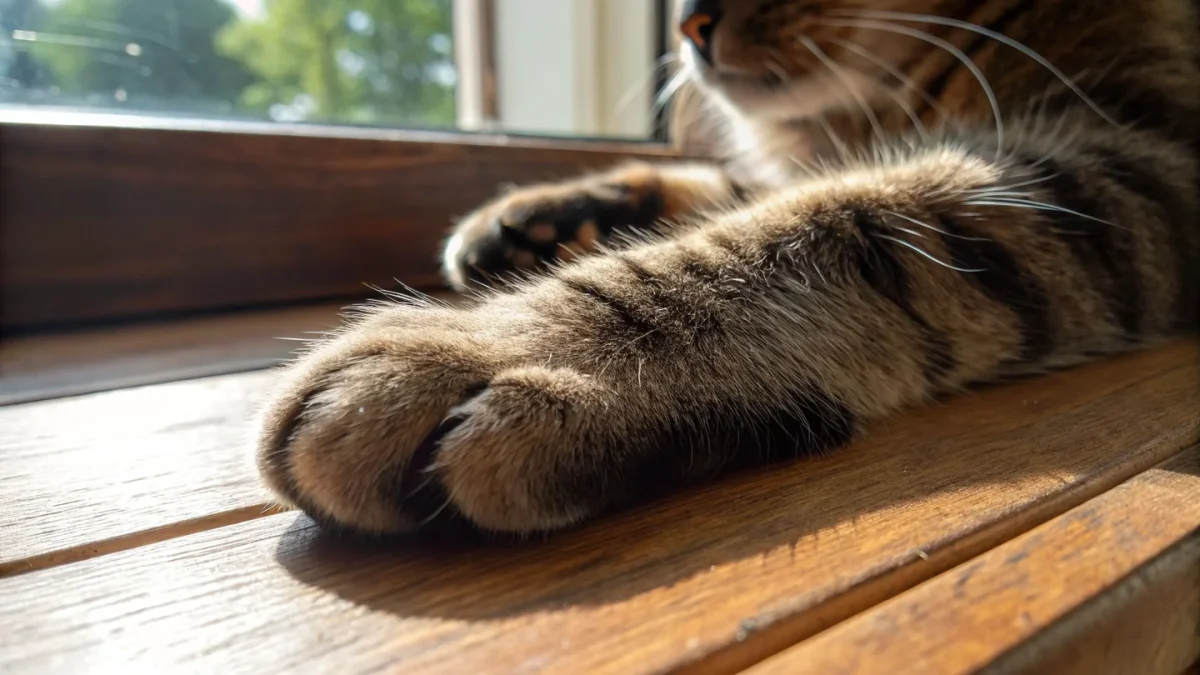
The most famous polydactyl cats in the world live at the Ernest Hemingway Home and Museum in Key West, Florida. Hemingway reportedly received a six-toed cat from a ship captain, and the descendants of that cat — approximately 40-50 cats at any given time — still patrol the property today. The extra-toed trait passed through the generations exactly as Mendel's genetics would predict: dominant, showing up in roughly half the offspring when one parent carries it.
Polydactyly is one of those genetic traits that is simultaneously well-understood mechanistically, visually striking, and essentially benign. It's also one of the more common non-coat genetic variations in domestic cats.
For context in the broader cat genetics landscape, the cat breed categories guide and cat genetics primer are useful background.
The Genetics
Normal domestic cats have 18 toes: five on each front foot, four on each back foot. Polydactyl cats have more — typically six or seven on the front feet, sometimes more. The record number of toes on a domestic cat is 28, per Guinness World Records — a mark first set by a Canadian cat named Jake in 2002 and tied more than two decades later.
The mutation responsible for most cat polydactyly affects the ZRS (Zone of Polarizing Activity Regulatory Sequence), a regulatory element that controls the expression of the Shh (Sonic Hedgehog) gene during limb development. In normal development, Shh expression is tightly controlled to produce the standard toe number. The polydactyl mutation disrupts this regulation, allowing additional toe development.
The mutation is autosomal dominant — located on a non-sex chromosome, and requiring only one copy for expression. This is why polydactyly breeds true through generations so reliably: every cat carrying the mutation shows the phenotype.
Multiple different mutations in the same regulatory region have been identified — geneticists have documented three distinct ZRS variants so far (two found in outbred UK cats, one traced specifically to the Hemingway lineage), which explains why polydactyl cats appear across different populations independently and why the exact toe configuration varies between individuals.
Geographic Distribution
Polydactyl cats are not evenly distributed globally. There is a notably higher frequency along the Atlantic coast of North America — particularly from Boston northward through Nova Scotia — and in Wales. The clustering suggests that polydactyl cats were common on specific sailing routes, possibly valued as ship cats for their reportedly superior grip on rigging — a story repeated constantly in cat circles, though I'll note the primary documentation behind it is thinner than the confidence with which it gets told.
Polydactyl Maine Coons are frequently mentioned. Early Maine Coon populations had significant polydactyl prevalence, though most modern breeding programs have selected away from the trait due to registry standards that historically didn't recognize polydactyly in the breed. Some breeders maintain polydactyl Maine Coon lines deliberately.
Health Implications
In most cases: none. Extra toes in cats are structurally sound, and polydactyl cats live normal lifespans, move normally, and don't have elevated rates of joint problems or other conditions directly attributable to the extra digits.
The primary management consideration is nail care. Extra toes sometimes have dewclaw-like positions where the nails don't wear naturally and can grow into the toe pad if not trimmed regularly. This is straightforward preventive care rather than a health concern.
Very occasionally, the extra toe development is incomplete — resulting in a toe that doesn't form correctly and may require veterinary attention. This is not the norm.
Polydactyly as a Trait vs. Polydactyl "Breeds"
There is no formally recognized "polydactyl breed" in most major registries. Polydactyly is a trait that appears across breeds and in mixed-breed cats. The Pixiebob breed has a tendency toward polydactyly and allows it within breed standards, but is not a "polydactyl breed" per se.
Here's where I need to correct something breeders repeat a lot: neither TICA nor CFA — the two biggest registries — recognizes a polydactyl Maine Coon variant or an "American Polydactyl" breed. TICA's show rules actually penalize or disqualify a cat for having more or fewer toes than the standard five-front, four-back count, unless it's documented as an injury. The American Polydactyl has only ever found a home with the smaller Rare and Exotic Feline Registry, which has recognized it since 2004. The debate among breeders is whether the trait should be selectively maintained or selected against in established breeds — a conversation that has been ongoing in Maine Coon circles for decades.
The cats themselves are untroubled by the debate. They seem pleased enough with the extra toes.