

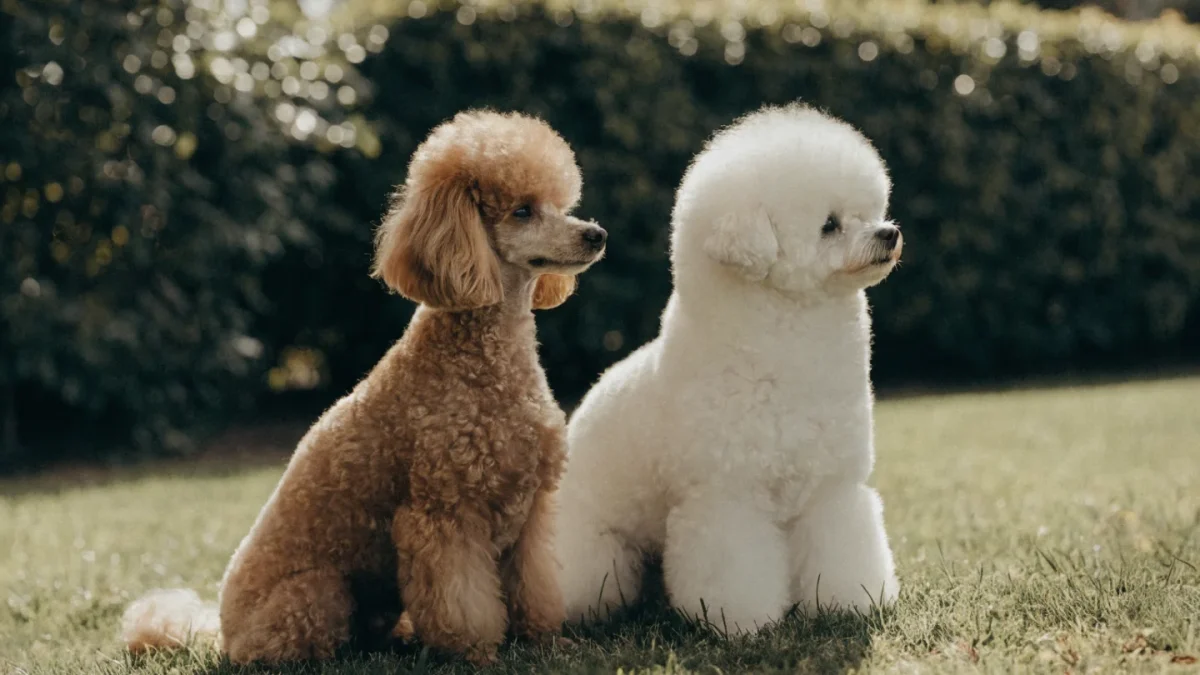
The Poodle's reputation as a pampered show dog obscures a genuinely impressive working history. The breed originated in Germany (not France, despite the persistent association) as a water retriever — the name derives from the German "pudel," meaning to splash. The elaborate grooming styles that look purely ornamental were originally functional: shaved areas reduced drag in water while pom-poms of fur protected joints and organs from cold. The Bichon Frise traveled a different route through history — from companion dogs on Mediterranean trade ships, to Renaissance Italian courts, to French royal chambers, to performing in street circuses after the French Revolution stripped them of their aristocratic homes.
Both breeds ended up on "good for allergy sufferers" lists, which brings most people to this comparison in the first place. But the similarities beyond coat type are fewer than people expect.
Size and Build
| Trait | Poodle (Miniature) | Bichon Frise |
|---|---|---|
| Height | 28-38 cm | 23-30 cm |
| Weight | 5-9 kg | 3-5 kg |
| Build | Square, athletic, elegant | Compact, sturdy, slightly rounded |
| Coat | Dense, curly, single layer | Double coat, soft undercoat, curly outer |
The comparison here uses the Miniature Poodle as the closest size match. Standard Poodles (45-60 cm, 20-32 kg) are in an entirely different size class. Toy Poodles (under 28 cm, 2-4 kg) overlap more with the Bichon's weight range but are more fragile.
Temperament
Poodles are intellectual athletes. They learn with remarkable speed, solve problems independently, and have a serious side that emerges in focused training or work. Poodles rank among the top breeds in every trainability metric. They're dignified — a well-bred Poodle carries itself with visible composure. They can be reserved with strangers initially, warming up on their own schedule.
Bichons are professional mood-lifters. Their default emotional setting is cheerful, and they maintain that disposition with unusual consistency. Bichons were bred specifically for companionship — not hunting, not herding, not guarding — and that single-minded purpose produced a dog whose primary skill is making people feel good. They're social with strangers, gentle with children, and adaptable to most social situations.
The practical difference: Poodles need mental challenges to stay happy. A bored Poodle becomes neurotic, creating repetitive behaviors or finding destructive outlets for unused intelligence. Bichons need social connection to stay happy. A lonely Bichon develops separation anxiety, house-training regression, and excessive barking. Different needs, different solutions.
Grooming
Both breeds require professional grooming every four to six weeks. This is non-negotiable and represents a significant ongoing expense. Both coats grow continuously and mat without regular maintenance.
Poodle coats are dense, curly, and single-layered. Between professional sessions, brushing every other day prevents matting. Line-brushing (brushing section by section down to the skin) is the effective technique — surface brushing misses mats forming close to the body. Many owners keep Poodles in shorter utility clips to reduce daily maintenance.
Bichon coats have a soft undercoat beneath the curly outer coat, which means more potential for deep matting. Daily or every-other-day brushing is ideal. The breed's signature powder-puff look requires careful scissoring — Bichon grooming is considered among the most technically demanding in the show ring.
Both breeds are low-shedding. Neither is truly hypoallergenic — allergens come from dander and saliva, not just hair. But both produce less environmental allergen spread than heavy-shedding breeds, which provides meaningful relief for many allergy sufferers. For another low-shedding comparison, see Maltese vs Bichon Frise.
Health Concerns
Poodles (Miniature) face patellar luxation, Legg-Calve-Perthes disease, progressive retinal atrophy, epilepsy, and Addison's disease (more common in Standards but documented in Miniatures). Hip dysplasia occurs at lower rates than in larger breeds but is not absent. Average lifespan: 12 to 15 years.
Bichons are predisposed to patellar luxation, bladder stones, allergies and skin conditions (they're among the itchiest breeds — allergic dermatitis is extremely common), cataracts, and liver shunt. Dental disease is a significant concern due to their small jaw size. Average lifespan: 12 to 15 years.
Both are generally healthy breeds with good longevity. The Bichon's allergy predisposition is ironic — a breed popular among human allergy sufferers is itself very prone to allergies.
Exercise Needs
Miniature Poodles need 45 to 60 minutes of daily exercise. They're genuine athletes capable of agility, obedience competition, dock diving (the water retriever heritage is real), and sustained hiking. Don't underestimate their physical capacity based on their appearance.
Bichons need 30 to 45 minutes. Moderate walks, indoor play, and short training sessions satisfy most individuals. They enjoy activity but don't demand the intensity that Poodles do. Bichons are more adaptable to lower-energy households.
Living Situation
Both breeds excel in apartments. Low shedding, manageable size, and moderate exercise needs make both compatible with urban living.
Poodles are quieter on average. They bark when alerting but don't vocalize compulsively. Bichons can develop barking habits, especially when left alone — the separation anxiety that many Bichons experience often manifests as persistent barking.
Both are good with children and other pets. Poodles are sturdier (in the Miniature size) and can tolerate slightly rougher play. Bichons are gentle but small enough that very young children should be supervised to prevent accidental injury.
Who's the Right Fit
Choose the Poodle if you want an intelligent, athletic, versatile dog and enjoy training as an activity. Poodles reward invested owners with a depth of capability that surprises people who underestimate the breed. You'll need to provide mental stimulation as a daily requirement, not an occasional bonus.
Choose the Bichon Frise if you prioritize a consistently cheerful, social companion and can be present enough to prevent separation distress. Bichons are the simpler dog to live with emotionally — fewer behavioral complexities, more straightforward needs. You'll need to budget for professional grooming and manage the breed's allergy predisposition.
For more side-by-side breakdowns, visit our breed comparisons guide. For a complete profile of the Bichon Frise — covering its Renaissance court history, circus career, and modern health profile — see the Bichon Frise complete breed guide. For a comprehensive look at the Poodle's German water-retriever origins, size varieties, and Addison's disease predisposition, the Poodle complete breed guide covers all three size variants in full.