

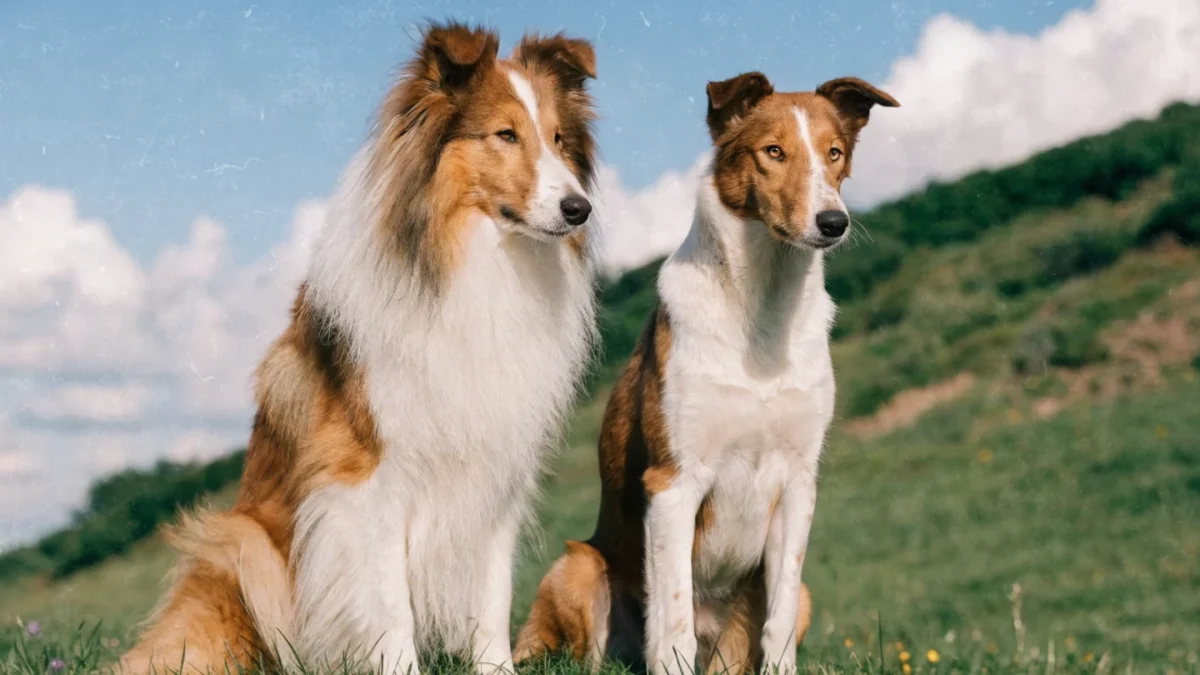
When Queen Victoria visited Balmoral in the 1860s and fell for the collies working the Scottish estates, the dogs she encountered came in both coat types. Rough-coated and smooth-coated collies worked the same hills, herded the same sheep, and shared the same breeding lines. The distinction between them was never about function — it was always about coat. That hasn't changed.
Today's rough and smooth collies are the same breed in every meaningful sense except the length and density of their outer coat. Most kennel clubs, including the American Kennel Club and the Kennel Club (UK), register them as varieties of one breed, judged by the same standard apart from coat specifications. They can interbreed, and mixed-coat litters are common in programs that use both varieties.
The Coat: Where the Real Difference Lives
Rough Collie
The rough collie's coat is the breed's signature — a dense double coat with a long, harsh-textured outer layer and soft, thick undercoat. The mane and frill around the neck and chest are abundant. Leg feathering and tail plume are full. The coat serves a functional purpose: insulation against Scottish Highland weather, protection from thorns and brush, and temperature regulation in both cold and moderate heat.
Grooming demands are significant. Thorough brushing two to three times per week prevents matting, with daily sessions needed during the spring and fall coat blows. The areas behind the ears, under the elbows, and along the rear feathering mat fastest. Bathing every four to six weeks keeps the coat clean without stripping natural oils. A neglected rough collie coat deteriorates rapidly — mats pull on the skin, trap moisture, and create conditions for hot spots.
Smooth Collie
The smooth collie has a short, dense, flat coat with a thick undercoat. There is no mane, no feathering, no tail plume. The smooth coat still sheds — that undercoat releases significant amounts of hair during seasonal blows — but grooming is dramatically simpler. Weekly brushing with a bristle brush or rubber curry keeps the coat in order. Mats are essentially not a concern.
The smooth variety shows the dog's body structure more clearly, which is why some fanciers describe smooths as looking "more athletic." The bone and muscle are the same; you just see them without the coat's visual padding.
Temperament: Minimal Difference
Rough and smooth collies share the same temperament profile. Both are sensitive, people-oriented, vocal, and gentle with families. Both read human emotion with the same accuracy. Both bark with the same enthusiasm.
Some smooth collie owners report that their dogs carry slightly higher energy and slightly more working drive than typical rough collies. Whether this represents a genuine variety-level difference or reflects the breeding lines selected for smooth programs is debatable. Smooth collie breeders have historically maintained closer ties to working-type lines, which may concentrate marginally higher drive in the variety. But the overlap is enormous — a high-energy rough collie and a calm smooth collie are both well within the breed's normal range.
The collie temperament profile applies equally to both varieties.
Health Profile: Identical Concerns
Both varieties share the same health predispositions:
- Collie Eye Anomaly (CEA): A congenital eye condition with variable severity, from clinically insignificant to vision-threatening. DNA testing identifies carriers. Prevalence is high across both varieties.
- MDR1 gene mutation: Produces drug sensitivity to certain medications including ivermectin. DNA testing is available and strongly recommended.
- Progressive retinal atrophy (PRA): Can cause progressive vision loss. Testable through DNA screening.
- Dermatomyositis: An inflammatory condition affecting skin and muscle, with a genetic basis. Occurs in both varieties.
- Bloat (GDV): A risk for both, given the breed's deep chest.
There is no evidence that either coat type confers health advantages or disadvantages. The coat gene (FGF5 locus) is independent of the genes governing the conditions listed above.
Exercise: Same Needs
Both varieties need 60 to 90 minutes of daily exercise. Activity type and intensity are identical. Neither variety has meaningfully greater or lesser stamina than the other.
Climate Considerations
The rough coat provides better insulation in extreme cold and may offer marginally better heat protection (the double coat insulates against heat as well as cold when maintained properly). The smooth coat dries faster after rain or swimming and collects less debris. In hot, humid climates, the smooth collie is marginally easier to manage because there's less coat to trap moisture and heat close to the skin.
Choosing Between Them
The decision comes down to two practical questions:
Do you enjoy grooming, or will it feel like a chore? If brushing a dog for 20 minutes several times a week sounds like pleasant bonding time, the rough collie's coat is manageable and the aesthetic is undeniably striking. If coat maintenance sounds like an obligation you'll resent, the smooth collie gives you the same dog with a fraction of the grooming commitment.
Does appearance matter to you? The rough collie is the iconic silhouette — the Lassie look. The smooth collie is less immediately recognizable and often mistaken for other breeds. If public recognition or the classic collie appearance factors into your decision, that's a valid preference.
Everything else — temperament, health, exercise, trainability — is the same dog. The collie breed guide covers both varieties comprehensively.