

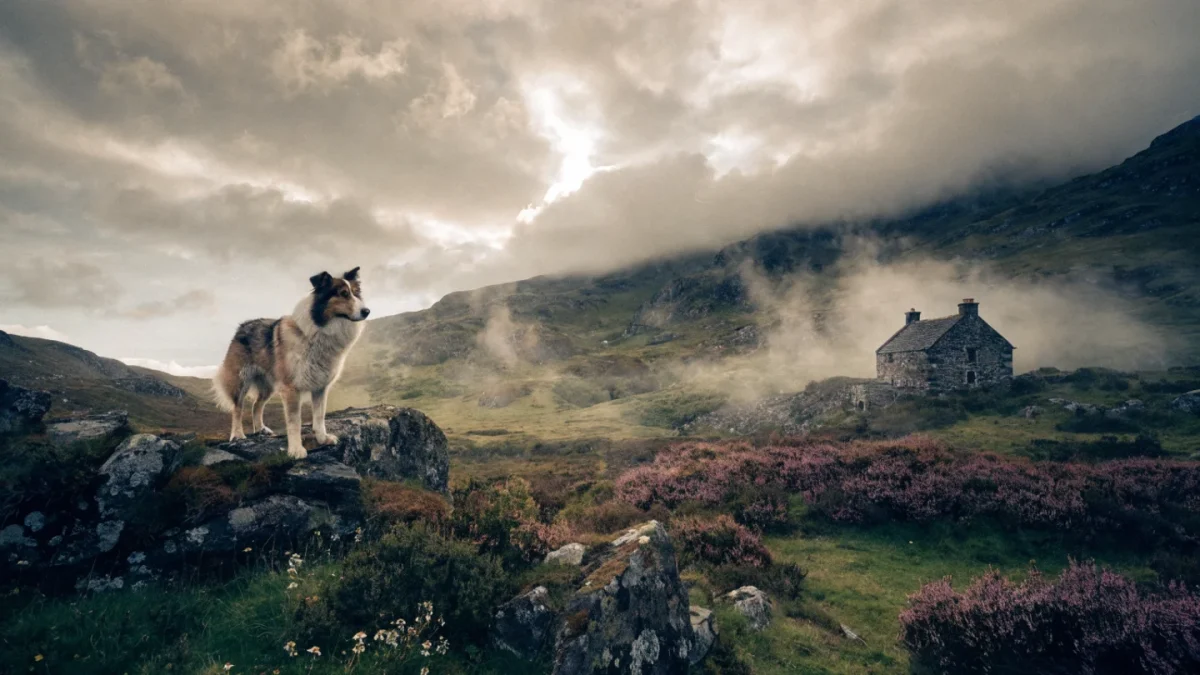
Before the collie had a name, it had a job. In the Scottish Highlands and the border country between Scotland and England, medium-sized herding dogs with pricked or semi-erect ears and a natural gathering instinct had been working sheep for centuries before anyone thought to classify them as a breed. The oldest surviving references to dogs matching the collie's general description date to the 1500s, but the working type almost certainly existed well before written records bothered to note them.
These were not pets. They were tools — as essential to Highland shepherds as the crook and the whistle. A good herding dog could manage a flock of several hundred sheep across miles of steep, open terrain, and without one, the job was nearly impossible. The dogs were bred for function with total indifference to appearance: whatever combination of traits produced a reliable gather, a controlled drive, and the stamina to work a full day on rough ground got passed to the next generation.
The collie history origins trace through three distinct eras, each of which transformed the breed in fundamental ways.
The Working Era: Before 1860
The pre-show collie was a variable animal. Size, coat type, color, and ear carriage differed by region and by the preferences of individual shepherds. What was consistent was the working style: a wide, sweeping gather that brought sheep toward the handler from distance, controlled by "eye" — that intense, fixed gaze that pressures livestock into moving without physical contact.
The name "collie" first appears in written records in the mid-eighteenth century. Its etymology is genuinely uncertain. The most widely cited origin connects it to "colley," a word for the black-faced sheep common in the Scottish Lowlands — the dog was the "colley dog," the dog that worked colleys. Alternative theories link the name to the Gaelic word "cuilean" (puppy) or to the Anglo-Saxon "col" (black), referencing the predominant coat color of early herding dogs in the region.
What matters more than the name's origin is what the name represented: a type, not a breed. The collie of 1800 was defined by what it did, not by how it looked. Two collies from different regions might have looked nothing alike while performing identical jobs.
Highland shepherds valued temperament traits that remain recognizable in modern collies: responsiveness to subtle handler cues, calm steadiness around livestock, and the ability to work independently at distance while remaining attentive to direction. The sensitivity that modern collie owners experience — the emotional attunement, the reading of moods — is a domestic expression of working traits that were indispensable on the hill.
The Victoria Transformation: 1860-1910
The complete collie breed guide covers Queen Victoria's role in transforming the breed, but the historical mechanics deserve fuller treatment.
Victoria first encountered Highland collies during her visits to Balmoral Castle in the 1850s and 1860s. She was taken with their appearance and temperament, and she began keeping them at Windsor, Buckingham Palace, and her various residences. In an era when royal tastes shaped public fashion, Victoria's patronage was transformative.
The first dedicated collie classes appeared at dog shows in 1860, coinciding almost exactly with Victoria's public enthusiasm. The timing was not coincidental. Dog showing itself was a new enterprise in the 1860s — the first modern dog show had occurred in Newcastle in 1859 — and breeders were actively looking for breeds that would draw public interest. A breed endorsed by the queen was commercial gold.
Between 1860 and 1886, the collie changed more rapidly than it had in the previous three centuries. Show breeders selected for traits that had nothing to do with herding ability: a longer, narrower head; a more profuse coat; increased height and elegance; a more refined expression. The 1886 formation of the Collie Club in Britain codified these aesthetic priorities into a written standard.
A dog named Old Cockie, born in 1867, is widely credited by breed historians with introducing the sable color that would become the breed's most iconic look. Before Old Cockie, most collies were black and white or tricolor. The warm gold-to-mahogany sable — the color most people picture when they think "collie" — traces to this single dog's influence on the breed's gene pool.
By 1900, the show collie had diverged significantly from its working ancestors. Shepherds who needed functional dogs continued breeding for performance, creating the line that would eventually become the border collie. The show collie became taller, heavier-coated, and less driven — a companion and exhibition animal rather than a livestock manager.
The Great Divergence: Collie and Border Collie
The split between the show collie and the working collie is one of the clearest examples in canine history of breeding priorities creating separate breeds from a common ancestor.
Working-bred dogs from the Scottish-English border region were selected exclusively for herding ability: drive, eye, stamina, responsiveness to commands. Appearance was irrelevant. A functional border collie might be large or small, smooth-coated or rough, black and white or any other color. The only criterion was performance.
Show-bred collies were selected for conformation: the long wedge head, the full coat, the elegant movement, the refined expression. Herding ability was not tested or prioritized. A winning show collie might or might not have any working instinct at all.
By the mid-twentieth century, the two populations were genetically distinct enough that most breed registries recognized them as separate breeds. The border collie received formal recognition by various registries between the 1970s and 1990s. The name "collie" — without prefix — was retained by the show type.
This history matters because it explains the modern collie's temperament. The breed retains herding instincts — circling, nipping, gathering — but in a softened form. The collie temperament article explores how these diluted drives manifest in daily life. The collie is a herding breed that no longer herds professionally, and understanding that evolutionary context helps owners interpret behaviors that might otherwise seem puzzling.
Lassie and the Popularity Surge: 1943-1980
The 1943 MGM film "Lassie Come Home," based on Eric Knight's 1940 novel, did for the collie what Victoria had done eighty years earlier — but at a global scale and at a speed that Victoria could never have achieved.
The film starred a male rough collie named Pal, trained by Rudd Weatherwax. Pal performed his own stunts, including the climactic river-crossing scene that had defeated the originally cast female dog. The film was a commercial success, spawning six sequels between 1945 and 1951, all starring Pal.
The television series "Lassie" premiered in 1954 and ran until 1973 — 591 episodes across nineteen seasons, making it one of the longest-running prime-time series in American television history. Various descendants and successors of Pal played the title role throughout the show's run.
The Lassie effect on collie popularity was immediate and massive. Registration numbers surged. Demand outstripped the supply of well-bred dogs, and commercial breeding operations expanded to fill the gap. The consequences were predictable: wider genetic bottlenecks, less rigorous health screening, and a wave of puppies sold to families whose expectations had been shaped by a fictional character.
By the 1980s, the breed's popularity had receded from its Lassie-era peak, but the cultural imprint remained. To this day, the collie is one of the most recognized dog breeds in the world, and the word "Lassie" is functionally synonymous with the breed in popular culture. Whether that association helps or hinders the breed is a matter of perspective. It attracts people to collies, but it attracts them for the wrong reasons more often than the right ones.
The Modern Collie
Today's collie occupies a specific niche in the dog world. It is a companion breed with herding heritage, prized for its temperament, its beauty, and its versatility in dog sports and therapy work. Show lines continue to emphasize the refined appearance established in the Victorian era. A small but dedicated community of working-type collie enthusiasts maintains lines that retain stronger herding instincts, sometimes under the label "Scotch collie" or "farm collie."
The breed faces ongoing health challenges — collie genetics including CEA and MDR1 are concerns that responsible breeders screen for, both of which trace back to the genetic bottlenecks created by the breed's rapid transformation from working type to show dog.
The collie's story is, in many ways, a cautionary tale about what happens when a working breed becomes famous. Royal patronage reshaped its body. Hollywood reshaped its public image. Neither the royals nor the filmmakers asked the dog's opinion. But underneath the show coat and the celebrity mythology, the essential collie — attentive, sensitive, devoted, alert to every shift in its human's world — remains recognizable. The Highland shepherds who bred the original collies would still see their dog in the modern breed. They'd just wonder why anyone would want that much fur on an animal that was supposed to work.