

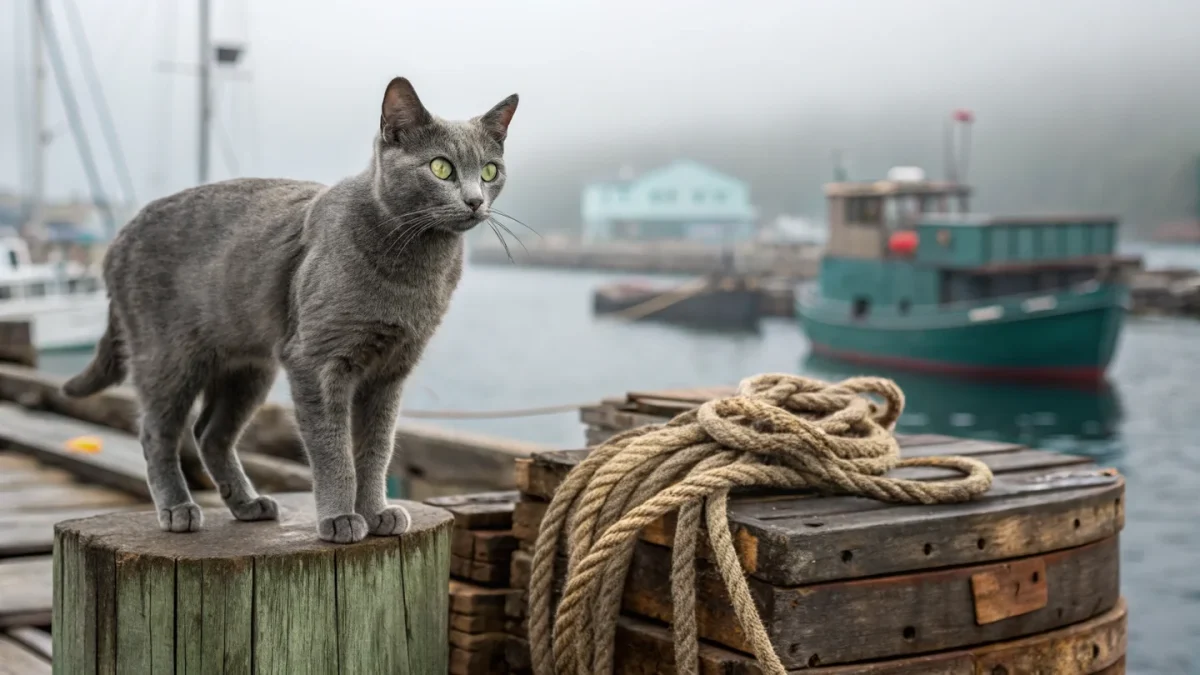
Arkhangelsk — the Russian port city on the White Sea, known to British merchants as Archangel — was a significant trading hub between Russia and Britain throughout the 18th and 19th centuries. Lumber, furs, and naval stores moved through its docks. At some point in that commercial traffic, so did cats.
The cats that arrived in Britain described as "Archangel cats" were blue-grey, dense-coated, and noticeably distinct from the British shorthairs and random-bred cats of the period. They appeared in British show records in the 1880s and collected both admirers and prizes. Within decades, this trade cat from a northern Russian port had become one of the recognizable pedigree breeds of the British cat fancy.
The Victorian Show Cat
The first documented showing of cats described as "Archangel cats" in Britain took place in 1875, at the Crystal Palace in London — one of the earliest organized cat shows anywhere, and the same venue that helped launch the British cat fancy as an organized hobby.
Early show records describe the cats as blue-grey with short, dense, plush coats and greenish or yellow eyes. The striking, dense coat quality and the distinctive grey-blue color made them immediately noticeable among the mixed assortment of cats being shown in those early years of the cat fancy.
The name shifted between "Archangel cat," "Russian cat," "Russian Blue," and "Foreign Blue" depending on the era and the registry. The Siamese influence — the "Foreign" category — affected how these cats were classified and shown, with different registries handling the classification differently. The current universal use of "Russian Blue" settled in across the 20th century.
The cats competed in the same class as other blue-grey cats in the earliest shows, competing against British Blues (the precursors of the modern British Shorthair) and others. Breeders argued for a separate class and eventually achieved it, which allowed the Russian Blue's distinctive characteristics — particularly the coat texture and the color depth — to be judged on their own terms rather than against a fundamentally different physical type.
Who Brought Them?
The mechanism by which cats traveled from the Archangel region to Britain has been the subject of considerable speculation and no definitive documentation.
The most commonly repeated story — sailors bringing cats aboard ships — is plausible but unverified. Ships trading between Archangel and British ports regularly carried cats as working mousers. A beautiful, unusual cat could easily have been acquired by a sailor as a curiosity and brought home.
An alternative theory holds that the cats were deliberately imported by cat fancy enthusiasts who recognized the distinctive type. This would explain the consistency of the cats' characteristics in early show records — a deliberate selection rather than random acquisition. But this also lacks documentary support.
What is verifiable: cats of this type arrived in Britain from the direction of Russia, established themselves in the show halls, and attracted enough interest to become a recognized pedigree breed. The precise story of how is, honestly, unknown.
World War II and Near-Extinction
The breed's history was nearly ended by the second world war. By 1945, essentially no pure Russian Blues remained in Britain or Europe. The disruptions of wartime — the death of breeders, the impossibility of maintaining breeding programs under occupation and food rationing, the general collapse of the cat fancy as a peacetime activity — eliminated the breeding population.
British breeders working to reconstruct the breed in the postwar years used what they had available. Siamese crosses were used to maintain a blue body and green eyes while rebuilding the population. Scandinavian breeders contributed independently, and their lines were merged with British reconstruction efforts.
The Siamese influence created an ongoing tension in the breed. Some breeders preferred the elongated, more oriental type that resulted from Siamese crosses; others worked to re-establish the more moderate, cobby body type of the pre-war standard. This tension persisted for decades and produced some divergence in type between different national standards — a divergence that is more resolved today than it was in the 1950s and 1960s, though individual breeders' preferences still vary.
The Modern Standard
The modern Russian Blue standard — across most international registries — describes a medium-sized, lithe cat with a slightly elongated body, large upright ears, a wedge-shaped head, and the characteristic double coat with silver tipping that creates the breed's luminescent quality. Adult eyes are vivid green.
The coat quality — the plushness, the silver tipping, the specific feel of the double coat — is what breeders have consistently prized and worked to maintain across the breed's history in Britain and internationally. It is, arguably, the feature that distinguished the Archangel cat from every other blue-grey cat on the show bench in 1880, and the feature that continues to define the breed today.
The Russian Blue breed guide covers the living breed in full — the temperament, the grooming, the health considerations. The history gives context: this is a breed that survived a very long journey, literal and figurative, from a northern Russian trading port to its current position as one of the most recognized and beloved breeds in the world.