

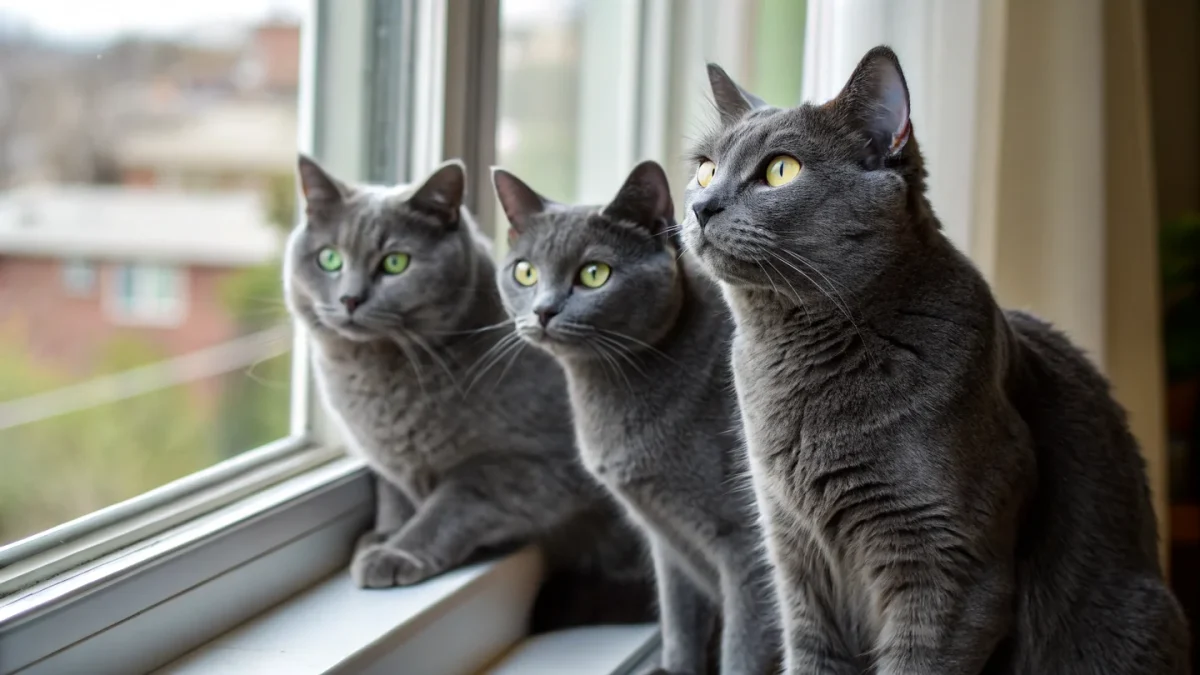
"Blue cat" in the cat fancy means a specific thing: a blue-grey coat produced by dilute pigmentation. Three breeds wear this color as their defining characteristic — the Russian Blue, the Chartreux, and the Korat — and all three are frequently confused with each other by people encountering them for the first time. Each is a genuinely distinct breed with different physical structure, different coat texture, different origin, and a meaningfully different personality.
At a Glance
| Feature | Russian Blue | Chartreux | Korat |
|---|---|---|---|
| Origin | Russia (Archangel region) | France | Thailand |
| Body type | Lithe, medium | Robust, muscular | Medium, semi-cobby |
| Eye color | Vivid green (adults) | Gold to amber | Peridot green |
| Coat texture | Dense plush double coat | Dense, water-resistant wool | Short, single coat, fine |
| Size | Medium | Medium-large | Small-medium |
| Temperament | Reserved, loyal | Calm, devoted | Energetic, loyal |
The Russian Blue
The Russian Blue is a lithe, medium-sized cat with a wedge-shaped head, large upright ears, and the characteristic plush double coat with silver tipping that creates a shimmer effect. Adult eyes are vivid green — deep, brilliant, and one of the breed's most recognizable features.
Temperamentally, the Russian Blue is the most reserved of the three. It forms deep bonds with its inner circle and is distinctly aloof with strangers. The Russian Blue temperament is one of quiet, deliberate loyalty rather than open sociability.
The coat is relatively low-maintenance with weekly brushing under normal circumstances. Seasonal shedding is the most demanding grooming period.
The Chartreux
The Chartreux is the big one. Developed in France over centuries (the documented history extends to at least the 18th century, with legendary claims to medieval origin), the Chartreux is substantially more robust than the Russian Blue — a broad-chested, muscular cat that can look almost stocky. Adult males can reach 6 or 7 kilograms. The head is round and broad, quite different from the Russian Blue's wedge. Eye color is gold to amber (never green). The coat is a true blue-grey with a distinctive woolly texture — dense, water-resistant, and clearly different in feel from the Russian Blue's silk-plush.
Temperamentally, the Chartreux is calm, observant, and devoted to its family without being clingy. It is somewhat more outgoing with strangers than the Russian Blue, and tends to be quieter — the Chartreux is known for its near-silence and for communicating primarily through chirping rather than conventional meowing. It is an adaptable, stable cat that handles household changes well.
The Chartreux coat requires similar grooming attention to the Russian Blue: weekly brushing with more intensive attention during seasonal shedding. The woolly, double-layered texture behaves differently under a brush than the Russian Blue's silk-plush coat — owners and groomers who've worked with both generally find the Chartreux needs more consistent attention to keep tangles from forming, especially through a seasonal coat blow.
The Korat
The Korat is a Thai cat with a documented history going back to the 14th century in the Siamese text Tamra Maew (Cat Book Poems), where it appears as one of the "good luck cats" of the region. It is the smallest of the three blue breeds and the most overtly affectionate.
The coat is single-layered — no undercoat — and fine, with silver tipping that creates a halo effect. The body is semi-cobby: substantial for its size, with a distinctive heart-shaped face and large peridot-green eyes that are proportionally enormous and give the breed an arresting expression.
Temperamentally, the Korat is one of the more people-dependent breeds in the "blue cat" category — energetic, playful, and bonded intensely to its people. It is more emotionally expressive than either the Russian Blue or Chartreux, and tends toward separation anxiety if regularly left alone. It is not suited to households where it will spend long periods without company.
The Korat coat is the easiest of the three to maintain — a single coat that requires no specialist grooming, just occasional brushing for loose hair.
Telling Them Apart
Up close, these three breeds are clearly distinct once you know what you're looking for. From a distance or in photographs:
- The Chartreux is the largest and most solidly built, with amber/gold eyes (never green)
- The Korat is the smallest, with the most dramatically oversized green eyes and heart-shaped face
- The Russian Blue is intermediate in build, with vivid green eyes and the characteristic silver-tipped plush coat shimmer
The silver tipping effect on the Russian Blue is typically more pronounced and more luminescent than the similar tipping on the Korat. The Chartreux's woolly coat has a distinctly different texture visible even in good photographs.
Which Is Right for You?
If you want the most reserved, independent companion with the most distinctive coat texture: Russian Blue.
If you want a calm, stable, extremely adaptable cat that handles household changes well and tends toward quiet devotion: Chartreux.
If you want the most energetic, openly affectionate of the three, with the highest social need: Korat.
All three are beautiful animals. The choice comes down to personality fit more than aesthetic preference — the appearances are different enough to distinguish, but similar enough that all three breeds share the "blue cat" visual identity.