

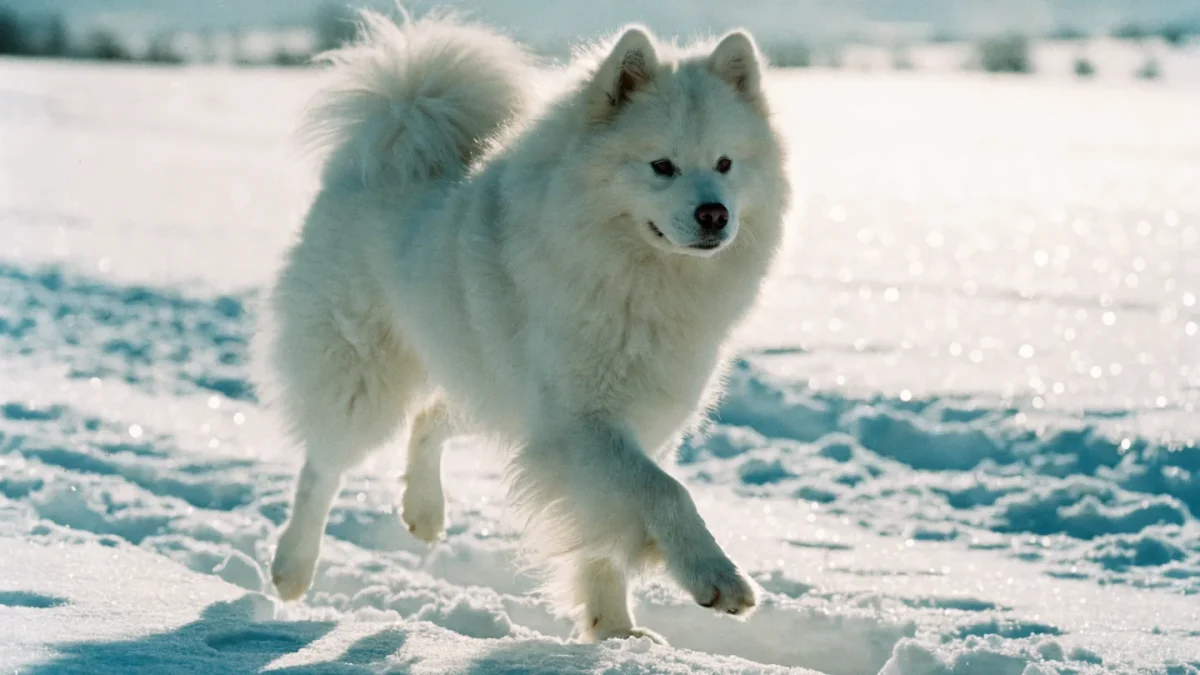
In the late 1970s, researchers at Texas A&M University identified a familial kidney disease in a colony of Samoyeds that would become one of the most studied hereditary conditions in veterinary genetics. The disease — now called Samoyed hereditary glomerulopathy — proved to be X-linked, caused by a mutation that produces defective collagen in the kidney's filtration system, and lethal in affected males. Its discovery reshaped how the breed community approached genetic screening and opened a window into a broader truth about Samoyed genetics: the breed's beauty comes from a narrow genetic base, and that narrowness carries consequences.
Understanding samoyed genetics white coat glomerulopathy means understanding three interrelated stories: why the coat is white, why the kidneys fail, and why a handful of dogs imported from Siberia over a century ago still determine the health of puppies born today.
The White Coat: Genetics of Color
The Samoyed's characteristic white to cream coat is not produced by a single gene. It results from the interaction of multiple loci, primarily:
The S locus (white spotting). The extreme white spotting allele (S^w) produces dogs that are predominantly or entirely white by preventing melanocyte migration to most of the coat during embryonic development. This allele is fixed or nearly fixed in Samoyeds — virtually all breed members carry it in homozygous form, based on the breed's uniformly white to cream phenotype.
The E locus (extension). The E locus controls whether eumelanin (black/brown pigment) can be deposited in the coat. Many Samoyeds carry the e/e genotype at this locus, which restricts coat pigment to phaeomelanin (yellow/red range), producing the cream or biscuit shading seen in some individuals. Combined with extreme white spotting, this creates the range from pure white to biscuit-tipped that the breed standard permits.
The A locus (agouti). The agouti series affects pigment distribution patterns but has limited visible effect in dogs that are already e/e at the extension locus and heavily white-spotted. Its contribution to the Samoyed's appearance is masked by the dominant effects of the other loci.
The practical result: the "white" Samoyed is genetically a cream or biscuit dog wearing extreme white spotting. The biscuit coloring visible on ears and dorsal areas in some individuals is the underlying pigment showing through where the white spotting pattern is incomplete. Both pure white and white-with-biscuit are normal expressions of the breed's genetics.
Notably, the Samoyed's black nose, eye rims, and lip pigment are produced by eumelanin in areas where the white spotting gene does not prevent pigment deposition. This creates the striking contrast between the white coat and the dark facial features that defines the breed's visual signature.
Hereditary Glomerulopathy: The Breed's Defining Genetic Disease
Samoyed hereditary glomerulopathy (SHG) is caused by a mutation in the COL4A5 gene on the X chromosome. This gene encodes the alpha-5 chain of type IV collagen, a structural protein in the glomerular basement membrane — the filtration barrier in the kidney that separates blood from urine.
In affected dogs, the defective collagen produces a structurally compromised basement membrane that progressively deteriorates under normal filtration pressure. The kidney's filtration function degrades over time, leading to proteinuria (protein in the urine), progressive renal failure, and eventually death.
X-Linked Inheritance Pattern
Because the gene sits on the X chromosome, the inheritance follows a sex-linked pattern:
-
Affected males (X^a Y): Receive one copy of the mutant gene from their carrier mother. Because males have only one X chromosome, there is no normal copy to compensate. Affected males typically show proteinuria by two to three months of age and progress to renal failure, usually dying between three and fifteen months of age, as documented in the Texas A&M University research colony studies.
-
Carrier females (X^A X^a): Carry one normal and one mutant copy. They often show milder proteinuria and may develop some degree of kidney involvement, but their prognosis is significantly better than affected males. However, they pass the mutation to approximately half their sons (who will be affected) and half their daughters (who will be carriers).
-
Clear females (X^A X^A): Carry no copies of the mutation and cannot produce affected offspring regardless of the sire's status.
Testing and Breeding Implications
DNA testing for the COL4A5 mutation is available and identifies affected males, carrier females, and clear animals. Every Samoyed intended for breeding should be tested. The math is straightforward: breeding a carrier female to any male produces, on average, 25% affected males, 25% carrier females, 25% clear males, and 25% clear females. These are the odds per puppy, not guarantees per litter, but over time the percentages hold.
Eliminating the condition from a breeding program requires testing all breeding stock and not breeding carrier females — or, at minimum, testing all offspring from carrier females and removing affected animals and new carriers from the breeding pool.
The Founder Effect: Narrow Genetic Base
The breed's history explains how the Western Samoyed population traces to a small number of dogs imported from Siberia and surviving polar expeditions in the late 1800s and early 1900s. That narrow founding population created what geneticists call a founder effect: the allele frequencies in the modern breed are disproportionately shaped by the specific genes those handful of foundation dogs carried.
The consequences are measurable. Samoyed genetic diversity, assessed through heterozygosity measures and effective population size estimates, is lower than in many breeds with larger or more diverse founding populations — a finding consistent with population genetics studies of breeds derived from narrow founder populations. This reduced diversity concentrates deleterious recessive alleles — including the glomerulopathy mutation — at higher frequencies than they would exist in a genetically broader population.
Other hereditary conditions in the breed that trace, at least in part, to this genetic bottleneck include:
- Progressive retinal atrophy (PRA): Degenerative eye disease leading to blindness. DNA tests exist for specific variants.
- Hip dysplasia: Moderate prevalence, screened through standard evaluation programs.
- Pulmonic stenosis: A congenital narrowing of the pulmonary valve. Screened through cardiac evaluation.
- Diabetes mellitus: Samoyeds are reported to have higher diabetes prevalence than many breeds in multiple veterinary epidemiological studies.
What This Means for Owners
The Samoyed's genetics aren't just academic. They translate into specific responsibilities:
- Know your dog's glomerulopathy status. If you acquire a Samoyed from any source, DNA testing for the COL4A5 mutation provides definitive information. For males, this determines whether the dog is affected. For females, it determines carrier status.
- Require testing from breeders. No Samoyed should be bred without documented glomerulopathy, PRA, and hip evaluation results on both parents. The complete breed guide covers the full health screening panel.
- Understand the coat genetics. Biscuit coloring is genetically normal and does not indicate crossbreeding. Pure white and white-with-biscuit are equally valid expressions of the breed's coat genetics.
- Support genetic diversity efforts. Breeding programs that prioritize genetic diversity alongside health screening are working to counteract the founder effect that concentrates hereditary conditions.
The Samoyed's genetics reflect the breed's journey — from a functionally diverse population of working dogs in Siberia to a narrower Western breed shaped by a handful of foundation animals. Understanding that journey explains both the beauty and the vulnerability of the breed as it exists today.