

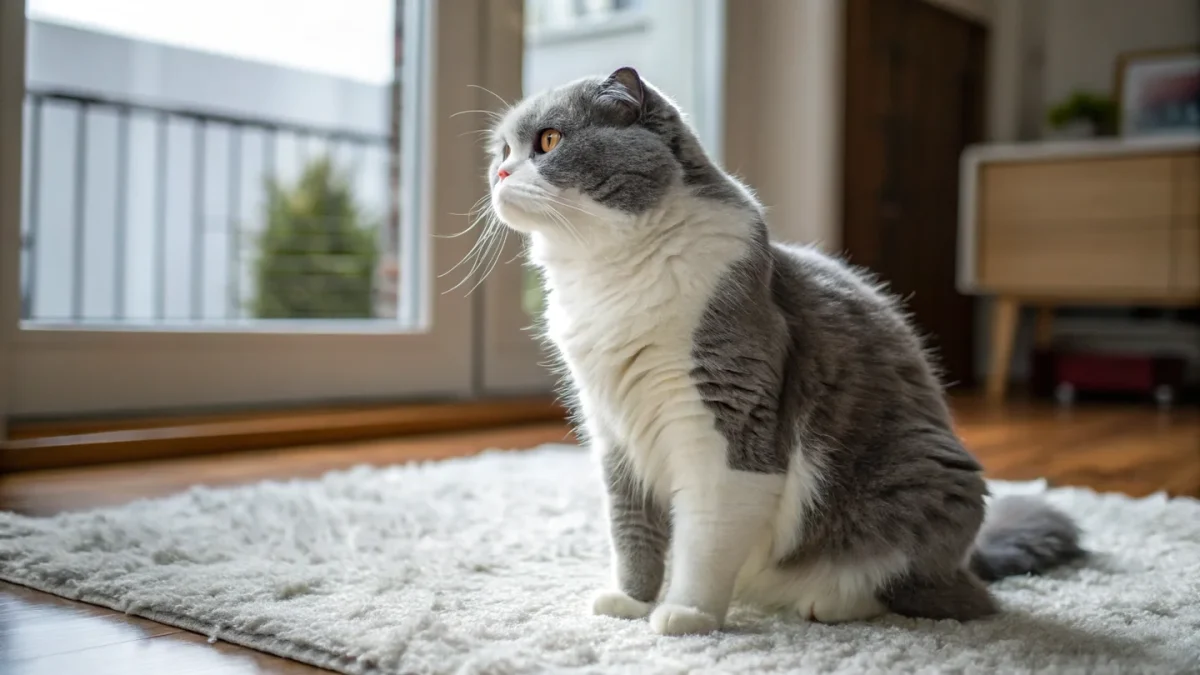
The Scottish Fold's appearance is famous enough that most people arriving at the breed already know the basics: folded ears, round face, wide eyes. What tends to surprise them during ownership is a different set of things — practical, behavioral, and occasionally unsettling. These are the five I hear most from owners in their first year.
1. Kittens Are Born with Straight Ears
Every Scottish Fold kitten arrives in the world with standard upright ears. The fold, if it will develop, begins to appear around 3–4 weeks of age when the cartilage starts to reflect the gene's effect.
This means you cannot tell at birth which kittens will be Folds and which will be Straights. Responsible breeders don't sell kittens before 12 weeks at the earliest, partly for this reason — by then, the fold (or absence of fold) is clear and stable.
The surprise is not so much the timing as the implication: a kitten that has folded ears at 8 weeks has been expressing the genetic mutation for only a month or so. Everything you see in the adult fold — the characteristic posture, the health implications — has been building from that first fold.
2. There Is a Longhaired Version
The Highland Fold, or longhaired Scottish Fold, comes from the same genetic background. The longhair trait entered the breeding population at some point (believed to be from longhaired cats included in early program crosses) and produces a substantially different visual effect: the folded ears with a full semi-long coat, a significant ruff, and the dramatic plume tail that characterizes longhaired cats.
For many people, the Highland Fold is actually their first encounter with the breed — the combination of the folded ear appearance and the longhaired coat is visually arresting. The grooming commitment is higher (2–3 brushing sessions weekly versus once weekly for shorthaired Folds), but the underlying temperament is identical.
3. The "Buddha Sit" Is Charming and Also Worth Watching
Understanding Scottish Fold temperament includes the distinctive sitting posture where the cat sits upright with hind legs extended forward, paws resting flat on the floor, looking like a small round person at rest. Owners find it endearing; it's one of the breed's characteristic visual signatures.
What most people aren't told before getting a Fold: this posture can be a comfort position for a cat with OCD-related hip or stifle discomfort. It removes the pressure of tucked legs on affected joints. This doesn't mean every cat performing the Buddha sit is in pain — many Folds do this simply because it's comfortable, and it's been observed in individuals with no detectable OCD signs.
But a young cat that sits this way very frequently and doesn't move freely between this and normal cat postures should be evaluated. What looks purely charming can sometimes be the body's accommodation to discomfort.
4. The Silence Can Be Misleading
Scottish Folds are naturally quiet cats. They're not vocal in the Siamese sense — they communicate, but the baseline is low-key. Most owners experience this as a pleasant contrast to high-demand breeds.
What this quiet temperament can mask is discomfort. Cats in pain don't typically vocalize the way humans do. They become quieter, less active, more withdrawn — behaviors that in an already calm breed can read as "just being a Fold" rather than signs of a developing health issue.
A Fold that was previously playful and engaged and becomes gradually less interested in activity isn't necessarily just getting older or naturally calmer. Progressive changes in activity level, mobility, and engagement, even slow ones, are worth tracking and discussing with a vet. The complete Scottish Fold guide covers the OCD context; the practical application is that attentive owners notice drift from baseline.
5. The Breed Comes in Virtually Every Color and Pattern
People who know Scottish Folds primarily from social media may have a narrow visual image of the breed — blue-gray cats with round faces and folded ears are disproportionately represented. The actual range of colors and patterns in the Scottish Fold is as broad as in any domestic cat population.
Folds come in solid colors (black, white, blue, cream, red, chocolate, lilac), tabby patterns (classic, mackerel, spotted), bicolor, calico, pointed (colourpoint Folds), and ticked — any combination that exists in domestic cats. The round face and folded ears are consistent; the color and pattern are wide open.
This matters practically for anyone whose heart is set on a specific color or pattern: you're not limited to the blue-gray cats most often photographed. And for anyone who encounters an unfamiliar-looking round-faced cat with folded ears and doesn't immediately recognize the breed — it's almost certainly a Scottish Fold in a less commonly photographed coat.