

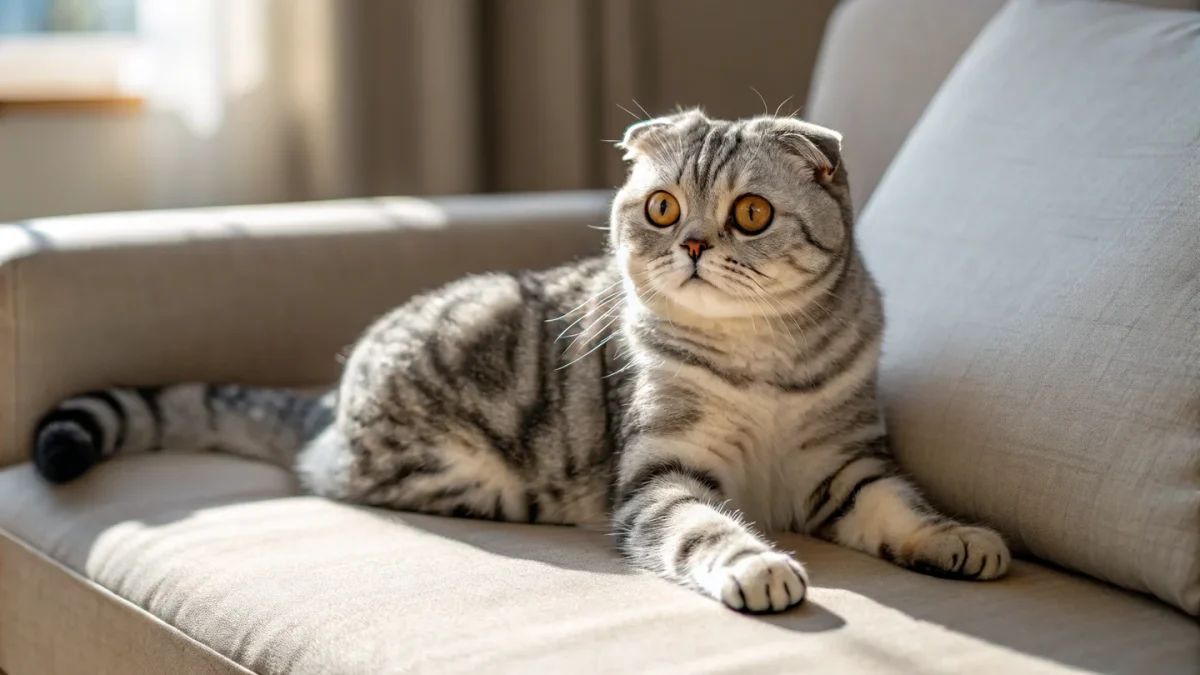
The Scottish Fold decision is different from most breed decisions, because it requires engaging with a genuine ethical question before getting to lifestyle compatibility.
Most breed guides work through the question of fit — activity level, grooming needs, social requirements, household suitability. The Scottish Fold guide needs to add a layer: the fold gene causes osteochondrodysplasia (OCD), a progressive skeletal condition that affects all folded cats to some degree. This is established veterinary science, not fringe concern, and it is inseparable from the characteristic that defines the breed. You cannot have the folded ears without the OCD susceptibility — they are produced by the same gene.
Read the full Scottish Fold breed guide before proceeding. This page assumes you have that context.
The First Question: Is It Legal Where You Live?
Before considering personality or lifestyle fit, verify whether breeding or owning a Scottish Fold is legal in your location. Several countries and some regional jurisdictions have restricted or banned Scottish Fold breeding on welfare grounds, and the regulatory landscape continues to evolve.
The Second Question: Can You Find a Responsible Breeder?
If ownership is legal and you've decided to proceed, the source matters substantially for welfare outcomes.
What responsible Scottish Fold breeding looks like:
- Never breeds Fold-to-Fold (both parents folded) — this creates a high probability of homozygous (Fd/Fd) offspring with severe OCD
- Breeds Folds only to Scottish Straights (unfolded cats from the same breed population)
- Conducts radiographic monitoring of breeding animals for OCD expression
- Health-tests for polycystic kidney disease (PKD1 mutation)
- Can provide health documentation for both parents
The absence of any of these is a meaningful red flag. Irresponsible breeding programs selling Fold kittens cheaply without health documentation produce cats with significantly more severe health outcomes.
The Third Question: Are You Prepared for Ongoing Health Monitoring?
Scottish Fold personality includes a tendency toward stoicism that means pain can be non-obvious. Living responsibly with a Scottish Fold involves:
- Regular veterinary checkups with specific attention to joint mobility, tail flexibility, and gait
- Monitoring for behavioral changes that may indicate developing discomfort (reduced jumping, stiff tail, reluctance to be touched along the back)
- Appropriate response to OCD expression — weight management, pain management as needed, environmental modifications to reduce high-impact activity on affected joints
- Understanding that OCD progression varies — some Folds age with mild, manageable effects; others develop more significant disease
This is not a theoretical checklist. It is an ongoing commitment that this specific breed requires because of its genetic makeup.
The Lifestyle Compatibility Side
Setting aside the health complexity — or more accurately, incorporating it as context — what kind of household does a Scottish Fold actually suit?
Activity level: Moderate. The Fold is not a high-energy cat and doesn't require the sustained intensive engagement that Abyssinians or Bengals do. Two interactive play sessions daily of 15–20 minutes are adequate for most Folds. This makes the breed genuinely manageable for people who don't want a high-maintenance companion.
Household composition: Scottish Folds adapt well to varied households. They're generally compatible with other cats, can adjust to dogs with proper introduction, and suit families with children who interact with cats calmly. The breed's lack of high reactivity makes it one of the more flexible for multi-animal households.
Presence requirements: More moderate than breeds like Siamese. A Fold will appreciate company but is less likely to express isolation stress dramatically. That said, no cat thrives completely alone all day — a companion animal or regular company is still preferable to sustained solitude.
Apartment living: Entirely suitable. The Fold's activity level and space requirements are modest.
The Alternative to Consider
If the appeal of the Scottish Fold is primarily the round, calm personality rather than specifically the folded ears, consider the Scottish Straight — the straight-eared counterpart from the same breed population. Scottish Straights have the same gentle, adaptable personality, the same round build, and the same coat variety. They don't carry the OCD risk from the fold gene. Some find them a preferable option precisely for this reason.
If the folded ears specifically are the draw, that's a personal aesthetic choice worth making consciously with full knowledge of what accompanies it.
For the Right Person
The Scottish Fold suits someone who has done this research, accepts the health context with clear eyes, sources their cat responsibly, and commits to the monitoring that responsible Fold ownership requires. For that person, the breed delivers a calm, affectionate, visually remarkable companion with a personality that fits comfortably into most households.
It is not a suitable choice for someone who wants to minimize or ignore the health context. The ethical weight of the decision belongs to the owner, not to the cat. For anyone who wants to fully understand the mechanism before committing, reading about the genetics behind the fold and the OCD connection is worth the time — it makes the health discussion more concrete than abstract.