

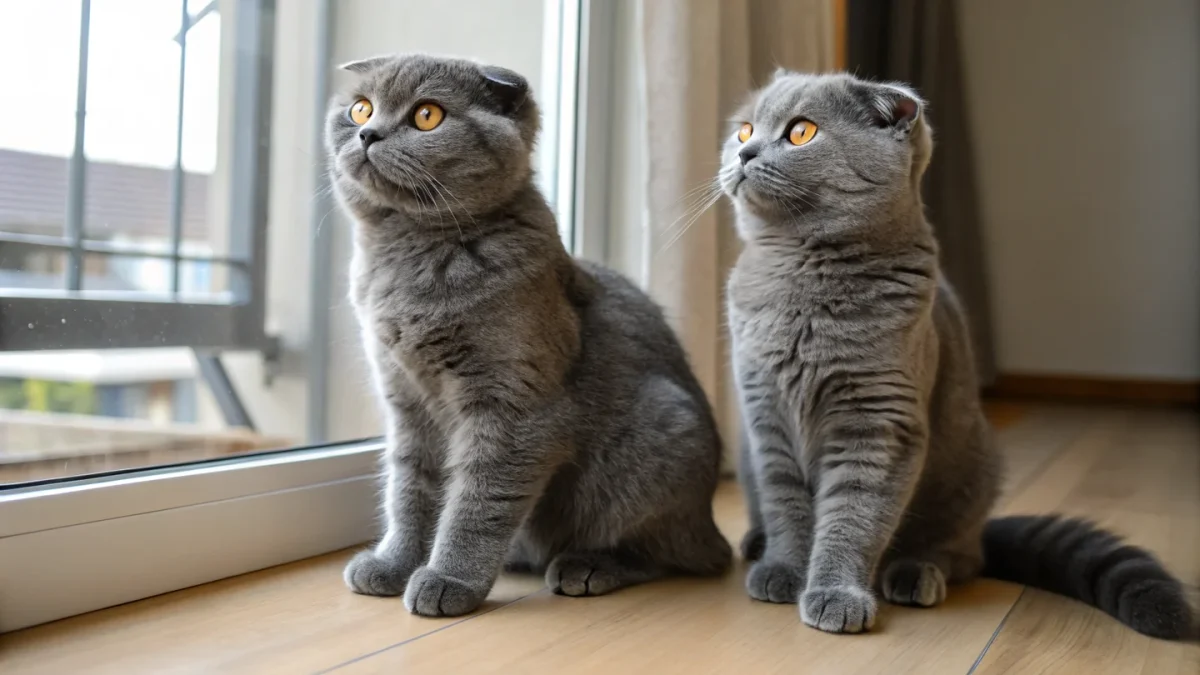
In any litter from a Scottish Fold breeding program, roughly half the kittens will be born with ears that remain upright. These straight-eared kittens are called Scottish Straights, and for most of the breed's history they were the overlooked half of the litter — not the "point" of the breeding, placed as pets without the premium pricing or registry recognition that Folds commanded.
That has changed substantially in recent years, as understanding of the fold gene's health implications has grown and as some countries have moved toward restricting Fold breeding. The Scottish Straight now has both its own registry recognition and a growing community of people who choose it specifically as the ethically less complicated option for the same underlying breed personality.
The Genetic Foundation
The Scottish Fold and its genetics explains the fold mechanism. The brief version: the fold is caused by a dominant mutation in the TRPV4 gene (designated Fd). Cats with one copy of Fd (Fd/fd) have folded ears and are heterozygous for the mutation. Cats with no copies (fd/fd) have straight ears.
All Scottish Straights from Fold breeding lines are fd/fd — they carry no copies of the fold mutation. Some may carry one copy of Fd but express straight ears anyway; breeders increasingly DNA test Straights to determine which category they're in, as Fd-carrier Straights can produce folded offspring in future pairings.
Physical Differences
The ears are the only difference in appearance. A Scottish Straight from a well-bred Scottish Fold program has the same round head, full cheeks, large round eyes, and stocky body that characterize the Fold. The breed standard body type is identical.
Without the ears, telling the two apart requires knowing which is which. The round face, the substantial build, the same range of coat lengths and colors — all identical.
The ears themselves make a visual difference that some people find substantial and others find minor:
Scottish Fold ears: Folded forward and down, pressed against the skull, giving the characteristic flat-topped owl appearance. The fold degree varies — from a subtle fold to a tight triple fold where the ear lies almost completely flat.
Scottish Straight ears: Standard upright cat ears, positioned normally on the round skull. The same large round head without the flat-cap look.
Both look like cats. Whether the folded ear is the specific aesthetic appeal you're seeking, or whether the round-faced personality is the point, affects which feels more appealing.
Personality: Identical
There is no systematic personality difference between Scottish Folds and Scottish Straights from the same breeding lines. Both share the same calm, adaptable, moderately social temperament. Both tend toward proximity over insistence, both integrate into varied households without drama, and both have the same moderate activity level.
This is the same breed, with the same ancestry, the same behavioral genetics, and the same socialization history. The ears have nothing to do with personality.
Health: The Critical Difference
The fold gene and OCD covers this fully. The summary:
Scottish Fold (Fd/fd): Carries one copy of the fold mutation. Has folded ears. Is affected by osteochondrodysplasia to varying degrees — mild in some cats, significant in others. The OCD is a direct consequence of the Fd gene and cannot be separated from the fold.
Scottish Straight (fd/fd): Carries no copies of the fold mutation. Has normal ear position. Is not affected by OCD from the fold gene. Subject to the same general health conditions that affect the breed (PKD risk, HCM screening advisable) but without the OCD susceptibility.
This is the meaningful difference between the two. The Straight is not a lesser version of the Fold — it's the same cat without the gene causing the primary health concern.
Which to Choose?
The honest framing: if you want the round, calm Scottish breed personality, the Scottish Straight delivers it without the ethical and health complexity of the fold gene. You get the same temperament, the same build, and the same grooming needs — and a cat that won't require OCD monitoring.
If the folded ears specifically are the draw — the owl-like appearance, the aesthetic of the flat-capped head — then you're making a considered choice to accept the health implications of the fold gene in exchange for the specific appearance.
| Feature | Scottish Fold | Scottish Straight |
|---|---|---|
| Ear position | Folded forward | Upright |
| TRPV4 gene | Carries Fd | No Fd |
| OCD risk | Yes (varying severity) | No (from Fd gene) |
| Body type | Round, stocky | Identical |
| Personality | Calm, adaptable | Identical |
| Coat options | Short or long | Identical |
| Health monitoring | OCD required | General health monitoring |
Some people who come to the comparison expecting to choose a Fold end up choosing a Straight after understanding the genetics. Others decide the folded appearance is specifically what they want and proceed accordingly. Neither is an irrational position — they're just different trade-offs weighted differently by different people.