

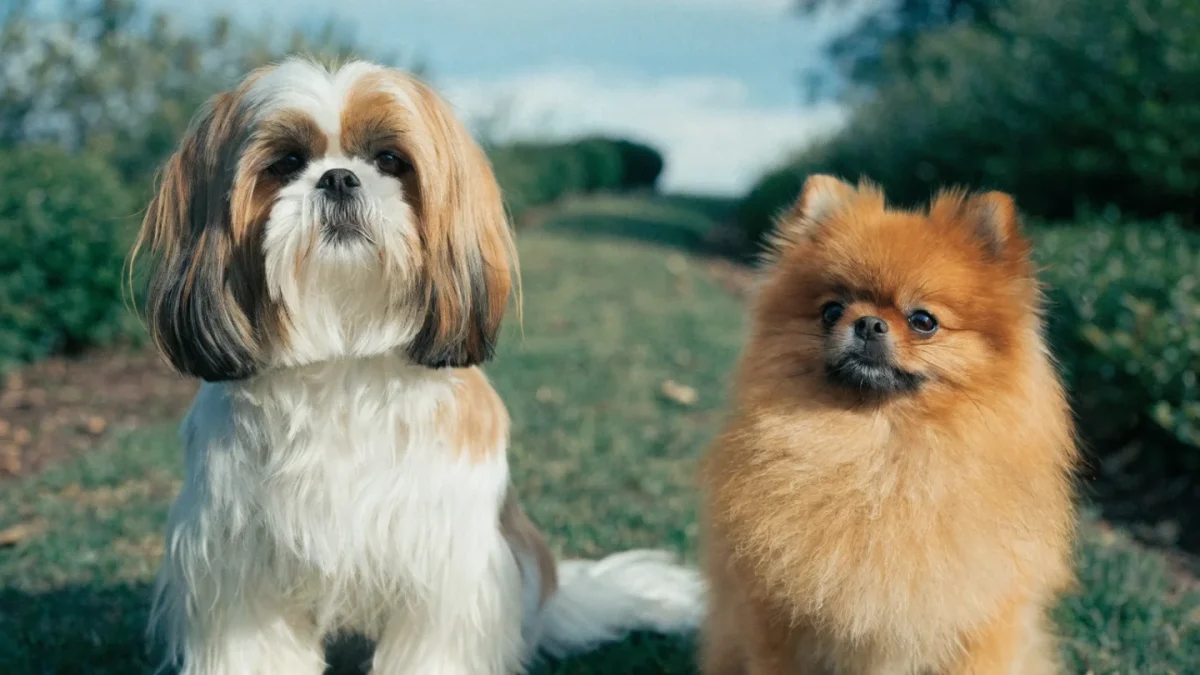
The Shih Tzu's name translates to "lion dog" — a reference to the breed's resemblance to the lions depicted in traditional Chinese art, not any actual lionlike behavior. These dogs lived in Chinese imperial palaces for centuries, bred exclusively as companions for royalty. The Pomeranian's ancestors pulled sleds across the Arctic — the breed descends from large German Spitz dogs and was bred down from roughly 14 kg to under 3.5 kg during Queen Victoria's era. The miniaturization happened within a few decades in the late 1800s, a process that compressed a working sled dog's personality into a body the size of a loaf of bread.
A palace lapdog and a miniaturized sled dog. The origins explain the personality gap between two breeds that share shelf space in the "small companion" category.
Size and Build
| Trait | Shih Tzu | Pomeranian |
|---|---|---|
| Height | 20-28 cm | 18-24 cm |
| Weight | 4-7.3 kg | 1.8-3.5 kg |
| Build | Compact, solid, slightly longer than tall | Compact, fox-faced, plumed tail |
| Muzzle | Short (brachycephalic) | Moderate length, pointed |
| Coat | Long, dense, double coat | Thick double coat, profuse ruff |
The Shih Tzu is the sturdier dog. At 5 to 7 kg, it has more substance and tolerates handling better than the Pomeranian, which is fragile at under 3.5 kg. The Shih Tzu's brachycephalic face creates breathing limitations that the Pomeranian's pointed muzzle avoids entirely.
Temperament
Shih Tzus are relaxed by nature. They were bred to sit on laps and be pleasant company, and they fulfill that job description with quiet consistency. They're affectionate without being demanding, playful in short bursts, and content to spend long periods resting nearby. Shih Tzus carry a gentle independence — they enjoy your presence but don't disintegrate when you leave the room.
Pomeranians run on a different operating system. They're alert, curious, opinionated, and confident far beyond what their size warrants. A Pomeranian believes it is the most important entity in any room, and it communicates that belief loudly. The barking is the breed's most significant behavioral feature — Pomeranians alert-bark at sounds, movements, visitors, and sometimes apparently nothing at all. Training can moderate it. Silence it completely, you will not.
Both breeds bond closely to their owners. Pomeranians are more likely to follow you around the house. Shih Tzus are more likely to wait for you to come to them. It's the difference between a dog that orbits you and a dog that gravitates toward you when convenient.
With children, both require supervision. The Shih Tzu's sturdier build makes it slightly more tolerant of accidental rough handling, but neither breed belongs in a household with very young children who can't understand gentle interaction. For how the Pomeranian compares to another tiny breed, see Pomeranian vs Chihuahua.
Grooming
Both breeds require consistent coat work. Skipping grooming sessions creates mats, skin issues, and an uncomfortable dog.
The Shih Tzu's long double coat needs daily brushing if kept at full length. Most pet owners choose a shorter clip, which reduces brushing to every other day but still requires professional grooming every four to six weeks. The face needs daily cleaning — the flat face and prominent eyes accumulate discharge and debris.
The Pomeranian's thick double coat needs brushing three to four times weekly. The undercoat is dense and mats where friction occurs — behind the ears, under the collar, and in the armpit area. During twice-yearly shedding, daily brushing becomes necessary. The Pomeranian sheds more visibly than the Shih Tzu, and the volume of fur from a 3 kg dog remains genuinely surprising.
Neither breed should be shaved. The Pomeranian's double coat doesn't always regrow correctly after shaving, sometimes resulting in permanent texture changes. The Shih Tzu's coat can be clipped short but shouldn't be razor-shaved to the skin.
Health Concerns
Shih Tzus face brachycephalic obstructive airway syndrome (degree varies by individual but is structurally inherent), intervertebral disc disease, eye problems (proptosis, corneal ulcers — those large, prominent eyes are vulnerable), renal dysplasia, and dental crowding from the compressed jaw. Heat tolerance is poor due to the shortened airway. Average lifespan: 10 to 16 years, with most in the 12 to 14 range.
Pomeranians deal with tracheal collapse, patellar luxation, alopecia X (black skin disease, a poorly understood coat-loss condition), hypothyroidism, and heart disease. Hypoglycemia is a risk in very small or very young Pomeranians. Their longer muzzle means breathing is not a structural issue. Average lifespan: 12 to 16 years.
The Pomeranian has an advantage in respiratory health. If you live in a warm climate, that difference becomes clinically significant — the Shih Tzu's heat sensitivity restricts outdoor activity during summer months in ways the Pomeranian doesn't face.
Exercise Needs
Shih Tzus need 20 to 30 minutes of daily exercise. Short walks and indoor play are sufficient. They're not built for distance or speed, and the brachycephalic anatomy limits exertion, especially in warm weather.
Pomeranians need 30 to 40 minutes. They're more energetic than their size suggests — alert, active, and interested in their environment. Short walks combined with indoor play and trick training satisfy them well.
Living Situation
Both breeds are natural apartment dogs. Both handle small spaces without difficulty and travel easily.
The key apartment consideration is noise. Pomeranians bark significantly more than Shih Tzus. In a shared-wall environment, this is the deciding factor for many people. Shih Tzus are among the quieter small breeds — they vocalize when necessary but don't provide running commentary on neighborhood activity.
Who's the Right Fit
Choose the Shih Tzu if you want a calm, quiet, easygoing small companion and can commit to daily face cleaning and coat maintenance. The Shih Tzu is the more relaxed daily experience — fewer demands, less noise, more content to simply coexist.
Choose the Pomeranian if you enjoy a bold, spirited personality in a tiny package and can tolerate persistent alertness and vocalization. The Pomeranian is the more entertaining dog — but that entertainment includes a soundtrack.
For more breed matchups, see our breed comparisons guide. For a complete profile of the Pomeranian — covering Queen Victoria's role in the breed's dramatic miniaturization and the full health picture of this Arctic-descended toy dog — see the Pomeranian complete breed guide. For an encyclopedic look at the Shih Tzu's imperial Chinese history, brachycephalic health management, and eye care requirements, the Shih Tzu complete breed guide covers the breed in full.