

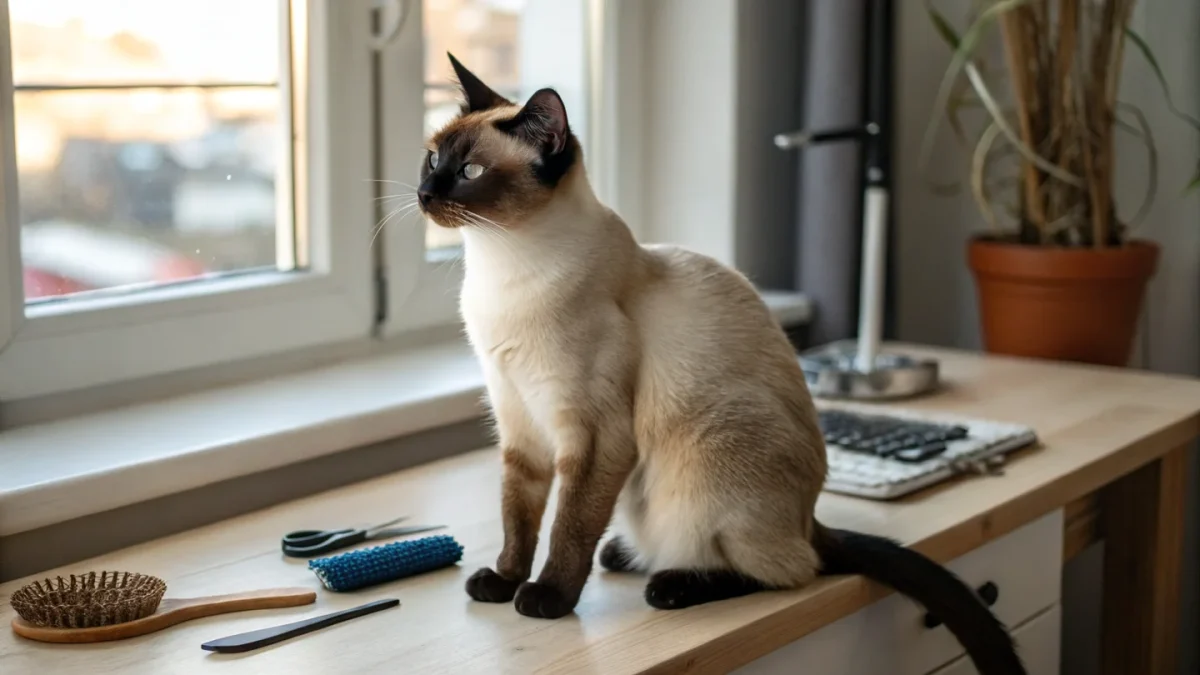
The Siamese might look high-maintenance — all those elegant angles, that distinctive coat pattern, those piercing blue eyes. In practice, the coat is one of the easiest to manage in the domestic cat world. The Siamese has a single-layer coat, no substantial undercoat, and very fine hair that lies flat. This is a breed where grooming sessions take minutes, not hours.
What the Siamese actually needs more attention for — dental health and nail care — is less glamorous than coat maintenance, but more consequential for long-term wellbeing.
Coat Brushing: Once a Week Is Enough
Because the Siamese coat lacks a dense undercoat, shedding is minimal compared to double-coated breeds. A quick once-over with a soft rubber brush or grooming glove weekly will remove loose hair and distribute skin oils. Some owners do this more frequently simply because their cat enjoys the attention — Siamese often find brushing a social activity rather than a chore.
A damp chamois cloth can be used instead of a brush to give the coat a shine and pick up any loose hair. This is the approach many show Siamese owners use, and it works well for household cats too.
Bathing is rarely necessary. The Siamese coat stays reasonably clean through self-grooming. If a bath is needed — after getting into something, or for a cat with skin issues — their fine coat dries quickly and most Siamese accept bathing with less protest than you might expect, particularly if introduced to water carefully as kittens.
Dental Care: The Priority Most Owners Overlook
The jaw structure of the Siamese's lean build creates a relatively narrow muzzle, which can lead to tooth crowding. Crowded teeth accumulate tartar and plaque more quickly, increasing the risk of periodontal disease.
Regular dental maintenance matters here more than in broader-jawed breeds. The options:
Tooth brushing — the gold standard. Use a toothbrush and paste formulated for cats (human toothpaste is not suitable). Many cats accept brushing if introduced gradually, starting with just the brush against the lip, then the outer teeth, building to a full routine over several weeks.
Dental treats and additives — water additives, dental treats, and certain food textures can support oral health without brushing, though none replicate the mechanical cleaning of a brush.
Professional cleaning — annual dental checks by a vet allow early identification of issues. Professional cleaning under anesthesia may be needed if tartar has built up significantly.
Starting dental habits early — ideally as kittens — dramatically improves how well cats accept the routine as adults.
Nail Trimming
Indoor Siamese should have their nails trimmed every 2–3 weeks. Long nails snag fabric, can grow uncomfortably curved, and occasionally grow into the pad if left too long.
Small cat nail clippers work well. Clip just the transparent tip, before the pink quick. If you can see the quick, stay 2mm clear of it. Most cats are easiest to trim when relaxed or drowsy. A second person to hold the cat helps significantly if the cat is resistant.
Scratching posts and boards serve an important complementary function — they wear and condition the outer nail sheath — but they do not replace trimming for indoor cats that don't use surfaces that naturally wear their nails.
Ear Care
Check the ears weekly. A Siamese ear should be pale pink inside, with no dark debris, no discharge, and no odor. A small amount of light wax is normal.
If there is dark debris (possible ear mites), unusual discharge, or strong odor, a vet check is needed. Do not probe deeply into the ear canal — cleaning the visible outer portion with a soft cloth or cotton pad dampened with an appropriate ear cleaning solution is sufficient for routine maintenance.
Eye Care
The Siamese's vivid blue eyes are one of its most striking features. Some Siamese accumulate small amounts of discharge at the inner corner — this is common and normal, particularly in older individuals. Gently wipe away with a damp cloth.
Persistent discharge, redness, or cloudiness should be evaluated by a vet. Siamese are prone to certain hereditary eye conditions including progressive retinal atrophy, which typically first becomes apparent through behavioral changes in low light rather than visible eye changes.
The Grooming Relationship
Because Siamese are social cats, grooming sessions serve a dual purpose. The physical care matters, obviously — but the time also functions as a bonding routine. Siamese that are touched regularly, handled at their paws, and accustomed to having their mouths, ears, and eyes examined become dramatically easier to handle at the vet and during any health issue that requires physical management.
Building these habits early and keeping them positive — short sessions, calm handling, ending when the cat signals discomfort rather than pushing through resistance — pays dividends across the entire life of the cat. If grooming is the easy part and you're still deciding on the breed overall, see whether a Siamese is right for your household for the full lifestyle-match assessment.