

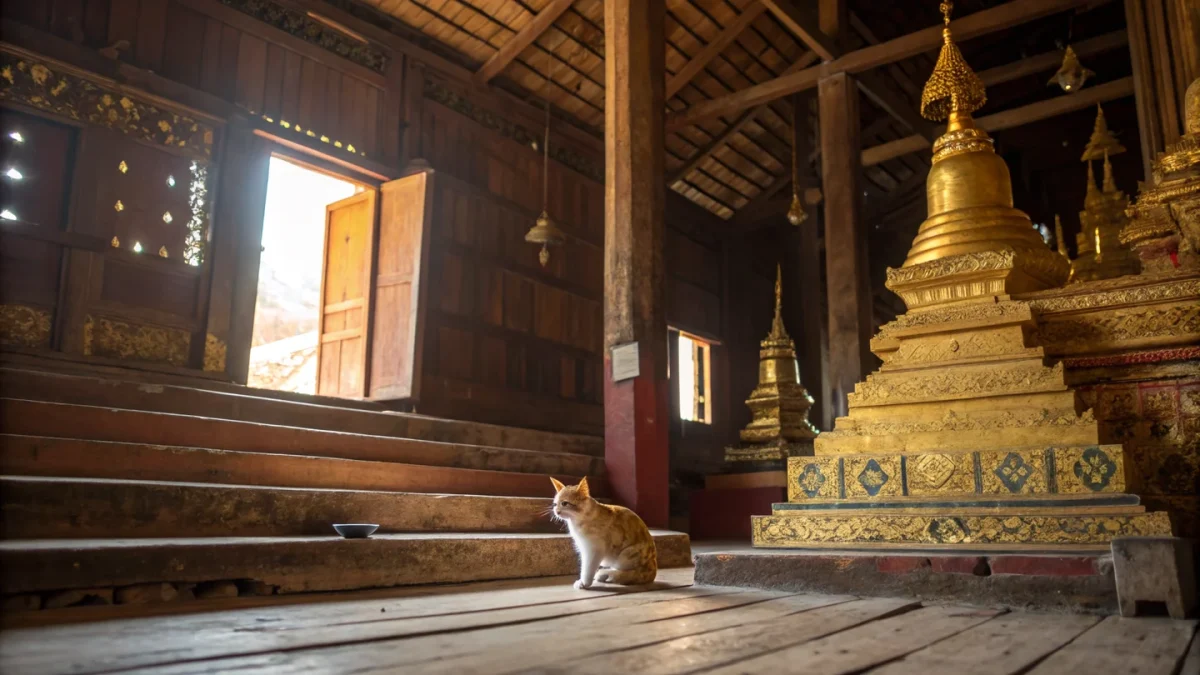
There is a manuscript in the National Library of Thailand that contains some of the most intriguing animal illustrations in the world. The Tamra Maew — "Cat Book Poems" or "Treatise on Cats" — is a collection of verse and illustration popularly traced to Ayutthaya, the ancient Thai capital, with tradition placing its origins as far back as the 14th century. The manuscripts themselves tell a less romantic story: not a single surviving copy predates the early 1800s — every one was produced after the Bangkok restoration of 1782, whatever older tradition they drew on. The illustrations show cats in a range of colors and patterns, some associated with good fortune and some with ill. Among the lucky cats: a pale-bodied, dark-pointed animal that is unmistakably a Siamese.
This is the beginning of the documented Siamese history in the sense that matters: not myth, not legend, but illustrated records showing that cats of this type were known, described, and culturally significant in the Kingdom of Siam for centuries before the first European ever saw one.
Royal Courts and Temple Legends
The Siamese cat occupied a specific position in Thai cultural and royal life that elevated it above ordinary domestic status. Oral tradition, colonial-era accounts, and later scholarship all describe Siamese cats as associated with Thai royalty — kept at court, given as gifts of considerable significance, and treated with a reverence that extended to the belief that the souls of the deceased could reside in them temporarily before advancing to the next existence.
The specific claim that Siamese guarded Buddhist temples is widely repeated but less clearly documented than the royal court connection. What seems more certain is that certain cat types — including pointed cats — were associated with auspicious qualities in Thai culture in ways that distinguished them from ordinary street cats.
Whether any of this represents organized breeding or simply the observation and appreciation of naturally occurring cats with the pointed mutation is unknowable from current evidence. The pointed coat is a recessive trait — both parents must carry the gene for pointed kittens to appear — which means populations of pointed cats could establish through drift and selection in relatively isolated communities. The royal courts of Siam, where favored animals were kept and bred within protected environments, were exactly the kind of setting where such a population could stabilize — though no surviving record documents a deliberate breeding program at the Thai court. What we have is inference from favorable conditions, not direct evidence of intent.
The Western Arrival: 1884 and the Crystal Palace
The documented Western introduction of the Siamese is dated to 1884, when Owen Gould — the British consul-general at Bangkok — brought two Siamese cats to England as a gift for his sister, Lilian Gould. The cats, a male and female, were exhibited at the Crystal Palace cat show in London in 1885.
The reaction was significant and polarized. Victorian cat fancy had developed standards for British shorthairs and Persians, with some attention to Angoras and other European types. A cat with pale cream body, deep brown extremities, and vivid blue eyes was genuinely unlike anything the show circuit had encountered. Some judges and spectators were fascinated; others were apparently repelled. Contemporary newspaper coverage described the cats variously as beautiful and bizarre.
Additional Siamese appeared in England in subsequent years. Breeding pairs were established, and the first breed standard was created. The Siamese became fashionable — possessed of the exotic prestige that Victorian England attached to things originating in the mysterious East — and a small breeding population began establishing itself.
Early American History
The Siamese arrived in the United States in the late 19th century. The first documented American Siamese arrived in early 1879 — a cat named Siam, sent to First Lady Lucy Hayes by David B. Sickels, the American consul in Bangkok, with a letter dated November 1, 1878, that's preserved today at the Rutherford B. Hayes Presidential Center. That's years before the Crystal Palace show, and yet this American introduction didn't spark a breeding program the way the British one did — Siam fell ill within months of arriving and died at the White House, and the line went no further.
American Siamese breeding developed more substantially in the early 20th century, initially drawing from British stock. By the 1930s, the Siamese had established a significant following in the United States. Post-World War II breeding programs expanded rapidly, and the Siamese became one of the most popular pedigree cats in both the American and British markets through the 1950s and 1960s.
This was also the period when the breed began its most dramatic physical transformation.
The 20th Century Transformation
The transformation of Siamese type in the 20th century is covered in detail in the breed history article. The brief version for historical context:
The cats that arrived in England in the 1880s were moderately built — not dramatically different from a typical domestic shorthair in body type, distinguished primarily by the pointed coat and blue eyes. Over the first half of the 20th century, selective breeding pushed gradually toward a more refined type. In the second half, particularly from the 1950s through the 1980s, that refinement accelerated substantially.
Show Siamese developed increasingly extreme features: the elongated wedge head, the tubular body, the outsized triangular ears. These features were rewarded in shows, which incentivized breeders to push further in each generation. By the 1970s and 1980s, the show Siamese was a dramatically different animal from the 19th-century imports.
A parallel population of breeders maintained the older type, eventually giving rise to the formal recognition of the "Traditional" or "Thai" Siamese as a distinct designation. This type more closely resembles the cats documented in the Tamra Maew and brought to England in 1884 than the modern show type does.
Hollywood and Cultural Presence
The Siamese's cultural reach in the Western world through the 20th century extended well beyond breed fanciers. The 1955 Disney film "Lady and the Tramp" featured two villainous Siamese cats — Si and Am — with a memorable song that embedded the "mean Siamese" stereotype in popular culture for decades. The portrayal was caricature, but the breed's visibility increased regardless.
The Siamese appeared in films, television, and fiction repeatedly through the mid-20th century, typically cast for the combination of striking appearance and distinctive personality. Elizabeth Taylor's Siamese, John Lennon's Siamese, and various other celebrity owner associations contributed to the breed's cultural cachet.
The Modern Breed
The modern Siamese breed in 2026 exists in two main types — the extreme wedge-head show type and the rounder traditional/Thai type — both legitimate descendants of the cats documented in 14th-18th century Thai manuscripts. The genetics are the same; the conformation differs dramatically.
What hasn't changed across six or more centuries of documented history is the personality. The vocal, socially attached, intensely relational cat described by observers in the 1880s is the same cat described by owners today. The appearance has been substantially altered by selective breeding. The character — loud, loyal, and perpetually opinionated — persisted through all of it.