

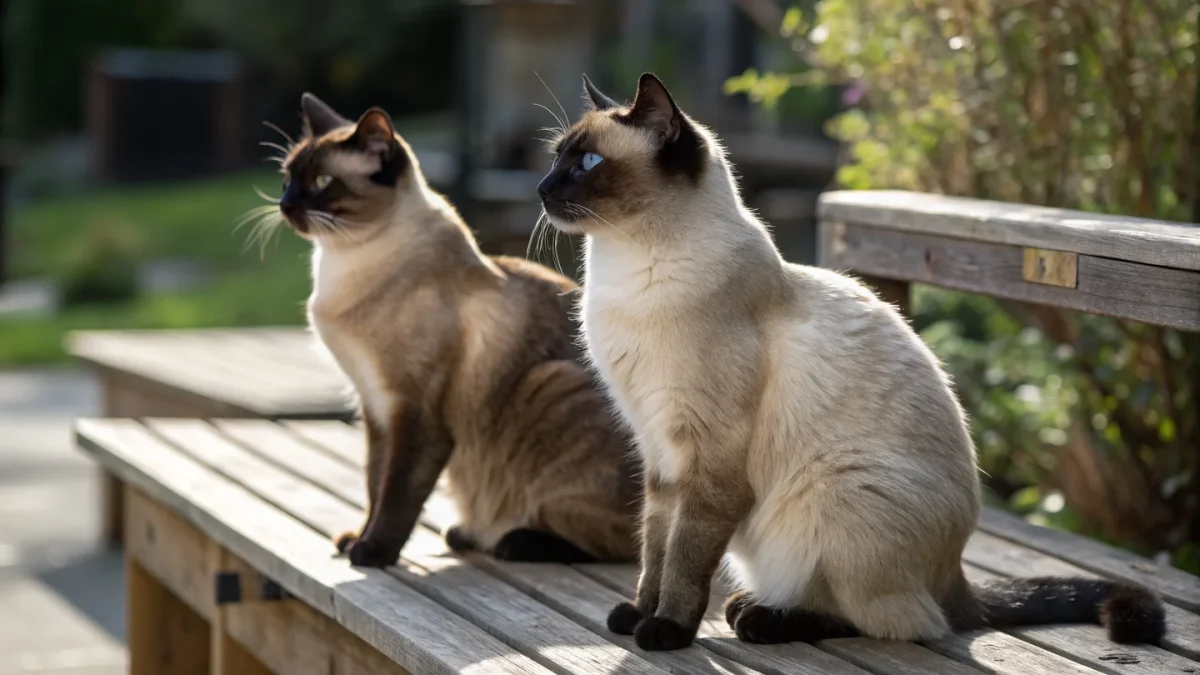
The Siamese that won the Crystal Palace show in 1885 would be unrecognizable on a modern show bench. Not in color, not in temperament — but in shape. The Victorian Siamese was a moderately built cat with a rounded head, proportional ears, and a body type not dramatically different from a typical domestic cat. The animal that wins Siamese classes today is something quite different: a long, angular creature with a head like a geometric exercise, huge triangular ears, and an extreme elegance that reads as architectural.
Same breed. Same pointed coloring. Same demanding personality. Completely different silhouette.
Understanding how that happened — and what it means for people choosing between the two types — requires looking at how cat breeding culture evolved through the 20th century.
The Original Imports: What They Actually Looked Like
The first Siamese cats in Europe arrived in the 1880s. Contemporary descriptions and early photographs show cats with stocky to moderately proportioned bodies, apple-shaped or slightly rounded heads, normal ear size relative to the skull, and sometimes slightly crossed eyes — a trait that was common in early Siamese and resulted from a neurological compensation for their particular retinal structure.
These cats were unusual enough to create a sensation: the pointed coloring was genuinely novel in Western experience, and the blue eyes were striking. But the body type was relatively moderate. They were not dramatically different in build from a typical shorthaired domestic cat, just marked very differently.
When and How the Shift Happened
Through the early 20th century, Siamese breeding in England and America remained relatively conservative. The cats stayed reasonably moderate in build.
The shift toward extreme type accelerated substantially in the post-World War II period, reaching its most dramatic expression in the 1960s and 1970s. Breeders competing on the show circuit increasingly selected for the traits that judges were rewarding: longer head, more pronounced wedge shape, larger ears set further out, more elongated body, finer bones. Each generation pushed slightly further toward the extreme, with incremental steps that were individually subtle but cumulative over decades.
By the 1980s, the show Siamese had transformed substantially from what any 19th-century observer would have recognized. The wedge head, the oversized triangular ears, the tubular body — these were the products of around a century of deliberate selection pressure.
The Traditional Siamese Response
Not everyone was pleased with the transformation. A segment of breeders and enthusiasts preferred the older, more moderate type — what they called the "traditional" or "apple-head" Siamese. Some specifically used the term "Thai cat" to distinguish them from the modern show type.
These breeders maintained lines that preserved the rounder head, more moderate body, and proportional ear size of earlier Siamese. In some registries, these cats are registered simply as Siamese; in others, they're classified as a separate breed variant or under the name "Thai."
The traditional Siamese has had a revival in recent decades, partly driven by health concerns about extreme conformation in the show type, and partly by people who simply prefer the older look.
What Changed: Side-by-Side
Head: Traditional Siamese have a rounded to moderately wedge-shaped head. Modern Siamese have a pronounced, elongated wedge that in extreme examples runs in an unbroken line from ear tips to nose tip.
Ears: Traditional ears are medium-sized, set relatively normally on the skull. Modern ears are large, triangular, and set at the outer edges of the wedge, continuing the skull line rather than sitting atop it.
Eyes: Both types have vivid blue eyes. Traditional Siamese eyes tend to be more rounded; modern eyes are distinctly almond-shaped and set at a more extreme slant.
Body: Traditional Siamese are moderately built — athletic but not extreme. Modern Siamese are very long, tubular, and fine-boned.
Overall impression: Traditional Siamese look like elegant, distinctive cats. Modern Siamese look like a design object that happens to be alive.
What Most People Get Wrong
The most common misconception is that traditional Siamese are somehow "less pure" or "mixed" compared to modern show Siamese. This is historically backwards. The traditional type is closer to the original import type. The modern show type is the product of deliberate selection away from what the breed originally was.
The second misconception is that the two types have different temperaments. They don't, in any systematic way. Both types carry the same fundamental Siamese personality — vocal, social, intelligent, demanding. Individual variation in personality exists within each type, but neither the traditional nor the modern type is notably calmer or louder, more or less affectionate, than the other.
Health Considerations
The extreme conformation of modern show Siamese introduces some structural concerns that traditional Siamese don't share. The very elongated skull of extreme wedge Siamese creates a flatter facial profile that can slightly compress the upper airway, though this is substantially less severe than in genuinely brachycephalic breeds like Persians.
The fine, angular build of modern Siamese also means less body mass reserve — a concern during illness when rapid weight loss is a health signal. Traditional Siamese, being more moderately built, have slightly more margin in this regard.
Neither type escapes the Siamese breed's particular predispositions — amyloidosis, progressive retinal atrophy, dental crowding — because these are genetic characteristics shared across the breed.
Which Is "Better"?
Neither. This is a question of preference and context.
If you are interested in the complete Siamese breed history and find the modern silhouette beautiful — that extreme, angular elegance — the show Siamese delivers it with the full Siamese personality intact. If you prefer the rounder, more classically "cat-shaped" appearance, the traditional type gives you the same personality in a package that looks closer to the 19th-century original.
Siamese temperament is not determined by head shape. Choose based on what you find appealing, and know that in either case you're getting one of the most personality-rich companions in the domestic cat world.