

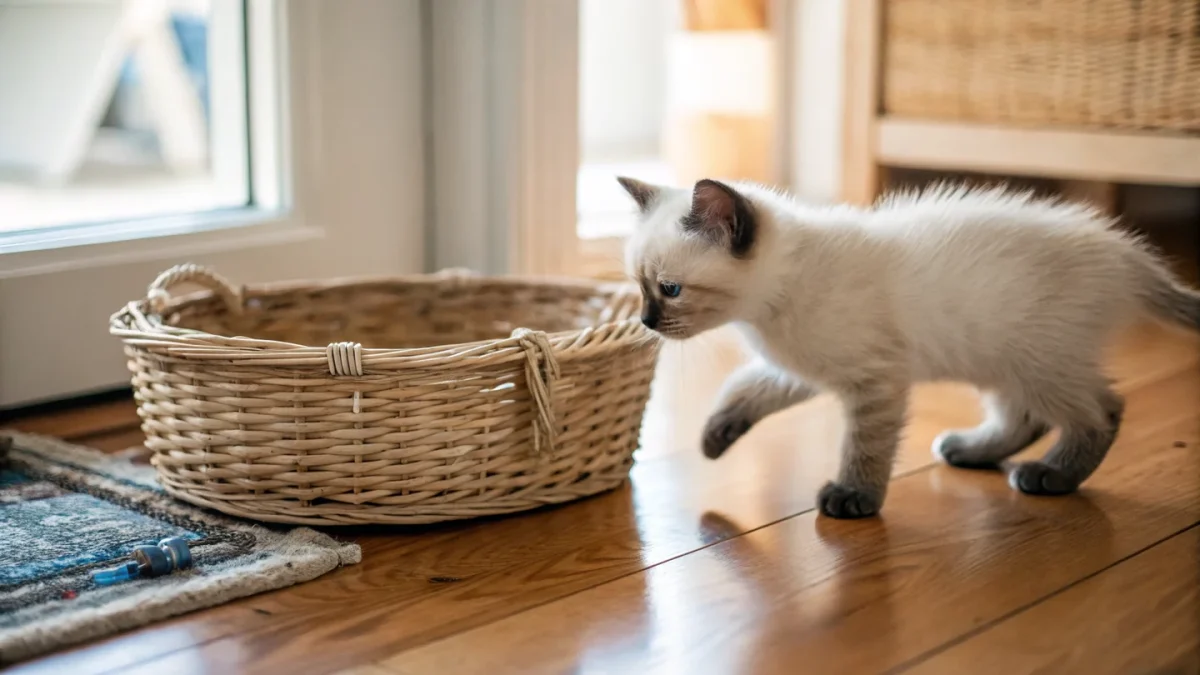
A Siamese kitten at eight weeks is a contradiction: tiny, slightly wobbly, those blue eyes still a bit unfocused — and already, without question, in charge of the room. The voice arrives before everything else. Long before coordination or confident movement, the Siamese kitten has opinions, and it makes them known.
Understanding what those first weeks and months involve will help you build the foundation for the kind of Siamese adult the breed can be at its best.
Before Your Kitten Arrives
Create a safe introduction room. New kittens overwhelmed by a large space take longer to settle. A single room — ideally where you spend time — with food, water, litter box, a high perch, and hiding spots lets your kitten gain confidence gradually before exploring the rest of the house.
Set up environmental enrichment before day one. A Siamese kitten needs things to interact with from the start. Scratching posts, low cat trees, a few puzzle toys, and a window perch if possible. The sooner these become normal parts of the environment, the better.
Have your vet chosen in advance. Ideally, a vet familiar with the Siamese breed and its specific characteristics — including the sensitivity to certain anesthetic agents and the dental predispositions. A first vet visit within the first week to ten days is advisable.
The First Days Home
Siamese kittens are often more confident in new environments than other breeds — the social orientation that characterizes adults shows up early. Some will begin exploring almost immediately. Others take a few days.
Resist the urge to force interaction in the early days. Let the kitten come to you. Sit on the floor at kitten level. Offer a hand without reaching. The Siamese personality responds well to feeling like the investigation is its idea.
Expect noise, including at night. Young Siamese kittens in a new environment vocalize more than settled adults. This typically reduces once they've established their relationship with you and feel secure. "Typically" is doing real work in that sentence — some Siamese kittens are simply loud indefinitely.
Socialization: The Window That Matters
The socialization window for kittens — the period during which experiences most readily shape adult behavior — runs approximately from two to seven weeks of age, with meaningful influence through twelve weeks. By the time you bring a kitten home at eight weeks, much of this critical period has passed, but the weeks that follow still matter significantly for Siamese.
Handle regularly, from the start. Touch paws, ears, mouth. Not intrusively — gently, during calm moments, with quick releases at any sign of discomfort. A Siamese kitten that learns routine handling becomes dramatically easier to groom and to treat medically as an adult.
Introduce varied sounds and situations. Vacuums, visitors, the sounds of daily household life. Siamese that encounter these as kittens adapt better than those kept in very quiet, constant environments.
If you have other animals, controlled introduction is worthwhile even if your kitten won't share the space immediately. Brief, positive early exposures to other cats or calm dogs reduce the intensity of adult territorial responses.
Play and Mental Engagement
Siamese kittens have stamina. They will initiate play at times that feel inconvenient and escalate it in ways that involve surfaces you'd prefer they avoided. Channeling this energy into structured play sessions — two or three per day — serves multiple purposes: it exercises them, satisfies the predatory instinct, builds your relationship, and reduces the likelihood of 3 a.m. ceiling investigations.
Wand toys that simulate prey movement are ideal. Kittens that learn to play with interactive toys as kittens continue to engage with them as adults, unlike some breeds that lose interest in play young.
Puzzle feeders introduced early become useful tools throughout the Siamese's long life. The mental engagement matters as much as the physical.
Establishing Grooming Habits Early
Building grooming habits early pays off significantly with this breed. The Siamese coat needs minimal maintenance, but the dental care and nail trimming that Siamese benefit from require an adult cat that accepts handling. Start with very brief sessions — touching the paws, lifting the lip — and build to nail trims and tooth brushing over weeks.
Do this calmly, ending before resistance builds into struggle. Cats that associate handling with forced confrontation become difficult for life. Cats that associate it with brief, calm routine accept it easily.
The Foundation You're Building
The Siamese you have at seven is largely shaped by the experiences and habits of the first six months. A kitten handled frequently becomes a cat that accepts touch easily. A kitten with established play routines becomes a cat with channeled energy. A kitten socialized to varied stimuli becomes a cat that adapts to change rather than unraveling.
This is a breed that rewards investment in the early period. The social intelligence and emotional responsiveness that make adult Siamese remarkable companions are shaped by experience — they're the same traits that make the kitten phase feel intense.