

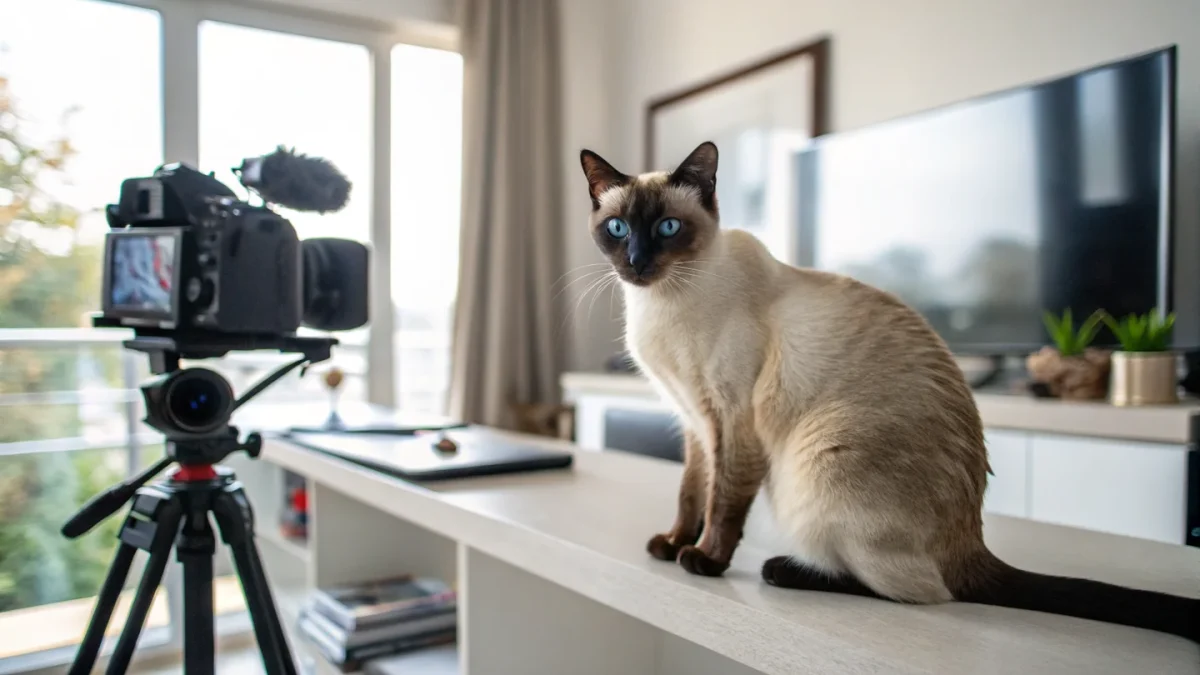
The Siamese accumulates misconceptions efficiently, probably because the breed's distinctive appearance and vocal personality make it easy to caricature. In twenty-plus years of writing about cat breeds, I've found that people approaching the Siamese for the first time arrive with a fairly specific set of wrong assumptions, and those assumptions shape their early experience with the breed until reality corrects them.
Here are the six I hear most.
1. "Siamese Are Mean or Aggressive"
This misconception is persistent and does real harm — it keeps people who might love the breed away from it, and it causes owners to misattribute normal Siamese behavior as problematic.
The Siamese breed is not aggressive. It is opinionated, communicative, and capable of being theatrical about what it wants. A Siamese that bites during handling is a Siamese that has communicated it doesn't want to be held right now and has been ignored. A Siamese that swipes at a stranger is often a Siamese that hasn't decided the stranger is trustworthy yet.
These are boundary communications, not aggression. The distinction is meaningful. Managing a Siamese well involves reading its signals and respecting them — the same skills that help with any animal that has the communication capacity to say "I'd rather you didn't." The cat isn't mean. It just has opinions and a voice.
2. "All Siamese Have Crossed Eyes"
The crossed eyes that historically appeared in Siamese cats were a real trait in earlier breeding lines — not cosmetic, but neurological. The traditional Siamese has a particular retinal structure where the optic nerve fibers cross differently than in other domestic cats, and some cats developed a slight eye-crossing as a compensation to avoid double vision.
Modern selective breeding has substantially reduced the incidence of visibly crossed eyes in Siamese, both in show lines and in most reputable pet breeders' stock. Most contemporary Siamese cats have straight eyes. The trait is not a necessary feature of the breed, and encountering a Siamese with straight eyes does not mean it's not "a real Siamese."
3. "The Meowing Can Be Trained Away"
No. It cannot. Siamese temperament includes vocal communication as a structural feature of the breed — not a learned behavior, not a bad habit, not something that will reduce once the cat "settles in." The Siamese voice is built in.
What owners can shape, somewhat, is the triggers and the escalation. A Siamese that has learned to yell at mealtimes until it gets fed on demand is showing a learned escalation pattern. Feeding on a schedule (not on demand) reduces this specific expression. But the base level of vocal commentary — the running narration, the greetings, the opinion on every closed door — doesn't go away.
If you want a quiet cat, this matters enormously. The Siamese is genuinely the wrong breed for quiet-apartment living without significant noise tolerance.
4. "They're Low-Maintenance Because They're Small and Short-Haired"
The coat is low-maintenance. The rest of Siamese ownership is not.
The social requirements are substantial. The intelligence means boredom has consequences. The emotional investment in their people means isolation affects them physically, not just behaviorally. The health predispositions — amyloidosis, progressive retinal atrophy, dental issues — require ongoing veterinary attention.
"Low-maintenance" in the domestic cat world tends to describe cats that self-manage well, don't need much active engagement, and don't have significant health predispositions. The Siamese fails most of these measures. The short coat is one easy thing about them. It's almost the only easy thing.
5. "The Point Colors Don't Change"
The Siamese temperature-sensitive coat pattern is dynamic, not fixed. A seal point kitten looks different from a seal point adult, which looks different from the same cat at age ten.
Point colors darken with age as the temperature-regulating enzyme becomes less efficient. Most elderly Siamese are noticeably darker overall than they were in young adulthood — some appear nearly uniform in color from a distance. Cold climates accelerate this effect; warm climates slow it. None of this is a health problem. It's expected physiology.
New owners who see their Siamese's body color shift over years sometimes worry something is wrong. It isn't. The color change is written into the genetics from the start.
6. "They're Aloof Until They Choose You"
This description captures something real about Siamese selectivity with strangers, but creates a misleading frame. The Siamese is not aloof — aloofness suggests indifference to social contact. The Siamese is highly social and highly specific.
With familiar people, the Siamese is the opposite of aloof: attached, attentive, present. With strangers, it may take time to decide whether this new person is worth engaging with. The assessment is often visible in real time — the slow approach, the assessment, the decision to either engage or return to base. This is discernment, not coolness.
Owners who understand this don't take the initial reserve personally and generally find that Siamese warm up quickly once they've made their evaluation. The visitors who interpret the assessment as rejection and stop engaging tend to confirm the Siamese's initial uncertainty by becoming less interesting.