

The oldest known painting of a dog working alongside a hunter with a net dates to roughly 1400 in France — and the dog in that painting is unmistakably a spaniel. Sporting breeds have been human hunting partners for at least six centuries, and their modern descendants carry the physical and behavioral hallmarks of that partnership in every fiber of their being.
The Sporting Group encompasses breeds developed for one overarching purpose: helping humans find, flush, and retrieve game birds. Within that shared mission, the group divides into four distinct subtypes, each refined for a specific phase of the hunt. Understanding those subtypes is the key to understanding what makes any sporting breed tick.
Four Subtypes, One Mission
Retrievers
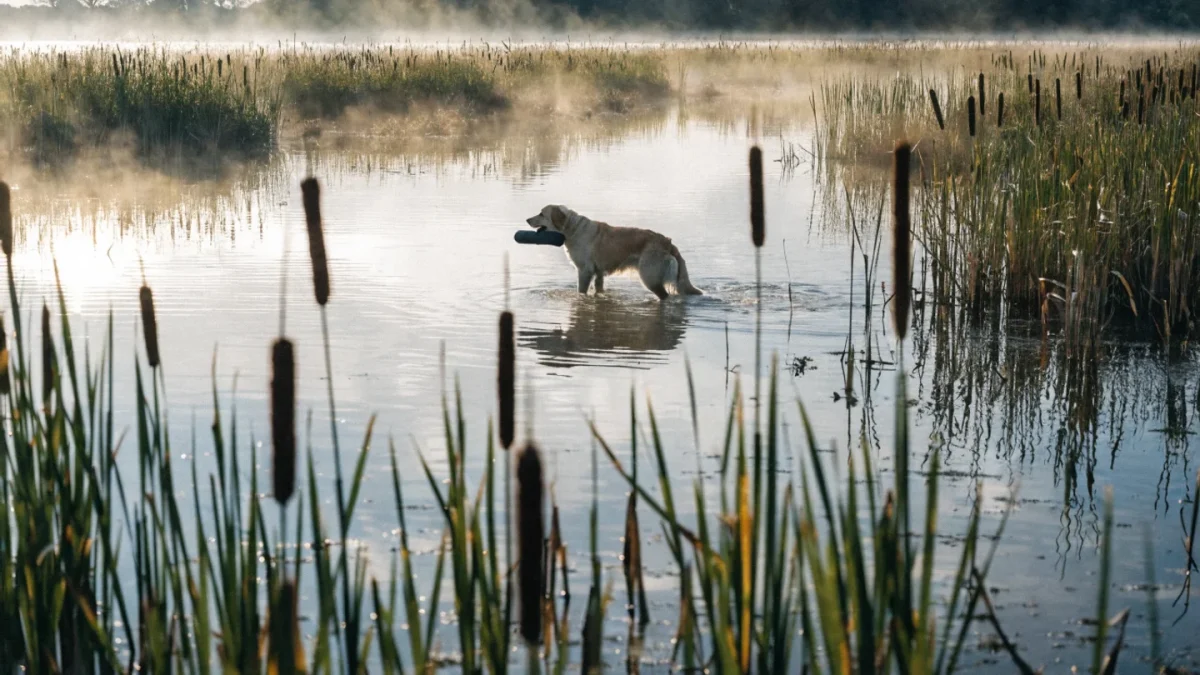
Retrievers — the Golden Retriever, Labrador Retriever, Chesapeake Bay Retriever, and others — specialize in recovering shot game, particularly waterfowl. They were bred to wait patiently beside a hunter, mark where birds fall, then retrieve them with a "soft mouth" that doesn't damage the game.
This combination of patience, intense focus, and cooperative drive translates directly into modern family life. Retrievers are among the most biddable dogs in existence. They want to work with their handler, they learn quickly, and their enthusiasm for retrieving anything — balls, sticks, shoes, socks — is essentially bottomless.
Physically, retrievers are medium to large, athletic, with dense water-resistant coats and webbed feet. The Labrador and Golden Retriever are consistently the two most popular breeds in the United States, and that popularity brings both familiarity and the consequences of overbreeding. See the Labrador Retriever complete breed guide for the full profile including health trends specific to the breed.
Spaniels
Spaniels — Cocker Spaniels, English Springer Spaniels, Boykin Spaniels — were developed to flush game from dense brush and undergrowth. Their job is to work close to the hunter, systematically quartering through cover to push birds into the air within gun range.
This heritage produces dogs that are perpetually busy, nose-driven, and happiest when they have vegetation to push through. Spaniels tend to be smaller than retrievers, with long, silky coats that pick up every burr, twig, and mud clump in a ten-mile radius. They're generally friendly, eager to please, and more active than their size might suggest.
The split between field-bred and show-bred lines is particularly pronounced in spaniels. A field-bred English Springer Spaniel and a show-bred English Springer Spaniel barely look like the same breed — the field dog is lighter, leggier, and considerably more intense.
Setters
Setters — English Setter, Irish Setter, Gordon Setter, Irish Red and White Setter — are the group's long-range scouts. They cover vast stretches of open ground at a fluid gallop, using their noses to locate game birds, then "setting" (freezing in a point or crouching position) to signal the bird's location to the hunter.
These are elegant, athletic dogs with flowing coats and a running style that looks effortless. They need significant daily exercise and can cover remarkable distances without tiring. Setters tend toward a softer temperament than pointers — they're sensitive, affectionate, and don't respond well to heavy-handed handling.
The Irish Setter's reputation as a beautiful but scatterbrained dog is one of the breed world's more persistent unfair stereotypes. Field-bred Irish Setters are focused, capable working dogs. The "airhead" reputation largely stems from show lines bred for appearance over working ability during the mid-twentieth century.
Pointers
Pointers — German Shorthaired Pointer, English Pointer, Wirehaired Pointing Griffon, Vizsla, Weimaraner — locate game by scent and freeze in a dramatic pointing posture: body rigid, one front paw lifted, muzzle aimed at the bird's location. Some pointing breeds also retrieve, making them versatile "do-everything" field dogs.
Pointers tend to be lean, muscular, and built for speed and endurance. Their energy levels are among the highest in the sporting group — a German Shorthaired Pointer that doesn't get adequate exercise will dismantle your home with the cheerful efficiency of a demolition crew. These are dogs for active people, ideally people who actually hunt or participate in field trials.
Shared Traits Across the Group
Despite their functional differences, sporting breeds share behavioral characteristics rooted in centuries of selective breeding for cooperative hunting:
Handler focus. Sporting dogs were bred to work as a team with a human partner. They check in, they respond to direction, and they derive genuine satisfaction from the working relationship. This makes them highly trainable — but also highly dependent on human engagement.
Oral fixation. Most sporting breeds are mouthy. They carry things, they chew things, they want things in their mouths. Retrievers are particularly committed to this, but spaniels and setters share the tendency. Providing appropriate outlets for mouth activity isn't optional — it's management of a core drive.
Water affinity. Not universal, but widespread. Retrievers and many spaniels are natural swimmers who will find water and get in it whether you planned for that or not. Water-resistant coats, webbed feet, and an otter-like tail (especially in Labradors) are physical adaptations for aquatic work.
High energy. Sporting breeds were developed to work in the field for hours. A 20-minute walk does not satisfy a sporting dog. Most need 60 to 90 minutes of vigorous daily activity — more for pointing breeds and field-line dogs.
Health Patterns in the Sporting Group
The Sporting Group shares several health predispositions that appear across multiple breeds:
Hip and elbow dysplasia are common across most medium-to-large sporting breeds. Screening programs for breeding stock have helped reduce incidence, but dysplasia remains a significant concern in Golden Retrievers, Labrador Retrievers, and German Shorthaired Pointers.
Ear infections are nearly universal in sporting breeds. The long, floppy ears that characterize most of the group create a warm, moist environment ideal for bacterial and yeast growth. Routine ear cleaning — especially after swimming — is preventive maintenance, not optional grooming.
Cancer disproportionately affects certain sporting breeds. Golden Retrievers have one of the highest cancer rates of any breed, with hemangiosarcoma and lymphoma being the most common forms. Flat-Coated Retrievers face similarly elevated cancer risks.
Eye conditions including progressive retinal atrophy (PRA), cataracts, and entropion appear across multiple sporting breeds. DNA testing can identify carriers for PRA in several breeds, and annual ophthalmological exams are standard practice among responsible breeders.
Obesity is an underappreciated concern in the sporting group. Retrievers and spaniels are often intensely food-motivated, and their transition from working dogs to family pets has reduced their daily caloric expenditure without reducing their appetite. Maintaining a healthy weight is one of the single most impactful things a sporting breed owner can do for their dog's longevity.
The Sporting Group as Family Dogs
Sporting breeds dominate popularity charts worldwide, and for good reason: their combination of intelligence, trainability, social temperament, and athletic versatility makes them genuinely well-suited to active family life. But "well-suited" is not the same as "low-maintenance." Every sporting breed requires substantial daily exercise, consistent training, regular grooming (especially the long-coated breeds), and proactive health management.
The best owners for sporting breeds are people who want a genuine partnership with their dog — people who will hike, swim, train, and spend time in the field (or at least simulate field conditions through retrieving games and scent work). If you're looking for a dog that sits quietly while you work from home, the sporting group is not your group.
Frequently Asked Questions
What's the calmest sporting breed?
No sporting breed is truly "calm" in the sense of low-energy. However, the Clumber Spaniel and Sussex Spaniel are notably more moderate in energy than the group average. Among popular sporting breeds, the English Cocker Spaniel and the Nova Scotia Duck Tolling Retriever tend toward slightly lower energy levels than Labrador Retrievers or German Shorthaired Pointers. But every sporting breed needs meaningful daily exercise — "calmer" is relative within a group that was bred to work.
Do sporting dogs get along with other pets?
Generally yes. Most sporting breeds have moderate prey drive and were bred to work cooperatively rather than independently. They typically coexist well with other dogs and can learn to live with cats, especially when introduced during puppyhood. However, individual variation matters, and some sporting breeds — particularly those from strong field lines — have higher prey drive that may pose challenges with very small pets.
Can sporting breeds live in apartments?
Physically, yes. Practically, it depends entirely on the owner's commitment to exercise. A Labrador Retriever in an apartment with an owner who runs five miles daily and trains regularly will be better off than a Labrador in a large house with an owner who opens the back door and calls that "exercise." Space is less important than activity. That said, pointers and high-drive field breeds make apartment life genuinely difficult to manage.