

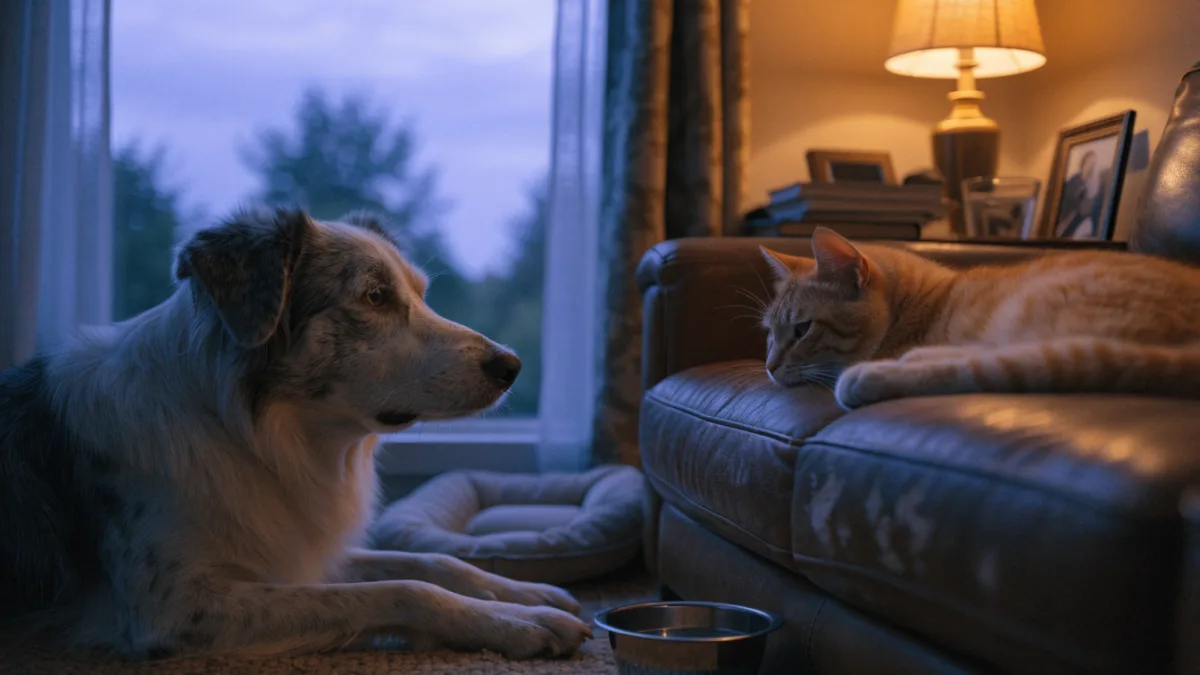
Barnaby, a twelve-year-old Beagle with a salt-and-pepper muzzle, had always been a creature of precise habit. Every evening at 7:30 PM, he would hop onto the foot of the bed, circle exactly three times, and crash out for the night. But last October, his owner, Linda, noticed a profound shift. As the sun dipped below the horizon, Barnaby began pacing the living room. He stared at the hinges of the kitchen door, completely forgetting how to push it open. By 9:00 PM, he was pacing in tight circles, panting, and had accidentally urinated on the rug by the sofa.
Linda sat in my exam room, exhausted and tearful, convinced Barnaby was reaching the end of his life. But as we ran our diagnostics, a different picture emerged. Barnaby wasn’t failing physically; his mind was playing tricks on him as the sun went down. In the veterinary world, we clinically refer to this as,[1] but most people know it by its human medical nickname: Sundowners Syndrome.
Understanding the “Twilight” Shift
Sundowners Syndrome isn’t a specific disease itself, but rather a descriptive term for a pattern of cognitive decline that peaks during a specific window: from the late afternoon into the evening, or after dark. When the sun sets and the household settles down, pets with CDS often experience a spike in disorientation, anxiety, and confusion. The fading daylight seems to short-circuit their internal compass.
For a long time, the veterinary community debated whether this was a true clinical phenomenon in animals or just owners anthropomorphizing their aging pets. However, growing clinical recognition backed by institutions like the NIH and PubMed Central has proven that cognitive decline in both aging dogs and cats is a very real, neurobiological reality. It is no longer something pet owners must silently accept as “just old age.” Still, we constantly navigate the debate of overdiagnosis versus underdiagnosis. Many owners brush off subtle house-soiling or nighttime pacing as normal aging, when in fact, these are clinical signs of a brain undergoing physical changes.
Spotting the Signs in Senior Dogs
Dogs are creatures of routine, which makes the disruption of that routine highly visible to us. When CDS begins to take hold in a senior dog, the evening hours often bring out behaviors that seem completely out of character. You might notice a decrease in their usual playfulness, replaced by a restless, pacing energy once the lights go down.
I see this constantly in my practice. A few months after Barnaby’s visit, I met a nine-year-old Labrador named Gus. Gus had been a rock-solid, happy-go-lucky family dog. But right around dusk, he became deeply irritable, growling at shadows in the corner of the dining room. His family was frightened by this sudden shift in personality.
Key Canine Indicators
- Late-Day Irritability: A normally friendly dog might become suddenly grumpy or anxious when approached in the evening.
- Sleep-Wake Cycle Inversion: Your dog might sleep heavily all day, only to become restless, pace, and pant throughout the night.
- Uncharacteristic House-Soiling: A dog who has been reliably potty-trained for a decade suddenly eliminates in the house right before bedtime. They haven’t forgotten their training out of spite; their brain simply lost the signal that tells them where the door is.
The Feline Twist: Sundowners in Cats
Spotting cognitive decline in cats requires a different set of eyes. Cats are incredibly adept at hiding physical and mental frailty. But make no mistake—late-day confusion absolutely develops in senior cats, and the altered sleep-wake cycles can be even more disruptive for owners.
I’ll be honest with you: early in my career, I used to tell owners that their older cats were just getting “cranky” or losing their eyesight when they began vocalizing at night. I’ve changed my mind on this completely. The research has evolved, and we now know that feline cognitive dysfunction mirrors canine CDS in many ways, right down to the twilight timing.
Take my patient, Cleo, a fifteen-year-old calico. For fourteen years, she was a dignified, silent hunter. Then, her owner brought her in because Cleo had started emitting mournful, loud yowls in the hallway at 3:00 AM. She wasn’t in pain. She was lost. In the dark, her brain wasn’t mapping her home the way it used to. This altered activity level and disrupted feline sleep cycle is a hallmark of feline Sundowners.
What to Watch For in Cats
- Nighttime Vocalization: Loud, persistent meowing or yowling, often in the middle of the night, seemingly for no reason.
- Disorientation: Getting “stuck” in corners of a room or staring blankly at walls as the house gets dark.
- Litter Box Avoidance: Forgetting the location of the litter box and eliminating just outside of it.
- Personality Shifts: A once-independent cat might suddenly become Velcroed to your side during the evening hours, or conversely, a highly social cat might hide under the bed.
A Healthy Body vs. A Fading Mind
The most important distinction I make with my clients is this: cognitive decline does not mean your pet’s physical body is shutting down. This is a crucial fork in the road for owners making end-of-life care decisions.
“It feels like his body is still completely ready to go, but his mind is checking out early.” — Linda, Barnaby’s owner.
Linda’s observation is perfectly accurate. Because CDS is a cognitive rather than a strictly physical ailment, dogs and cats can live for several years after the diagnosis with proper care and management. Their heart, liver, and joints might still have plenty of miles left on them. We aren’t managing a terminal disease; we are adapting to a new way of living.
This is why I urge owners not to panic if they see these signs. Yes, it is heartbreaking to watch your loyal companion get confused. But recognizing that their body is healthy while their mind needs a little extra scaffolding can bring a profound sense of relief.
Bringing Light to the Dark: Management and Empathy
While there is no cure for Cognitive Dysfunction Syndrome, we have a remarkable amount of tools to manage it. The goal is to reduce anxiety and provide an environment that makes sense to a failing brain.
Environmental Adjustments
The simplest intervention I recommend is lighting. Because the syndrome is tied to the setting sun, tricking the brain into thinking it’s still daytime can work wonders. I had owners install motion-sensor nightlights along the hallway leading to the litter box for a confused cat, and suddenly, the 3:00 AM yowling stopped. For dogs, keep the living space brightly lit until you are ready to go to sleep yourself.
Routine is your best friend. Pets with CDS rely heavily on muscle memory. Feed them at the exact same time, walk them along the exact same paths, and keep their beds and water bowls in places that never move. Minimize rearranging your furniture—a dog or cat relying on spatial memory to navigate a dark room will become highly distressed if a chair has been moved.
Nutrition and Supplementation
There is strong evidence supporting the use of specific nutrients to support brain health in aging pets. When looking for a therapeutic diet or supplement, check the labels for ingredients like medium-chain triglycerides (MCTs) derived from coconut oil, which provide an alternative energy source for the brain, as well as antioxidants like vitamin E and vitamin C to reduce oxidative stress. Omega-3 fatty acids, specifically DHA, are also vital for cognitive function.
Always consult your veterinarian before adding any supplements to your pet’s routine, as we need to ensure they won’t interact with other medications or underlying health conditions.
Preserving the Bond in the Twilight Years
Watching a pet navigate the fog of cognitive decline is one of the most emotionally taxing parts of sharing your life with an animal. They have spent their entire lives reading our emotions and caring for us in their own quiet ways. When the roles reverse, and they need us to guide them through the dark, it requires a deep well of patience. We have to forgive the puddles on the floor and the midnight pacing.
It is a profound privilege to care for a senior pet. They may forget where the door is, or forget the trick they learned as a puppy, but they never forget the sound of our voice or the comfort of our touch. By adjusting our homes, extending our empathy, and utilizing evidence-based veterinary care, we ensure that their twilight years are met with the same unwavering devotion they have given us all along.
Sources
- Cognitive Dysfunction Syndrome (CDS) — adoptapet.com