

The Pekingese was so sacred in the Chinese imperial court that commoners were required to bow to it. During the Second Opium War in 1860, British soldiers found five Pekingese in the Summer Palace after the imperial family fled — the dogs had been left behind with instructions for their caretakers to destroy them rather than allow capture. One of those five was presented to Queen Victoria and named "Looty." A dog that started as a royal treasure of one empire ended as a trophy of another. The history of toy breeds is, at its core, a history of human power expressed through very small dogs.
Toy breeds exist because people wanted them to exist — not for hunting, herding, guarding, or any physical task, but for companionship. That purpose is no less valid than any working function, and it produced breeds with a remarkable capacity for emotional attunement, portability, and sheer personality per kilogram that larger breeds rarely match.
Origins of the Toy Group
The companion-dog impulse is ancient. Small dogs appear in art and writing from virtually every literate civilization: Chinese, Maltese, Roman, Aztec, Japanese. The Maltese has been documented since at least 500 BC, appearing on Greek pottery and in Roman poetry. The Chihuahua's ancestors were bred by the Toltec civilization in Mexico over a thousand years ago.
What changed during the European Renaissance was the systematic miniaturization of existing breeds. Pomeranians descend from large sled-pulling Spitz dogs that were bred progressively smaller — Queen Victoria's breeding program in the late 1800s reduced the breed from roughly 14 kg to under 5 kg in just a few decades. The Yorkshire Terrier started as a working ratting dog in English textile mills before being refined into a lap dog by the Victorian middle class.
This history means toy breeds carry genetic heritage from larger, often working ancestors. A Pomeranian has Spitz instincts. A Miniature Pinscher behaves like a much larger dog because its behavioral wiring predates its current size. Understanding that origin explains a lot of toy breed behavior that otherwise seems disproportionate.
Behavioral Profile
The single most persistent misconception about toy breeds is that their small size means small needs. This is wrong in every measurable way.
Emotional intensity. Toy breeds were bred specifically for close human bond-formation. They read human emotional states with remarkable accuracy and respond to mood shifts, stress, and attention changes. This attunement makes them exceptionally responsive companions — and exceptionally vulnerable to anxiety when separated from their person.
Territorial assertion. Small dogs that bark aggressively at larger dogs or strangers aren't being "cute" — they're exhibiting fear-based or resource-guarding aggression that gets reinforced because owners find it amusing rather than concerning. This is the "small dog syndrome" pattern: behaviors that would be corrected immediately in a large breed are tolerated in a small breed because the consequences seem minor. They're not minor to the dog, and they're not minor when they result in bites.
Exercise needs. Toy breeds need less total exercise than sporting or herding breeds, but they still need structured daily activity. A Cavalier King Charles Spaniel needs 30 to 45 minutes of walking and play daily. Even a Chihuahua benefits from two to three short walks and mental stimulation. "Small" doesn't mean "sedentary."
Training. Every toy breed benefits from the same basic obedience training as any other dog. House training can take longer in some toy breeds due to smaller bladder capacity and faster metabolism, but the principles are identical. The biggest training obstacle with toy breeds isn't the dog — it's the owner carrying the dog everywhere, making excuses for bad behavior, and failing to set boundaries because the dog is small enough to physically manage.
Representative Breeds
The Chihuahua is the world's smallest recognized breed, with some individuals weighing under 2 kg. Its history traces back over a thousand years in Mexico, and it carries itself with a confidence that borders on delusion. Chihuahuas bond intensely to one or two people and can be suspicious of everyone else. They're long-lived (often 14 to 16 years) but prone to dental disease, patellar luxation, and hydrocephalus. The Chihuahua complete breed guide goes into the archaeological and cultural history behind this ancient breed.
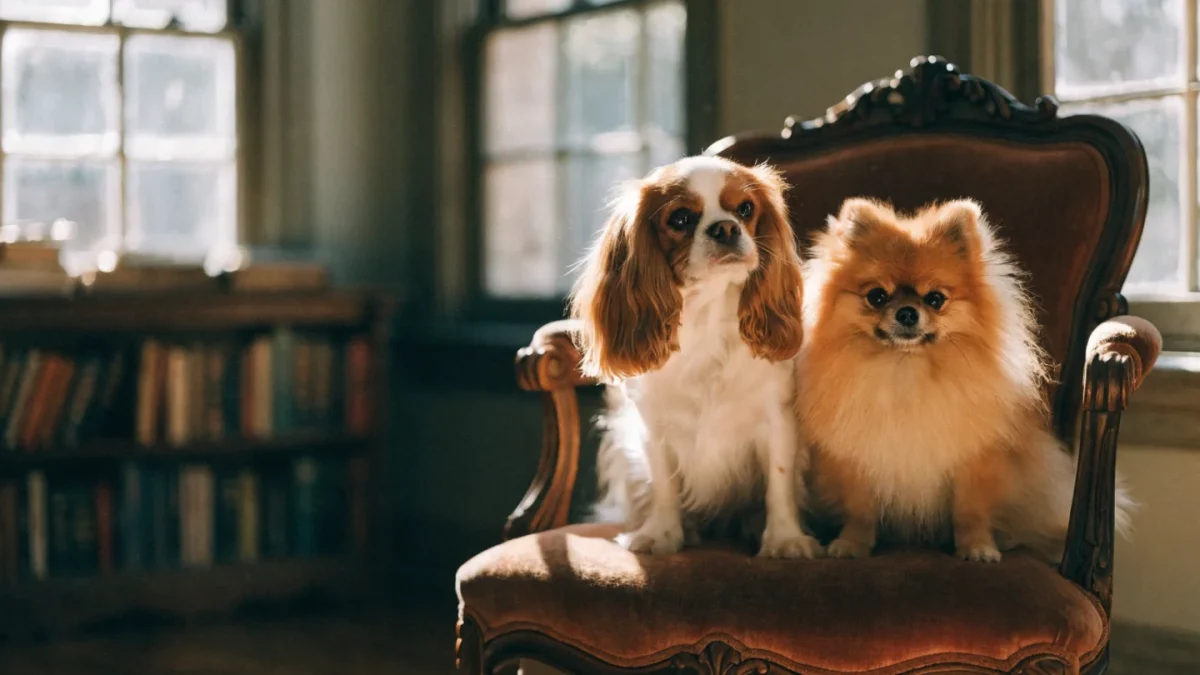
The Cavalier King Charles Spaniel was named for King Charles II of England, who was so devoted to his spaniels that he reportedly neglected affairs of state for them. Modern Cavaliers are among the most gentle and adaptable toy breeds — friendly with strangers, good with children, relatively easy to train. Their health profile, however, is the group's most sobering: mitral valve disease affects a substantial portion of the breed, and syringomyelia (a condition where the skull is too small for the brain) is a significant welfare concern.
The Pomeranian packed a large sled dog's personality into a body weighing 2 to 3 kg. Poms are alert, vocal, confident, and surprisingly athletic for their size. Their thick double coat requires regular grooming, and they tend toward a boldness with larger dogs that can put them in physical danger.
The Maltese has one of the longest documented breed histories — roughly 2,500 years. It's a single-coated breed (no undercoat), which means minimal shedding but a silky white coat that mats quickly without regular maintenance. Maltese temperament is typically gentle, playful, and people-oriented.
The Yorkshire Terrier retains genuine terrier temperament despite its toy classification. Yorkies are feisty, vocal, prey-driven, and far tougher than their silky coat and small frame suggest. At 2 to 3 kg, they're among the smallest terrier-derived breeds, but their personality operates independently of their body weight.
Health Patterns in the Toy Group
The Toy Group's health concerns are directly related to small body size and the genetic consequences of extreme miniaturization:
Patellar luxation — the kneecap slipping out of its normal groove — is the single most common orthopedic condition in toy breeds. It ranges from grade 1 (occasional, self-correcting) to grade 4 (permanently displaced, requiring surgery). Prevalence is high across Chihuahuas, Yorkshire Terriers, Pomeranians, and Maltese.
Dental disease affects toy breeds at disproportionate rates because small jaws crowd adult teeth, creating tight spaces where plaque and bacteria accumulate. Some toy breeds retain deciduous (baby) teeth that need surgical extraction. Dental care — brushing, veterinary cleanings, appropriate chews — is not optional in toy breeds; it's critical preventive health maintenance.
Tracheal collapse is a progressive condition where the tracheal cartilage rings weaken, causing coughing and breathing difficulty. It's particularly common in Pomeranians, Yorkshire Terriers, and Chihuahuas. Using a harness rather than a collar reduces tracheal pressure and is standard advice for most toy breeds.
Brachycephalic issues affect toy breeds with shortened skulls — Pugs, Shih Tzus, and French Bulldogs (technically Non-Sporting in some classifications). Brachycephalic obstructive airway syndrome (BOAS) causes chronic breathing difficulty and heat intolerance.
Hypoglycemia is a risk in very small toy breed puppies and adults under 2 kg. Their small body mass and high metabolic rate mean blood sugar can drop rapidly during periods of stress, missed meals, or excessive activity.
Portosystemic liver shunts are congenital vascular abnormalities that occur at elevated rates in Yorkshire Terriers, Maltese, and other small breeds. Bile acid testing can screen for this condition.
The Toy Group and Family Life
Toy breeds are excellent companions for people who understand what they are and what they aren't. They aren't disposable accessories, fashion statements, or substitutes for children. They are real dogs with real needs that happen to come in a small package.
The right owner for a toy breed provides consistent training, regular veterinary dental care, daily exercise appropriate to the breed, and — critically — treats the dog as a dog rather than as a doll. The wrong owner carries the dog everywhere, allows aggression because it seems harmless, skips training because the dog is small enough to physically restrain, and wonders why the dog is anxious, snappish, and miserable.
Toy breeds make particularly good companions for older adults, people in smaller living spaces, and anyone who values a close, emotionally attuned relationship with their dog and can commit to the specific health management small breeds require. For an overview of how toy breeds compare to other dog breed groups, understanding each group's core purpose clarifies whether this group fits your household.
Frequently Asked Questions
Are toy breeds good with children?
Some toy breeds — Cavalier King Charles Spaniels, Havanese — typically do well with gentle, respectful children. However, many toy breeds are too physically fragile for households with very young children. A toddler accidentally dropping, stepping on, or falling onto a 2 kg dog can cause serious injury. Additionally, some toy breeds (Chihuahuas in particular) tend toward resource guarding that can result in snapping when children approach their food, bed, or favorite person. Families with children under six should carefully evaluate whether a toy breed's physical vulnerability is compatible with their household dynamics.
Do toy breeds shed?
It varies enormously within the group. Pomeranians have dense double coats that shed heavily, especially during biannual coat blows. Chihuahuas (smooth-coated) shed moderately year-round. Yorkshire Terriers and Maltese have hair that grows continuously rather than cycling through a shed phase, which means minimal shedding but regular grooming and trimming requirements. No dog is truly non-shedding, but several toy breeds produce significantly less loose hair than the average dog.
How long do toy breeds live?
Toy breeds are generally among the longest-lived dogs. Many toy breeds routinely reach 12 to 16 years, with some individuals exceeding 18 years. Chihuahuas, Yorkshire Terriers, and Toy Poodles are particularly long-lived. The Cavalier King Charles Spaniel is a notable exception within the group, with a median lifespan closer to 9 to 12 years due to the high prevalence of mitral valve disease and other inherited conditions. Overall, smaller body size correlates strongly with longer lifespan across all dog breeds.