

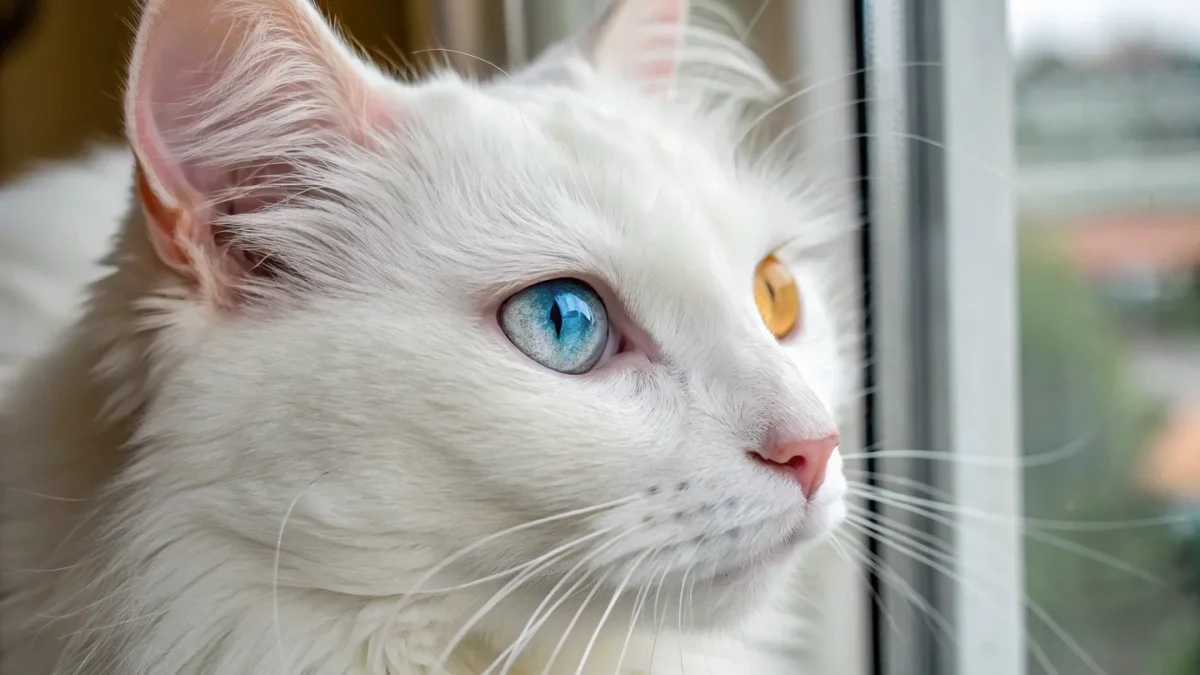
The odd-eyed white Turkish Angora is one of the more visually striking animals in domestic cat history — a white silky coat, one blue eye, one amber eye, an ancient Turkish pedigree. It's also one of the more genetically interesting, because the same gene responsible for both the white coat and the blue eye has a meaningful connection to hearing.
The Turkish Angora breed guide and health overview covers the breed holistically. This article is specifically about the eye color genetics and what the deafness association actually means in practice.
The W Gene: White Coat, Colored Eyes
The dominant W allele (KIT gene, producing the white masking phenotype) prevents melanocytes — pigment-producing cells — from properly migrating to the skin and hair follicles during embryonic development. The result is a cat with a white coat regardless of what other color genes it carries. A cat with a black tabby genotype that also carries one copy of W will present as white.
The same melanocyte migration process affects eye color. Normally, melanocytes populate the iris and produce the pigment that determines eye color. In W-carrying cats, this migration is disrupted to varying degrees. When melanocyte migration to the iris is partially or fully suppressed, the iris appears blue — not because blue pigment is present, but because the absence of dark pigment reveals the structural color of the iris tissue itself, which scatters light in the blue wavelengths.
When melanocyte migration is suppressed in one eye but proceeds normally in the other, you get an odd-eyed cat: one blue eye (suppressed migration) and one amber or green eye (normal migration). The Turkish Angora's association with odd eyes is a consequence of the W gene's variable expressivity — the same gene, in the same individual, can produce different outcomes in each eye.
Heterochromia in Turkish Angoras
The odd-eyed condition (one eye of each color) is technically called complete heterochromia iridis — distinct from sectoral heterochromia, where a single iris contains two colors in different segments. The Turkish Angora carries complete heterochromia.
The gene for heterochromia in Turkish Angoras is not a separate gene from the W gene — the heterochromia is a variable expression of the white masking gene rather than an independent trait. This is why odd eyes appear specifically in white-coated Turkish Angoras and not in other coat colors: non-white cats aren't carrying W in a configuration that would produce it.
The Deafness Connection
Melanocytes serve a function beyond pigment production. In the inner ear, specialized cells called stria vascularis cells depend on melanocytes for their development and function. The stria vascularis is essential for producing the endocochlear potential — the electrical charge that enables the hair cells of the inner ear to detect sound. Without properly functioning stria vascularis cells, congenital deafness results.
When W-gene-related melanocyte migration fails to reach the inner ear, the stria vascularis doesn't develop properly, and the cat is born deaf in that ear or both ears.
The relationship between eye color and deafness in white cats comes from this shared developmental pathway: both blue eyes and cochlear deafness result from impaired melanocyte migration. But they're not perfectly correlated, because melanocyte migration can succeed in the inner ear while failing in the iris, or vice versa.
The practical risk categories for white Turkish Angoras:
- Two blue eyes: highest deafness risk — studies land anywhere from around 65% to as high as 85%, depending on the population studied; bilateral deafness or unilateral deafness most likely
- Odd eyes (one blue, one amber): intermediate risk, commonly cited around 40%; unilateral deafness (on the blue-eyed side) is possible; some odd-eyed individuals are fully hearing
- Two amber or copper eyes: lowest deafness risk in white-coated individuals, typically 17-22%
Those ranges genuinely vary by study, mostly because of methodology — BAER testing catches unilateral deafness, behavioral observation often doesn't. For Turkish Angoras specifically, a study of 474 cats using behavioral testing alone put overall deafness at 11%, which is almost certainly an undercount — a cat that's deaf in one ear and compensating with the other can pass a behavioral check easily.
Critically, these are risk categories, not certainties. Not all blue-eyed white Turkish Angoras are deaf. Not all odd-eyed individuals have unilateral deafness. BAER testing — Brainstem Auditory Evoked Response, a non-invasive neurological test — is the only way to definitively determine whether an individual cat has normal hearing.
Why This Matters for Owners
A deaf Turkish Angora can be a happy, healthy indoor cat. The quality of life for deaf cats is genuinely good when owners understand and accommodate the condition: the cat must be strictly indoors (it cannot hear approaching dangers), communication uses visual cues rather than voice, and the cat should be approached within its visual field rather than from behind.
Responsible breeders BAER-test their breeding cats and can tell prospective owners exactly which animals carry hearing in both ears, one ear, or neither. This information should be available and documented — asking for it is standard practice, not overcaution.
Non-White Turkish Angoras: Different Eye Colors
Turkish Angoras in non-white coat colors don't carry the W gene and therefore don't express the blue-eye or odd-eye traits through this mechanism. Their eye color follows the standard cat eye genetics: most express vivid amber or gold, and some carry the green eye color associated with the tabby agouti genetic background. The striking odd-eyed appearance is specific to white-coated W-gene carriers.
The Ankara Zoo preservation program focused specifically on white, odd-eyed individuals — making the genetic traits discussed here central to the breed's conservation history as well as its genetics.