

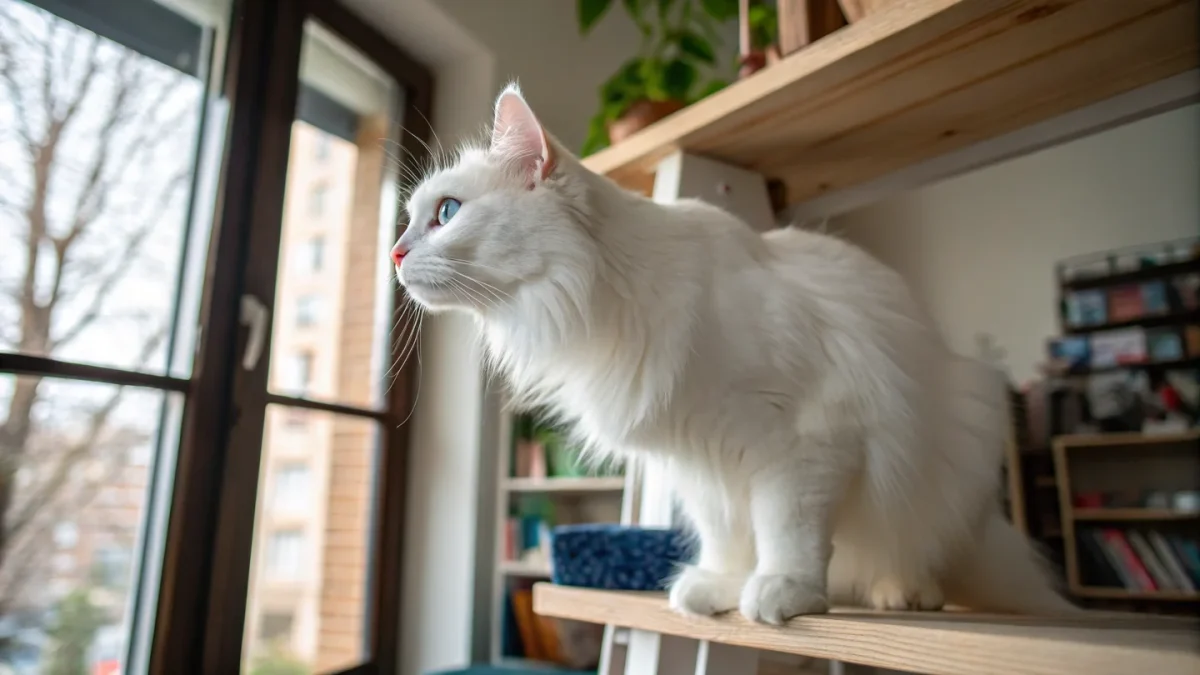
The Turkish Angora carries its appearance like a deliberate statement. The flowing single coat, the graceful posture, the almond-shaped eyes assessing everything from an elevated surface — it looks like a cat that has considered its options and found most of them wanting. The appearance isn't wrong, exactly, but it's incomplete. Underneath the composed exterior is a genuinely playful, athletically capable cat with a curiosity that doesn't quit and a will that's equally determined.
For the breed's full history and care requirements, Turkish Angora's history and breed origins covers the complete picture. This article focuses specifically on what the temperament means in daily life — the independence, the bonding patterns, the athletic drive, and the places where "willful" becomes the most accurate word available.
The Independent Nature: What It Actually Looks Like
The Turkish Angora's independence is often described as aloofness by people who expected more overt affection on demand. That's not quite right.
These cats do bond — the attachment is genuine and often strong, with a typical preference for one person in a household. But the bond is expressed on the cat's schedule, not the owner's. A Turkish Angora that wants contact will initiate it: climbing onto a lap, settling against a shoulder, head-bumping with the authority of a cat that has decided contact is appropriate now. When that need is met, they remove themselves with equal decisiveness.
What they won't do is sit indefinitely in a human's arms because the human wants to hold them. They won't be picked up and cuddled on demand with patience and compliance. The Turkish Angora's orientation toward humans is participatory rather than compliant — they want to be in the same activity, not necessarily at the mercy of human-imposed interaction.
This makes them wonderful companions for people who respect feline autonomy and find the self-directed nature of their affection more interesting than constant cuddle-demanding. It makes them frustrating for people who measure a cat's love in lap-time hours.
Athletic Drive: The High-Perch Cat
Every aspect of the Turkish Angora's body is built for movement. The hind legs are longer than the front legs, creating the characteristic upward slope that puts the cat's rump higher than its shoulders when standing — a configuration that favors jumping and sprinting over plodding.
Turkish Angoras jump with the confidence of cats that have never misjudged a landing. High surfaces — bookshelves, refrigerator tops, doorframe ledges — are natural territory. If a surface exists above floor level, the Turkish Angora has assessed whether it's worth occupying and has probably already occupied it.
This athletic quality means that the vertical dimension of a home matters to this breed in a practical way. Cat trees aren't decorative for Turkish Angoras; they're infrastructure. Homes without high perching options push the cats toward furniture and shelving that wasn't designed for the purpose, which is usually inconvenient.
The play drive is high and sustained into adulthood. Wand toys, particularly those with feather or ribbon attachments, engage the prey drive at the level these cats actually operate at. A toy that swipes back and forth predictably bores them within minutes. A toy with irregular, unpredictable movement that mimics actual prey behavior gets sustained, focused engagement.
The Willful Quality: When Yes Means Later
Experienced Turkish Angora owners will recognize the "willful" description immediately. These cats respond to "no" as an opening position in a negotiation.
This isn't aggression or disobedience in the way some people interpret it — the Turkish Angora doesn't break rules out of contempt or confusion. They break rules because they have assessed the situation and reached a different conclusion than the human did, and they're confident in their assessment.
Put a Turkish Angora down from a counter it shouldn't be on: it will give you a look of dignified offense, depart the counter, and return to it within five minutes via a slightly different route, as if that constitutes a new attempt at a new counter. Ask it to leave a room: it will leave, then re-enter when you're occupied with something else.
The practical approach is environmental management rather than behavioral correction. If the counter shouldn't be accessible, make it genuinely inaccessible — which may involve more ingenuity than you'd expect, given the Turkish Angora's problem-solving capacity. Training is possible but requires consistency and reward-based approaches; the breed does learn, responds well to positive reinforcement, and can be taught to come when called, perform simple behaviors, and respect designated spaces. But it requires genuine consistency, because they notice inconsistency and exploit it efficiently.
Curiosity and Environmental Engagement
Turkish Angoras approach their environment with thoroughgoing curiosity. New objects are assessed methodically. Doors that open to new spaces are investigated promptly. Changes in the household — new furniture, rearranged objects, new people — are catalogued with apparent efficiency.
The curiosity is interactive, not just observational. Turkish Angoras don't just look at interesting things; they engage with them. This means items on tables and shelves are at some risk from casual investigation. The breed has a tendency to knock objects off elevated surfaces that some owners find inexplicable — it's not malice, it's physics experimentation with things that were resting at an edge.
They're particularly engaged with small moving things. The prey drive in Turkish Angoras is more intact than in some highly domesticated breeds — they're genuinely interested in insects, small toys, and moving light in a way that reads as purposeful rather than casual.
The Water Affinity
The Turkish Angora's reported fascination with water comes up often enough in accounts of the breed that it warrants honest discussion. Many individuals — not all, but a notable proportion — show more interest in water than most cats. Playing with water in a bowl. Investigating a dripping faucet closely. Occasionally entering shallow water voluntarily.
No dedicated behavioral study exists documenting this tendency in the scientific literature, but the consistency of reports across Turkish Angora owners and breed communities — including acknowledgment in Cat Fanciers' Association breed references — is sufficient to treat it as a genuine breed tendency rather than random individual variation. It may connect to the breed's historical outdoor lifestyle near water sources in Turkey, or it may simply be an expression of their general curiosity applied to a stimulus that most cats find off-putting.
Practically, this means some Turkish Angoras require water bowl management — covered containers, fountain-style bowls — if the owner doesn't want water spread across the floor regularly.
Social Structure: Who Gets the Priority Bond
Turkish Angoras are social cats that typically identify one person in a household as their primary attachment. This person gets the full expression of the breed's devotion — proximity, grooming initiation, preferential lap access. Other household members get warmth and engagement, but the primary person is distinct.
This single-person focus can occasionally create household dynamics that require management. The Turkish Angora that has decided its primary person is Person A will not automatically extend the same level of access to Person B. Partners, roommates, and family members sometimes need to invest time in building their own relationship with the cat rather than relying on the primary person's existing bond.
With other cats, Turkish Angoras are generally fine but are particular about high-value spaces. The elevated perches they consider prime territory are defended through social pressure rather than overt aggression — positioning, staring, occupying preferred spots before others can. Multiple equivalent perches at the same elevation, with similar environmental access (windows, views), solve most of these tensions.
The Sociability Paradox
What makes Turkish Angoras interesting is the way their independence and their social drive coexist without contradiction. They don't need their people the way a Devon Rex needs them. They're not distressed by solitude in the same way. But they actively choose proximity, participate in household activities by preference, and maintain consistent interest in their people's movements and activities. Compare this to the Siamese, whose social need is more urgent and whose distress at solitude is more pronounced — the Turkish Angora operates with genuine choice where the Siamese operates more from dependency.
The best analogy is a human relationship with a partner who is genuinely self-sufficient but genuinely chooses to be present. The Turkish Angora doesn't depend on you — it decides you're worth paying attention to, and that decision, because it's chosen rather than compelled, feels like something real.
For an owner who respects that distinction, the Turkish Angora's temperament is deeply satisfying. For an owner who wants unconditional, always-available physical affection without negotiation, it will feel like something is being withheld.
It's not. It's just a different arrangement.