

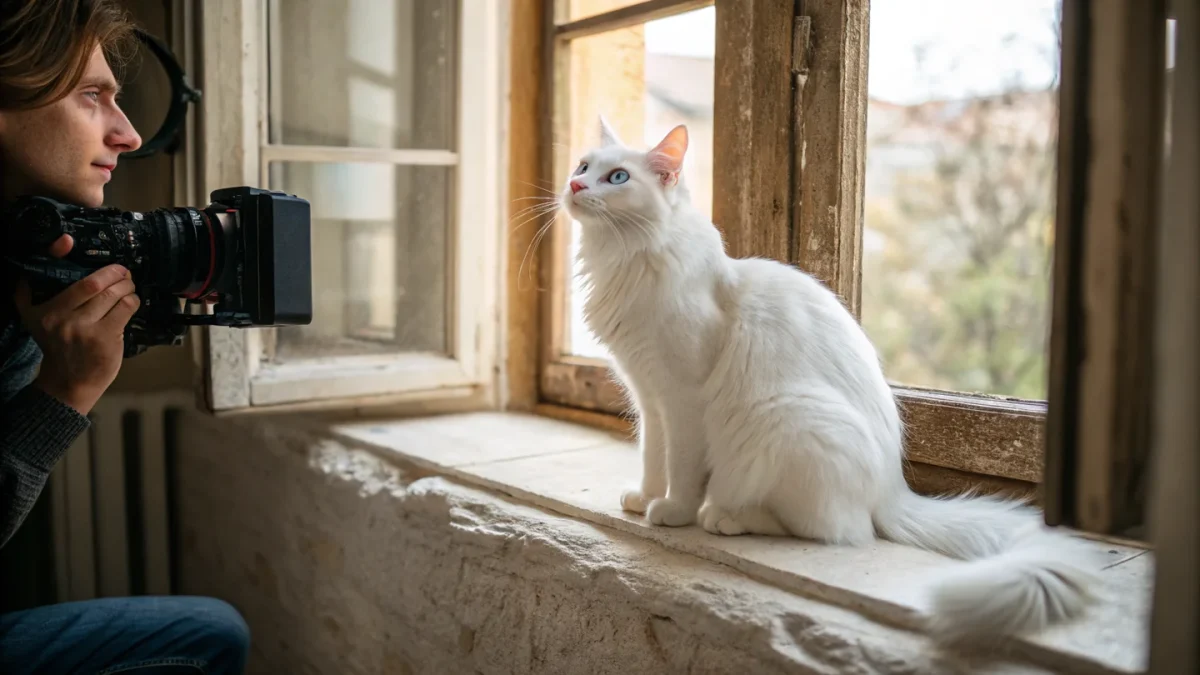
In the 1960s, the Turkish Angora nearly ceased to exist as a recognized breed. Decades of uncontrolled crossbreeding — much of it inadvertent, as the cat's long silky coat was introduced into Persian bloodlines throughout the 19th century — had blurred the breed into near-obscurity. The animals that saved it weren't breeders or cat fanciers. They were zookeepers at the Ankara Zoo in Turkey, where a deliberate preservation program had been quietly maintaining a colony of white, odd-eyed Turkish Angoras for years.
The Turkish Angora cat breed is one of those animals whose history reads like a rescue story. Ancient in origin, influential in shaping other long-haired breeds, nearly absorbed into the cat fancy's gene pool, and ultimately saved by institutional intervention in its country of origin. The cat itself is a study in contradictions — a silky, graceful exterior over a muscular, athletic build; a composed appearance alongside a personality that is anything but composed.
Origins: From the Ottoman Empire to the Edge of Extinction
The Turkish Angora is named for Ankara, the Turkish capital formerly known as Angora, where the breed was documented as far back as the 16th century. These cats were part of Ottoman court culture, gifted to European nobility as diplomatic presents, and among the first long-haired cats seen in France and Britain. The French naturalist Pierre Pomet referenced long-haired cats from Angora in the 17th century — these were Turkish Angoras.
Their near-extinction came through their own success as genetic contributors. When Persian cats became fashionable in the 19th century, Turkish Angoras were routinely crossed with Persians to introduce the silky coat texture. The two breeds blended together in Western catteries until the original Turkish Angora essentially disappeared as a distinct type. By the mid-20th century, finding a true Turkish Angora outside of Turkey was nearly impossible.
The Ankara Zoo's preservation program — which had maintained a breeding colony specifically to protect the breed — became the source from which the Western cat fancy eventually rebuilt. American breeders obtained cats from the zoo beginning in 1962, when Colonel and Mrs. Walter Grant were permitted to take an odd-eyed white male named Yildiz and an amber-eyed white female named Yildizcek back to the United States. The first American-born Turkish Angora litter arrived in 1963. A second import followed in 1966. These foundation cats were the source from which the Western cat fancy rebuilt the breed, and the Turkish Angora was formally recognized by the Cat Fanciers' Association in 1973.
Physical Characteristics
The Turkish Angora is a medium-sized cat whose physical appearance sends mixed signals. The coat is long and silky, suggesting a delicate, ornamental cat. The body underneath is muscular, fine-boned but athletic — a working cat's frame under a luxurious coat.
Body: Medium-length, graceful, and well-muscled. Longer in the hind legs than the front, which gives the cat a natural upward slope when standing — a distinctive characteristic called "rump higher than shoulders." Males weigh 7-10 pounds; females 5-8 pounds.
Head: Small to medium, wedge-shaped, with a gently rounded skull. The muzzle tapers. Large, almond-shaped eyes set at a slight angle.
Coat: Single layer — no thick undercoat. This is fundamental to the breed's appearance and care requirements. The coat lies close to the body on the shoulders, flares out to a full ruff around the neck and chest, and produces a plumed tail. Because there's no undercoat, it doesn't mat the way a Persian coat does, and it flows rather than puffs.
Colors: White is the traditional and most recognized Turkish Angora color, and it's associated with the odd-eyed trait. However, the breed comes in numerous colors and patterns — tabby, bicolor, tortoiseshell, black, blue, and more. Non-white Turkish Angoras are less represented in show halls but are genetically valid.
Eyes: Vivid, large, and almond-shaped. The most distinctive variation is odd-eyed — one blue eye and one amber or green eye. This is particularly associated with white-coated individuals and is connected to the W gene (see the genetics section below).
Temperament: Elegant, Athletic, and Willful
The Turkish Angora's silky coat and refined appearance suggest a serene, decorative cat that drapes itself gracefully across furniture. This is accurate, but incomplete. They drape gracefully — and then they climb your bookshelves, steal your pen, and redirect your attention from whatever you were doing.
These are intelligent, active cats with a strong streak of independence that falls short of aloofness. They attach firmly to their people — often with a preference for one particular family member — but on their own terms. They decide when interaction happens, and they're not given to excessive clinginess. Think of them as devoted but autonomous.
Their athleticism is frequently underestimated. Turkish Angoras jump confidently to high surfaces, move with the fluid speed of a cat that was historically a skilled hunter, and engage with play with genuine athletic focus. Wand toys, puzzle feeders, and high perches suit them well.
The willfulness is real. Turkish Angoras have been described as the cats most likely to "negotiate" — they'll accept being told no once, consider it, and then try a slightly different approach. Training them is absolutely possible (they learn their names, come when called, and pick up household routines quickly), but they tend to execute on their own schedule.
What Most People Get Wrong About the Turkish Angora
The most widespread misconception is that all Turkish Angoras are white. White is the traditional color and the most associated with the breed in Western cat culture, but the breed comes in a full range of solid colors, tabbies, and bicolors. Restricting the Turkish Angora to white would be like assuming all Siamese must be seal point.
The second misconception involves the coat. "Long coat = high maintenance" is the default assumption for most people, and Persian owners will confirm it. But the Turkish Angora's single-layer silky coat is categorically different from the Persian's dense double coat. Without an undercoat to mat, the Turkish Angora's coat requires far less work — twice-weekly brushing is usually sufficient, compared to the daily sessions a Persian demands.
Third: people assume that odd-eyed white cats are deaf. This conflation — which comes from a real but partial truth — is covered in the genetics section below. The short answer is that odd-eyed white Turkish Angoras are not necessarily deaf, though the risk is higher in blue-eyed and some odd-eyed individuals than in amber-eyed individuals.
The White Gene and Odd Eyes: A Genetics Note
The characteristic white coat and blue eyes of many Turkish Angoras are connected to the dominant W gene (white masking gene), which suppresses pigment production throughout the body. The same gene is associated with a higher risk of congenital deafness in cats, specifically in cochlear cells that require pigment-producing melanocytes for normal development.
White cats with two blue eyes have the highest deafness risk among white cats. Research across multiple studies — including data referenced in the ASPCA Complete Guide to Cats and confirmed by clinical studies on white cat populations — consistently places the deafness rate in blue-eyed white cats at 65–85%. Odd-eyed white cats (one blue, one amber) show approximately 40% deafness incidence, with deafness more likely on the blue-eyed side only (unilateral deafness). White cats with two amber or copper eyes have the lowest deafness risk in the white group, typically cited at 17–22% — still elevated compared to non-white cats, but meaningfully lower than either blue-eyed group.
Reputable breeders use BAER (Brainstem Auditory Evoked Response) testing on their breeding cats to identify and responsibly manage deafness in the breed. A deaf Turkish Angora can be a perfectly happy indoor cat — the implications are primarily about safety management (indoor-only status becomes especially important) and owner awareness, not about quality of life.
Grooming: That Silky Single Coat
The single-layer coat is the Turkish Angora's biggest practical advantage over other long-haired breeds. No undercoat means no dense matting, no hours-long grooming sessions, and less severe seasonal shedding (though there is shedding, particularly in spring).
Brushing: Two to three times weekly is sufficient for most individuals. During spring shedding, daily brushing for a few weeks prevents the loose coat from accumulating on furniture. A slicker brush or wide-toothed metal comb works well — the coat is fine enough that aggressive tools aren't needed.
Bathing: Occasional bathing — every few months — keeps the silky coat at its best and distributes the coat oils that give it the characteristic sheen. The Turkish Angora's single coat dries relatively quickly compared to double-coated breeds.
Tail: The plumed tail deserves its own attention. It collects the most debris and tangles, especially in outdoor or semi-outdoor cats. A gentle comb-through with the tail grooming twice a week prevents minor tangles from becoming real problems.
Eyes: The breed doesn't have the facial structure issues that cause excessive tearing in flat-faced breeds, but the large almond-shaped eyes occasionally need a gentle wipe with a soft cloth.
Health Considerations
Turkish Angoras have one serious breed-specific health concern: hypertrophic cardiomyopathy (HCM), a heart muscle disease that causes the left ventricle wall to thicken. It appears in many cat breeds, and Turkish Angoras — particularly males — are recognized as having an elevated predisposition, typically manifesting at middle age. Unlike the Maine Coon and Ragdoll, for which specific MYBPC3 gene mutations have been identified and DNA tests are available, no breed-specific genetic marker for HCM has yet been published for the Turkish Angora. Screening relies on echocardiogram rather than DNA testing.
Responsible breeders screen breeding cats annually with echocardiograms and are working with researchers to identify genetic markers for the condition. Ask any breeder about their HCM screening protocol before acquiring a kitten.
The deafness risk in white, blue-eyed individuals is discussed above — BAER testing is the standard tool for identifying it.
Otherwise, the breed is generally healthy. The absence of exaggerated physical conformation (no brachycephalic features, no extreme body proportions) means fewer structural health problems than in some other breeds. Lifespans of 12-18 years are not uncommon.
Living With a Turkish Angora
Indoor vs. outdoor: Turkish Angoras are athletic enough to be excellent outdoor cats, but breed preservation and safety considerations make indoor or supervised outdoor access the standard recommendation for pedigreed individuals. White, blue-eyed individuals with hearing loss should be strictly indoors.
Activity level: High. These cats need daily play and vertical enrichment. Cat trees, shelves, and access to high perches are not optional extras.
With children: Good, generally, with older children who understand feline body language. Turkish Angoras are not as tolerant of rough handling as some more patient breeds, but they're engaged, curious, and not easily spooked.
With other cats: Variable. Many Turkish Angoras do well with other cats, particularly those of similar activity level, but they can be territorial about high perches and prime resting spots. Slow introductions and multiple elevated spaces help.
With dogs: The breed's athletic confidence means they typically don't fear dogs. A compatible dog can become a genuine companion; an incompatible one will be firmly rebuffed by a Turkish Angora who has absolutely no plan to be chased.
The Right Owner for a Turkish Angora
The Turkish Angora suits someone who appreciates an intelligent, active, somewhat willful cat and doesn't need constant cuddling or compliance. They're not for someone who wants effortless, accommodating companionship — they'll let you know when the rules aren't working for them.
They suit people who are home reasonably often, can provide daily playtime and environmental enrichment, and find the breed's combination of elegance and stubbornness charming rather than frustrating. Their moderate grooming needs make them accessible to owners who want a long-coated cat without the daily commitment of a Persian.
If you want a cat that has opinions, that will choose to sleep with you on its own terms, and that brings genuine athletic grace to daily life — the Turkish Angora is a remarkable choice.
Frequently Asked Questions
Is the Turkish Angora the same as the Angora cat?
In casual usage, "Angora cat" often refers to any long-haired cat. The Turkish Angora is a specific recognized breed with documented origins in Turkey and a distinct breed standard. "Angora" alone doesn't guarantee you're looking at a Turkish Angora.
Are white Turkish Angoras always deaf?
No. White Turkish Angoras with blue eyes have a higher risk of deafness than those with amber eyes, but not all blue-eyed white Turkish Angoras are deaf. Odd-eyed individuals may be unilaterally deaf (one ear) or fully hearing. BAER testing identifies which individuals are affected.
Do Turkish Angoras get along with water?
Many Turkish Angora owners report unusual water interest in the breed — playing in bowls, investigating running faucets, and sometimes entering shallow water voluntarily. The Cat Fanciers' Association and multiple breed references acknowledge this as a recognized characteristic. It hasn't been the subject of dedicated behavioral research, but the consistency of owner reports across breed communities makes it a genuine breed tendency rather than random individual variation. It may connect to their historically active outdoor lifestyle and the single-layer coat that dries more readily than double-coated breeds.
How is a Turkish Angora different from a Turkish Van?
Both are Turkish breeds with long, silky coats and athletic personalities, but they are distinct. The Turkish Van is larger, typically semi-longhaired rather than longhaired, and carries the distinctive "Van pattern" (white body with color restricted to the head and tail). The Turkish Angora is smaller, finer-boned, and comes in a full range of colors.
What is the Ankara Zoo's role in the breed?
The Ankara Zoo in Turkey has maintained a breeding colony of Turkish Angoras for decades, originally as a preservation program to protect the purebred white, odd-eyed cats that were vanishing from Western breeding programs. This colony served as a foundation source when American and European breeders sought to re-establish the breed in the 1960s.