

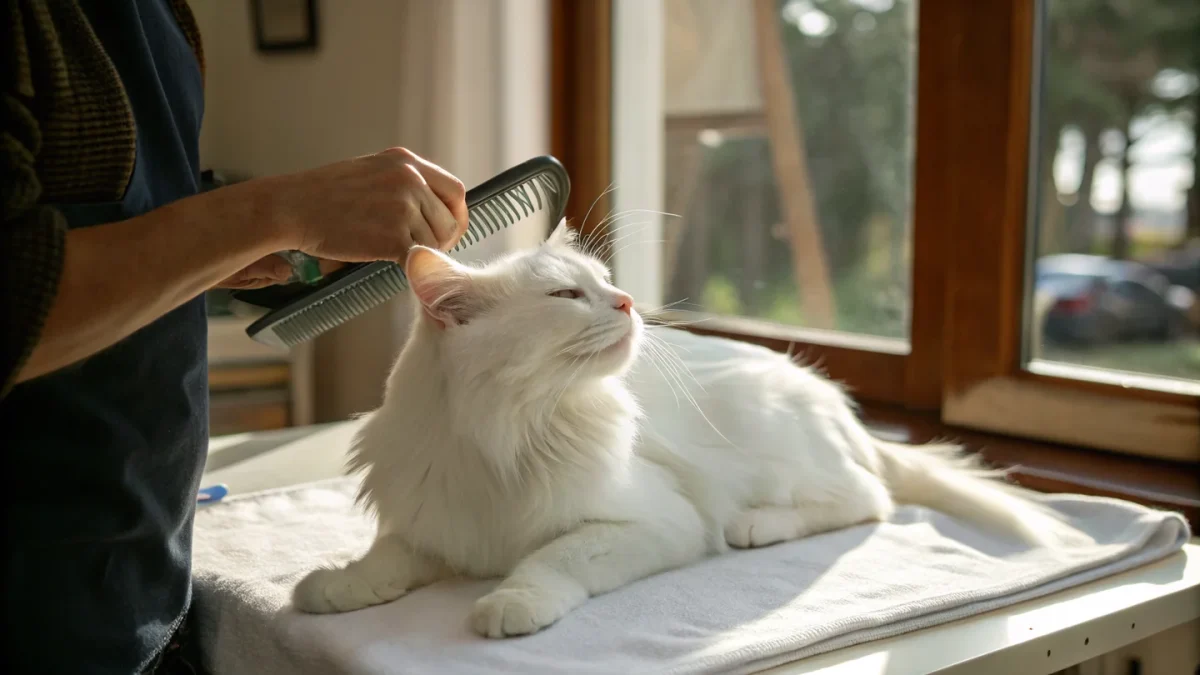
One of the questions Turkish Angora owners field most often from other cat owners is how much time they spend grooming that coat. The honest answer surprises people: not much. For context on why the Turkish Angora coat behaves differently from Persian or Maine Coon coats, Turkish Angora breed background and the single-coat difference explains the single-layer structure.
The practical upshot: no undercoat means no dense matting, no pelted fur, and no daily mandatory grooming sessions. This is the coat that other long-haired breed owners hear about and feel slightly cheated by.
The Weekly Routine
Two to three brushing sessions per week maintains the Turkish Angora coat in excellent condition during most of the year.
Tool choice: A wide-tooth metal comb or a slicker brush with flexible pins works well. The coat is fine enough that a stiff-bristle tool is unnecessary and risks static. Work with the coat's natural flow — these silky hairs lie close to the body on the shoulders, flare at the neck and chest, and feather along the tail. Follow those natural sections.
Technique: Start at the neck ruff and work backward toward the tail. Divide the coat into sections with your free hand and comb through each section gently. Tangles in the Turkish Angora coat are uncommon but happen most often in the ruff, the belly, and behind the ears — anywhere the coat is longer and rubbed against surfaces regularly.
If you encounter a minor tangle, work it from the ends back toward the root using your fingers to separate it before applying the comb. Never yank through a tangle — the silky texture means hairs break rather than release.
Belly and inner legs: The softer fur in these areas tangles more readily than the back and sides. Groom these areas more carefully and more frequently during shedding season.
Seasonal Shedding: The Spring Change
The Turkish Angora's single coat undergoes a dramatic seasonal change in spring. Unlike Persian cats, who shed moderately year-round (dense double coats release continuously), the Turkish Angora's spring shed is concentrated and more noticeable — the whole coat releases within a few weeks, and the cat may briefly look significantly thinner in coat until the summer coat grows in.
During this period, increase brushing to daily. A wide-tooth comb removes the loose coat efficiently and keeps it off your furniture. Some owners find that a bath at the beginning of the shed season loosens the coat and speeds the transition.
Outside this spring window, shedding is quite manageable. The single coat doesn't produce the year-round background shedding that double-coated breeds create.
The Plumed Tail
The Turkish Angora's tail is the most dramatic feature of the coat and deserves its own routine. The full, plumed tail collects debris, tangles at the tip in active cats, and often catches seed pods or plant material in cats with any outdoor access.
Comb the tail from the base to the tip twice a week, working through any tangles before they develop into matted sections. The tail hairs are slightly coarser than the body coat and stand up to more tool contact than the fine neck ruff.
Bathing
Turkish Angoras benefit from occasional bathing — every two to three months maintains the coat's silky texture and manages natural oil buildup. Use a gentle, diluted cat shampoo appropriate for the coat type. Work it through gently with your fingers rather than scrubbing, rinse very thoroughly, and dry with a warm towel.
The single coat dries faster than double-coated breeds — a significant practical advantage. Blow-drying on a low, cool setting while combing through the coat produces the full, flowing result that shows the coat at its best, but air-drying in a warm room works fine too.
Avoid overbathing. Too-frequent bathing strips the natural oils that give the Turkish Angora coat its characteristic sheen.
Eyes and Ears
The Turkish Angora's almond-shaped eyes occasionally accumulate minor discharge at the inner corner — a quick gentle wipe with a soft, damp cloth once a week manages this. Unlike flat-faced breeds, they don't have the structural tearing issues that require daily management.
Ears should be checked weekly and cleaned when needed. The Turkish Angora's large, open ears are less prone to wax buildup than the deep, narrow ear canals of some breeds, but regular inspection and gentle cleaning prevents accumulation.
When the Coat Signals a Problem
A Turkish Angora coat that's dull, is matting unusually fast, or is losing sheen despite regular grooming can indicate dietary deficiency, stress, or underlying health issues. The coat's condition is a reliable indicator of the cat's general health in this breed — attend to coat changes that can't be explained by seasonal transition or a missed brushing session.