

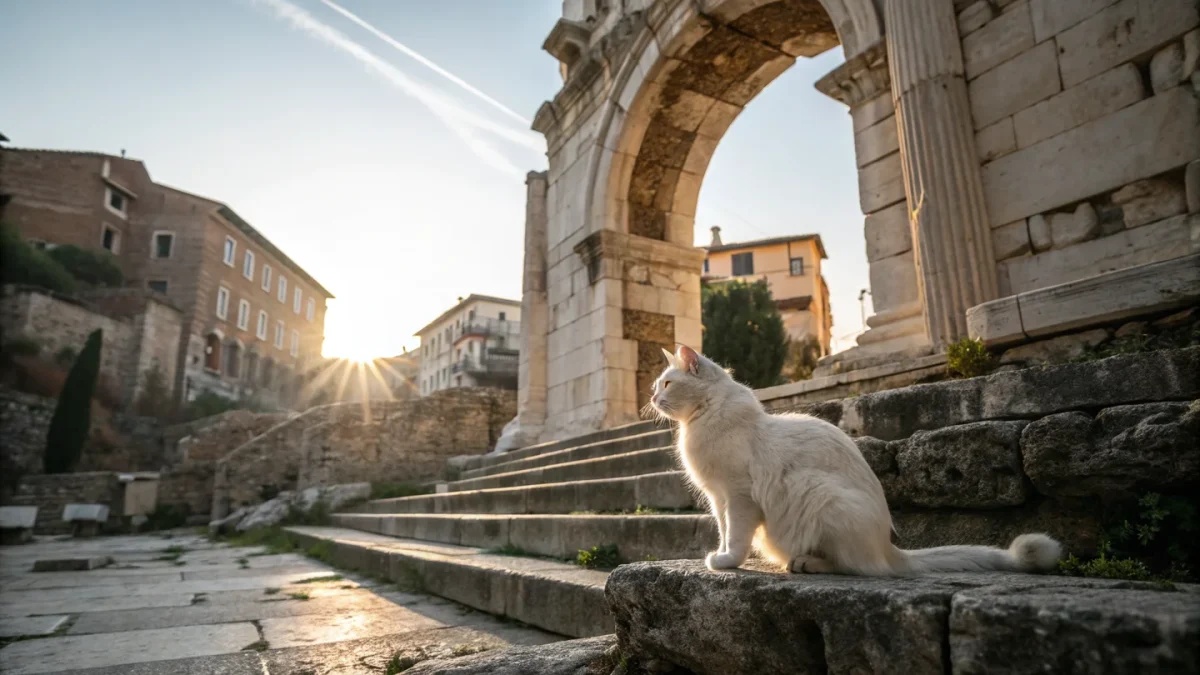
In the 16th century, long-haired cats from the city of Ankara — then called Angora — were considered gifts appropriate for European royalty. The French naturalist Pierre Pomet described them in the 17th century. Nicholas-Claude Fabri de Peiresc, a French scholar, reportedly kept one in the 1620s. Cardinal Richelieu, according to historical accounts, was fond of them. These were Turkish Angoras, carried westward as diplomatic gifts and curiosities, long before anyone thought to call them a breed.
For a full introduction to the complete Turkish Angora breed guide and what they're like today, that article covers the whole picture. This one is specifically about the history — the rise, the near-fall, and the rescue.
The Original Cat of Ankara
The Turkish Angora is not an artificial breed created through deliberate crossing programs. It's a naturally occurring landrace that developed over centuries in the Ankara region of central Anatolia. The cold winters and the specific environment of the region selected for the long, silky single coat — a coat different in structure from the thick double coats of northern European breeds.
The cats associated with Ankara were particular enough in appearance — white coat, odd eyes, graceful build — that observers noticed them centuries before the cat fancy existed as an institution. Some breed historians point to Ottoman-era court records referencing cats matching the type, though I haven't found a specific manuscript I'd stake my name on. The paper trail gets solid starting in 16th-century Europe, which is where this article picks up.
The European Influence and Near-Extinction
The Turkish Angora's near-disappearance is a story of its own success as a genetic contributor.
When long-haired cats began appearing in European cat fancy circles in the 19th century, the Persian and the Angora were often treated interchangeably, or the Angora coat quality was used to improve Persian bloodlines. The 1871 Crystal Palace cat show in London included both, but the categories were fluid and the breeding practices more so.
Through the late 19th and early 20th centuries, Turkish Angoras were repeatedly crossed with Persians — deliberately to introduce coat quality, and inadvertently as the record-keeping of the early cat fancy was less rigorous than it later became. The Turkish Angora's finer bone structure and single coat were gradually diluted into the broader, rounder Persian type. By the 1950s, finding a Turkish Angora in Western Europe or North America that wasn't significantly Persian-influenced was essentially impossible.
In Turkey itself, the situation was different. The Ankara Zoo had recognized the risk to the native breed and had established a breeding colony specifically to preserve pure white, odd-eyed Turkish Angoras — the traditional and most iconic variant. The colony was maintained as a conservation effort, not a show breeding program.
The Ankara Zoo Colony
The Ankara Zoo's Turkish Angora preservation program represents one of the more unusual interventions in domestic cat history. A public zoo, maintaining a colony of domestic cats as a cultural and natural heritage preservation effort — it reads as idiosyncratic, but the logic was straightforward: the Turkish Angora was a national breed, named for the capital city, and it was disappearing from its country of origin.
The zoo's colony focused on the white, odd-eyed phenotype that had been most associated with Turkish Angoras historically. Sources disagree on exactly when the program started — some breed histories cite as early as 1917, others put the formal effort closer to 1939 — and I haven't found an initial colony size that multiple sources agree on. What's solid is the outcome: by the time American servicemen and diplomatic staff came looking in the 1950s and 60s, the zoo had a colony pure enough to be worth crossing an ocean for.
What is well-documented is the outcome: when American breeders sought Turkish Angoras in the 1960s, the Ankara Zoo provided the source animals that founded Western bloodlines.
The American Reintroduction
American servicemen and diplomatic personnel stationed in Turkey in the postwar period became aware of the Ankara Zoo's cats, and interest in importing them to the United States grew through the 1960s. The Ankara Zoo, while maintaining its preservation mission, began allowing carefully selected cats to be exported to serious breeders who could demonstrate the infrastructure and intention to breed them properly.
The specific records of early American Turkish Angora breeding are held by breed registries, and the founding cats' names and sources are documented in pedigree databases. American breeders worked with the Ankara Zoo over subsequent years to continue importing animals that would maintain the breed's genetic integrity while expanding the population.
The Cat Fanciers' Association accepted the Turkish Angora for registration in 1968 and for championship competition in 1972. Other major registries followed.
The Breed Today
The modern Turkish Angora outside Turkey exists largely because of the Ankara Zoo's foresight and the American breeders who recognized the breed's value and invested in reestablishing it. The breed continues to benefit from periodic importation of animals from Turkey to maintain the connection to the original population.
For what the what Turkish Angoras are like to live with reveals, the cat that survived all of this — the ancient origins, the near-extinction, the zoo preservation program, the reintroduction — is still recognizably the same elegant, athletic, willful animal that was gifted to European courts four centuries ago. History didn't change it much. That's either a testament to the breed's original character, or to the Ankara Zoo's diligence. Probably both.