

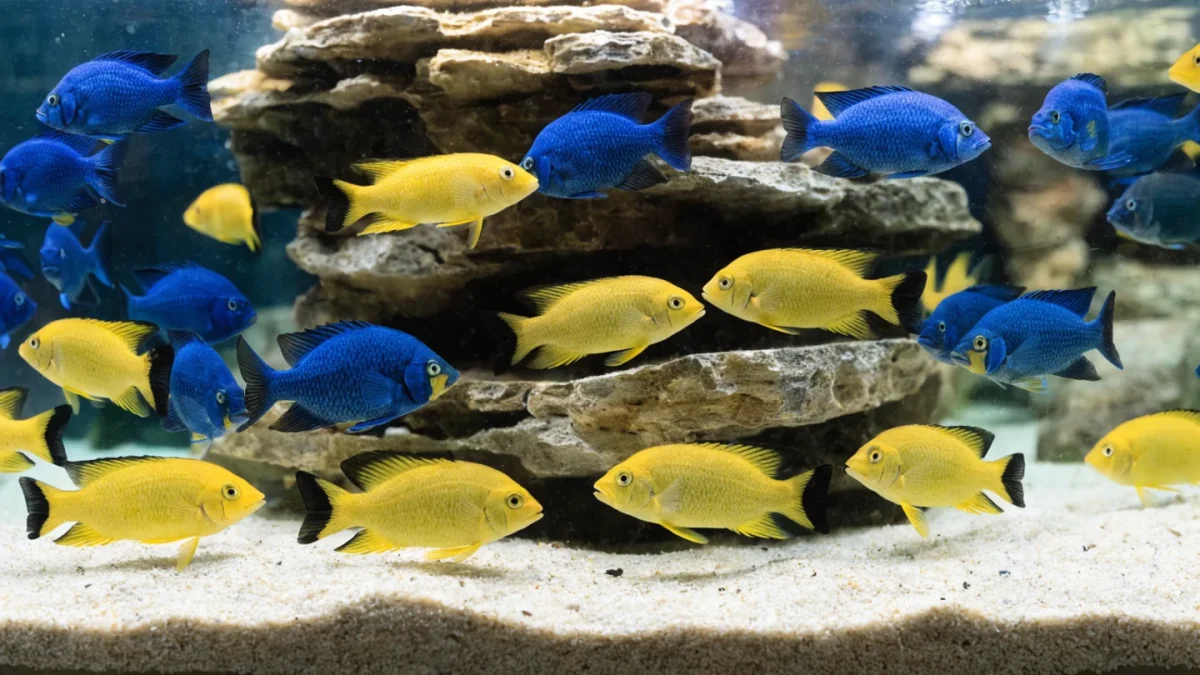
I walked into a breeder's fish room a few years back — wall-to-wall tanks, maybe forty of them — and every single one held African cichlids. Malawi mbunas in electric yellows and deep cobalt blues. Tanganyikan shell dwellers in tanks no bigger than a shoebox. Frontosa with those massive forehead humps drifting through a 300-gallon like slow-motion freight trains. The guy had been keeping them for over twenty years. "They ruined every other fish for me," he said. I understood completely.
African cichlids need hard, alkaline water between pH 7.8 and 8.6, a minimum tank of 55 gallons with extensive rockwork for territorial boundaries, and a species-appropriate diet. Herbivorous mbunas eat spirulina-based foods; carnivorous haps and peacocks need higher-protein pellets and frozen fare. Aggression isn't a problem to solve — it's a behavior to manage through tank design and stocking strategy.
If you've read the cichlid care fundamentals, you know the broad strokes already. This goes deeper into the African side.
The Three Lakes
Almost all African cichlids in the hobby come from three East African Rift Lakes, and each lake produces fish with distinct needs.
Lake Malawi is the hobby's workhorse. Mbunas (rock dwellers), haps (open-water predators), and peacocks (Aulonocara, sand sifters that display iridescent color) all originate here. Water parameters cluster around pH 8.0-8.4, GH 12-18, temperature 76-82°F. Malawi species are the most widely available and the easiest entry point.
Lake Tanganyika has even harder, more alkaline water — pH 8.5-9.0 in some areas. Tanganyikan cichlids include shell dwellers (Neolamprologus species that live in empty snail shells), Julidochromis (elongated cave dwellers), and the predatory frontosa (Cyphotilapia frontosa), which hunts sleeping fish at dawn and dusk. Tanganyikans tend to be more expensive and less forgiving of parameter swings.
Lake Victoria cichlids are less common in the hobby partly because many species are critically endangered in the wild. The ones available are colorful and active, but they hybridize readily, which makes maintaining pure species lines a constant concern for dedicated breeders.
Don't mix species from different lakes in the same tank. The chemistry overlap is close enough that survival is possible, but behavioral incompatibilities and aggression patterns differ between lake populations. Malawi mbunas and Tanganyikan shell dwellers have completely different social structures — forcing them together stresses both.
Tank Setup for Africans
Rocks. That's the short version.
The longer version: African cichlid tanks need stacked rock formations creating caves, overhangs, and visual barriers throughout the tank. I use a mix of limestone, ocean rock, and lace rock — anything with texture and holes that fish can claim as territory. Smooth river rocks look nice but don't create the kinds of tight hiding spots mbunas actually use.
Stack rocks directly on the glass bottom before adding substrate. Sand goes around and between the piles, not underneath. I learned this the hard way after a colony of demasoni undermined a rock tower by excavating a pit underneath it. The collapse didn't break anything that time, but the sound at three in the morning was enough to teach me.
Substrate should be sand — fine-grain pool filter sand or aragonite sand. Aragonite buffers pH upward, which helps maintain the alkaline conditions Africans need. Gravel works but mbunas can't sift it, and watching them try is like watching someone eat soup with a fork.
Plants are mostly decorative in mbuna tanks and won't survive long. Anubias attached to rocks and Java fern on driftwood are the exceptions — mbunas leave them alone because they don't taste good. Anything rooted in substrate will be uprooted within a day.
A friend runs a 75-gallon all-male peacock tank with no rocks at all — just sand and dim lighting. It works because peacocks are less aggressively territorial than mbunas. But that's a specialized approach for a specific group, not a general recommendation.
Stocking: The Overstocking Strategy
This confuses every beginner and I get asked about it constantly.
With mbunas, you deliberately overstock the tank. Fifteen to twenty fish in a 55-gallon isn't irresponsible — it's standard practice. The logic: when a dominant male can't single out one victim because there are too many targets, aggression gets diluted. One-on-one, a dominant demasoni will kill a subordinate in hours. Spread across fifteen fish, that energy becomes chasing and displaying rather than lethal assault.
This only works with adequate filtration and committed water changes. I run canister filtration rated for double my tank volume and change 35-40% weekly. Overstocking without overdoing filtration is just overcrowding, and that kills fish through water quality instead of aggression.
Stock in ratios. One male to three or four females per species. Mix species that look different from each other — a yellow lab, a red zebra, and a cobalt blue work because no male confuses another species for a rival. Three species of blue mbuna in the same tank is asking for cross-species aggression.
All-male tanks are the alternative. No breeding, reduced aggression from territorial spawning, and the males display their best color when surrounded by other colorful males. But species selection matters more here — research compatibility before buying.
Feeding Africans Right
Mbuna are herbivores. Full stop.
Their natural diet is aufwuchs — the biofilm of algae, microorganisms, and tiny invertebrates that coats rocks in Lake Malawi. In captivity, spirulina-based flakes or pellets replicate this. High-protein foods — especially bloodworms, which are often marketed as universal fish food — cause bloat in mbunas. Bloat kills fast, sometimes within 48 hours, and it's nearly impossible to reverse once symptoms appear.
I feed my mbunas a spirulina flake as the staple, with blanched zucchini or cucumber slices twice a week. That's it. No bloodworms, no brine shrimp, no high-protein sinking pellets. The temptation is to "treat" them, but the treat can kill them.
Peacocks and haps have different needs. They're omnivores to carnivores and do well on a varied diet: quality cichlid pellets, frozen mysis shrimp, brine shrimp, and occasional earthworm. Even with these species, I rotate food types rather than dumping protein at every feeding.
For a comparison with how South American cichlid species differ in their dietary requirements, the contrast is striking — what works for one continent can be dangerous for the other.
Dealing With Aggression Day-to-Day
A certain amount of chasing is normal. Healthy African cichlids are active, assertive fish. The display behaviors — flared gills, lateral posturing, lip-locking — are part of their social structure, and trying to eliminate them entirely means you've got the wrong fish.
What you're watching for is escalation. When one fish is hiding constantly, refusing food, showing torn fins, or being cornered with no escape route, the system has failed. Solutions in order of escalation:
Rearrange the rocks. Moving everything around resets territorial claims. Every fish has to re-establish its space, and the bully loses its advantage. I do this any time I see persistent harassment — usually every few months.
Remove the bully. Take the dominant aggressor out for two weeks in a separate tank, then reintroduce. When it comes back, it's the new fish, and the hierarchy has reshuffled. Sometimes this fixes the problem permanently. Sometimes the same fish regains dominance within days.
Add more fish. If aggression is concentrated because stocking is too low, adding three or four more females of the target species diffuses it. This sounds backward but follows the same principle as initial overstocking.
Remove the victim. If one fish is being singled out regardless of what you try, pull it. Some individuals just don't work in a particular group. A local fish club or online rehoming group can usually take them.
Frequently Asked Questions
What size tank do African cichlids need?
Fifty-five gallons is the realistic minimum for a Malawi mbuna colony. Seventy-five is better, and once you factor in rockwork displacing water volume, you want the extra capacity. Shell dwellers from Lake Tanganyika can work in smaller setups — a pair of Neolamprologus multifasciatus will thrive in a 10-gallon — but they're the exception. For haps and peacocks, 75 gallons minimum because they need swimming room.
Can I keep just one African cichlid?
Technically yes, but you'd be keeping a social animal in isolation. Some larger species like frontosa do fine as a solo showpiece in a big tank. For most mbunas and peacocks, though, their behavior is only interesting in a group, and a solitary cichlid in a tank of tetras is a stressed cichlid that will likely bully its tankmates.
How do I know if my African cichlid is male or female?
In many species, males are significantly more colorful. Male peacocks develop vivid blues, reds, and oranges while females stay silver-grey. Mbunas are trickier — some species (like yellow labs) look similar in both sexes, and you may need to vent them (examine the genital papilla) for accurate sexing. Venting takes practice. I got it wrong more often than right my first year.
Why do my African cichlids keep dying?
The three most common killers: bloat from wrong diet (usually feeding protein-heavy food to herbivorous mbunas), aggression from understocking or poor tank layout, and water quality crashes from inadequate filtration in an overstocked tank. Test your water, review your feeding, and check for a bully before assuming disease.