

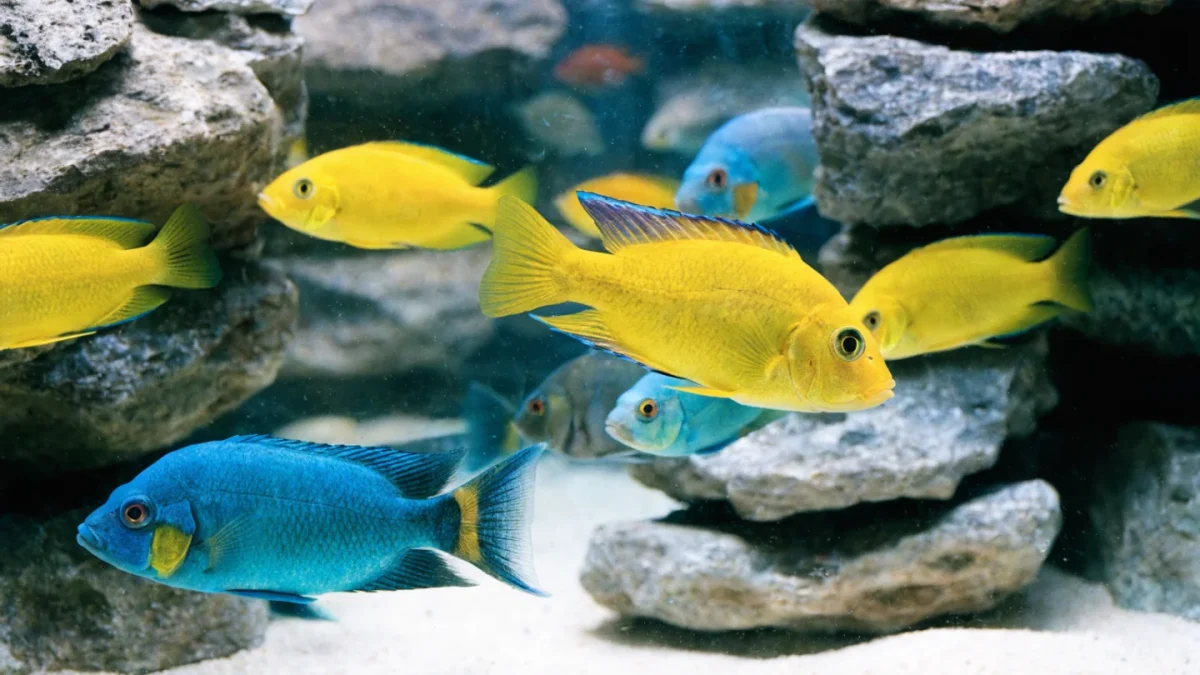
Seventeen years ago I bought six "assorted African cichlids" from a pet store bin. No species labels, no care sheet, no mention that three of them would grow to eight inches and terrorize everything else in my 30-gallon tank. Within a month I had two dead fish, a cracked heater from a territorial male ramming it, and a crash course in why cichlids aren't just "colorful community fish."
Cichlids need species-appropriate water chemistry, territory-conscious tank design, and a diet matched to their feeding type — herbivore, omnivore, or carnivore. African Rift Lake cichlids demand hard, alkaline water (pH 7.8-8.6) with rock structures for territory, while South American species like angelfish and discus prefer softer, warmer, slightly acidic conditions (pH 6.0-7.0). Get the region wrong and you're fighting water chemistry every week.
That early disaster taught me more than any care sheet could. And honestly, once I understood what I was doing wrong, cichlids became the fish I find hardest to stop keeping.
Two Worlds: African vs. South American
The word "cichlid" covers over 1,500 described species across multiple continents. But for most aquarists, the split that matters is African versus South American, because they require fundamentally different tank conditions.
African cichlids — primarily from Lakes Malawi, Tanganyika, and Victoria — evolved in mineral-rich, alkaline water. Their tanks look like underwater rock gardens. Aggression is a feature, not a bug; these fish establish and defend territories constantly, and your job is to manage that aggression through tank design and stocking density, not eliminate it.
South American cichlids come from rivers and floodplains with soft, acidic water stained by tannins. Think blackwater tributaries in the Amazon basin. Species range from the compact and relatively peaceful ram cichlid (Mikrogeophagus ramirezi) to the massive and personality-driven oscar (Astronotus ocellatus), which will outgrow a 55-gallon tank and still beg for food like a puppy.
You can't mix these two groups. Not because they'll fight — though they might — but because their water chemistry requirements are incompatible. A pH that keeps your mbunas healthy will stress your discus into disease. I've seen people try. It never ends well.
Tank Size: Bigger Than You Think
If cichlids have one universal rule, it's this: you need more tank than you expect.
For most African cichlid setups, I won't go below 55 gallons, and I actively push people toward 75 or larger. These fish are active, aggressive, and territorial. A small tank compresses territories until subordinate fish have nowhere to retreat, and that's when you find bodies in the morning.
South American cichlids vary more widely. A pair of German blue rams can thrive in a well-planted 20-gallon. A single oscar needs 75 gallons minimum — alone. Add a second large cichlid and you're looking at 125 gallons or more.
I had a couple contact me through a forum because their oscar was "acting depressed." Lethargic, dull coloring, refusing food. The tank? A 40-gallon breeder they'd had since the fish was two inches long. It was now eleven inches. That fish wasn't depressed — it was living in a closet.
Filtration Matters More Than Most Realize
Cichlids are messy. African mbunas constantly sift substrate and stir up detritus. Oscars are biological waste factories. Even smaller species like apistos produce more waste per body mass than most tropical freshwater species their size.
I run filtration rated for at least twice the tank's volume. A canister filter rated for 100 gallons on a 55-gallon cichlid tank isn't overkill — it's adequate. For large species or heavy stocking, I add a secondary sponge filter or a powerhead for extra circulation.
Weekly water changes of 25-40% are non-negotiable. I don't care how good your filter is. Dissolved waste products — nitrates especially — accumulate between changes, and cichlids show stress from nitrate buildup faster than most fish. Lateral line erosion, commonly called hole-in-the-head disease, is strongly associated with poor water quality combined with inadequate diet. Keep the water clean and you'll rarely see it.
The Rock Pile and Why It Exists
African cichlid tanks need structure. Lots of it.
Stacked rocks create sight-line breaks — visual barriers that let a subordinate fish disappear around a corner instead of being chased across open water. Without those breaks, dominant males patrol the entire tank and weaker fish get cornered and killed.
I stack rocks directly on the glass bottom, then add substrate around them. Never the reverse. Cichlids dig. If you put sand down first and then stack rocks on top, a digging fish will undermine the pile and you'll get an avalanche — potentially cracking the glass.
The rocks should create caves and passages. Not one big pile in the center, but distributed structures with multiple territories. I aim for at least one cave per fish, ideally two, spread across the tank so that no single male can control all of them.
South American setups look different. Driftwood, broad-leaf plants (real or realistic silk for plant-destroyers like oscars), and open swimming space. Angelfish need vertical height — at least 18 inches of water column. Discus want dim lighting and subdued decor. Your tank design follows the species, not the other way around.
For the full breakdown on materials, heating placement, and layout strategy, the habitat setup fundamentals article covers the principles that apply across all aquatic and terrestrial exotic setups.
Water Chemistry by Region
This is where people get into trouble. They buy a test kit, see that their tap water is pH 7.4 and moderately hard, and assume any cichlid will be fine.
African Rift Lake cichlids want:
- pH 7.8-8.6 (Lake Malawi tends toward 8.0-8.4; Tanganyika species often prefer 8.5+)
- General hardness (GH): 8-20 dGH
- Carbonate hardness (KH): 10-15 dKH
- Temperature: 76-82°F depending on species
South American cichlids want:
- pH 6.0-7.2 (discus prefer the lower end; severums are more flexible)
- GH: 2-8 dGH
- KH: 1-5 dKH
- Temperature: 78-86°F (discus run warm, 82-86°F; rams and apistos do well at 80-82°F)
If your tap water naturally matches one group's requirements, you're in luck — go with that group. Don't fight your water. Chasing a target pH with chemical buffers is unstable, stressful for the fish, and will drive you to quit the hobby. Crushed coral in a filter bag can gently raise pH and hardness for Africans. Peat or Indian almond leaves lower it for South Americans. But these are fine-tuning tools, not magic tricks.
Feeding Across the Family
The single most common cichlid care mistake I encounter is feeding the wrong diet.
Mbunas — the rock-dwelling cichlids from Lake Malawi — are primarily herbivorous algae grazers. Feed them high-protein food designed for carnivorous fish and you're looking at bloat, which kills fast and is often irreversible. Their staple should be a spirulina-based flake or pellet with minimal animal protein.
Haps and peacocks (also Lake Malawi, but open-water and sandy bottom species) are omnivores to carnivores. They do well on a varied diet of quality pellets, frozen foods like brine shrimp and mysis, and occasional earthworm.
South American cichlids vary widely. Oscars eat practically anything — pellets, frozen shrimp, earthworms, the occasional feeder (though I strongly prefer frozen over live for disease prevention). Discus are notoriously picky and do best on a rotation of frozen bloodworms, beef heart mixes, and high-quality granules.
Beef heart is traditional for discus, but it should be extremely lean — trimmed of every visible bit of fat. The claim that fish "can't metabolize" mammalian saturated fats gets repeated constantly in the hobby, but published aquaculture research hasn't actually confirmed it as a clear-cut toxicity issue. What is well-documented is that high-fat diets in general cause hepatic lipidosis (fatty liver) in fish — a 2020 study in Frontiers in Marine Science demonstrated this in tilapia — so keeping beef heart lean is still the right call regardless of the fat source.
Aggression: The Feature You Have to Manage
Every cichlid keeper deals with aggression eventually. Even the "peaceful" species — rams, apistos, keyhole cichlids — become territorial during breeding.
For African cichlids, aggression management is the core skill. Overstocking — yes, overstocking — is a legitimate and widely used strategy for mbunas. When you have 15-20 fish in a 55-gallon tank instead of 8, no single individual can establish absolute dominance. The aggression gets spread across so many targets that no one fish takes the brunt of it. This feels counterintuitive, but it works. It does require robust filtration and frequent water changes, because you're running a higher bioload than the "inch per gallon" crowd would tolerate.
Stock in ratios of one male to three or four females per species. Mixed all-male tanks work too, but they require careful species selection — you need fish that look different enough that they don't trigger territorial responses against their own species.
For South Americans, aggression spikes around breeding. Paired angelfish will murder tankmates if the tank is too small. Oscars that were best friends for two years will suddenly decide the tank belongs to one of them. Space and sight-line breaks solve most of these problems. Moving decor around after a territory is established — rearranging rocks, shifting driftwood — can reset hierarchies when things get out of hand.
Breeding: Expect It
If you keep cichlids long enough, they'll breed. Many species breed readily in captivity, and some — particularly mbunas — will produce fry every 3-4 weeks if conditions are stable.
African mouthbrooders are fascinating. The female holds fertilized eggs in her mouth for 2-4 weeks, during which she doesn't eat. You'll notice a swollen jawline and her refusal of food. After release, fry are surprisingly large and self-sufficient compared to egg-scatterers.
South American substrate spawners — angelfish, rams, severums — lay eggs on flat surfaces and both parents guard them aggressively. Watching a pair of angelfish defend their eggs from tankmates twice their size is genuinely impressive.
The practical question is: what do you do with the fry? If you're not set up to raise and rehome them, consider keeping all-male or all-female groups for African species. For substrate spawners, tankmates often solve the problem for you — community tanks rarely produce surviving fry without intervention from the keeper.
Common Health Problems
Cichlid diseases almost always trace back to water quality, diet, or stress from aggression. Fix those three things and you prevent ninety percent of illness.
Malawi bloat hits herbivorous mbuna species hard and progresses fast — loss of appetite, swollen abdomen, white or stringy feces. It's often fatal within days. The root cause is almost always dietary: too much protein, or the wrong kind. Prevention is the only reliable strategy.
Ich (white spot disease) appears when fish are stressed, usually from a temperature swing, a new introduction, or poor water quality. It's treatable if caught early — raising temperature to 86°F and adding aquarium salt is the first-line approach, with copper-based medications as backup.
Hole-in-the-head disease (HLLE) shows up as pitting erosions around the head and lateral line. It's associated with high nitrates, carbon filtration removing trace minerals, and vitamin-poor diets. I've seen it reverse completely with improved water quality and dietary variety, but advanced cases leave permanent scarring.
A Quick Starter Decision Framework
If you're standing in front of a tank of cichlids at a fish store trying to decide, ask yourself these three questions:
What's my tap water like? Hard and alkaline? African cichlids are your natural match. Soft and acidic or neutral? South Americans will be easier.
How big a tank can I realistically maintain? Under 55 gallons, stick to dwarf species — rams, shell dwellers, apistos. Over 75 gallons, the full range of mbunas, peacocks, angelfish, and severums opens up. Over 125, you can think about oscars and other large species.
How much time will I spend on water changes? Cichlids aren't set-and-forget fish. Weekly maintenance is the minimum. If that sounds exhausting, a planted community tank with tetras might honestly make you happier.
That's not a knock on anyone. It's a reality check I wish someone had given me before I impulse-bought those six assorted Africans and learned everything the hard way.
Frequently Asked Questions
Can I keep African and South American cichlids together?
No. Their water chemistry needs are too different — hard alkaline water for Africans, soft acidic for most South Americans. Even if you found a middle ground both could survive in, neither group would thrive, and you'd be stacking stress that leads to disease. Pick a continent.
How many cichlids can I put in a 55-gallon tank?
For African mbunas, 15-20 is a functional range when paired with strong filtration and 30-40% weekly water changes. That high density spreads aggression. For South American species, it depends entirely on the species — a pair of large angelfish and a school of tetras, or maybe a trio of rams. Don't apply African stocking logic to South Americans; they need more personal space.
Do cichlids need live plants?
Mbunas will uproot and eat most plants. Don't bother unless you're using anubias or Java fern attached to rocks (they'll leave those alone because they taste bitter). South American tanks benefit enormously from live plants — Amazon swords, vals, floating plants for shade — and species like angelfish and rams genuinely feel more secure with plant cover.
Why is my cichlid hiding and not eating?
New fish hide for days to weeks. That's normal. If an established fish suddenly hides, check for aggression — look for torn fins or a bully monopolizing the tank. Also test water parameters immediately. A pH crash or ammonia spike will make fish reclusive before it makes them visibly sick. Females holding eggs in their mouths (mouthbrooders) will also refuse food for weeks.
How often should I do water changes for cichlids?
Weekly, minimum. I change 30-40% in my heavily stocked African tanks and 25-30% in my South American setups. Some discus keepers do 50% every other day. The more fish, the more waste, the more water you need to move. Buy a Python-style water changer and hook it to your sink — carrying buckets gets old fast when you're maintaining 75+ gallons.