

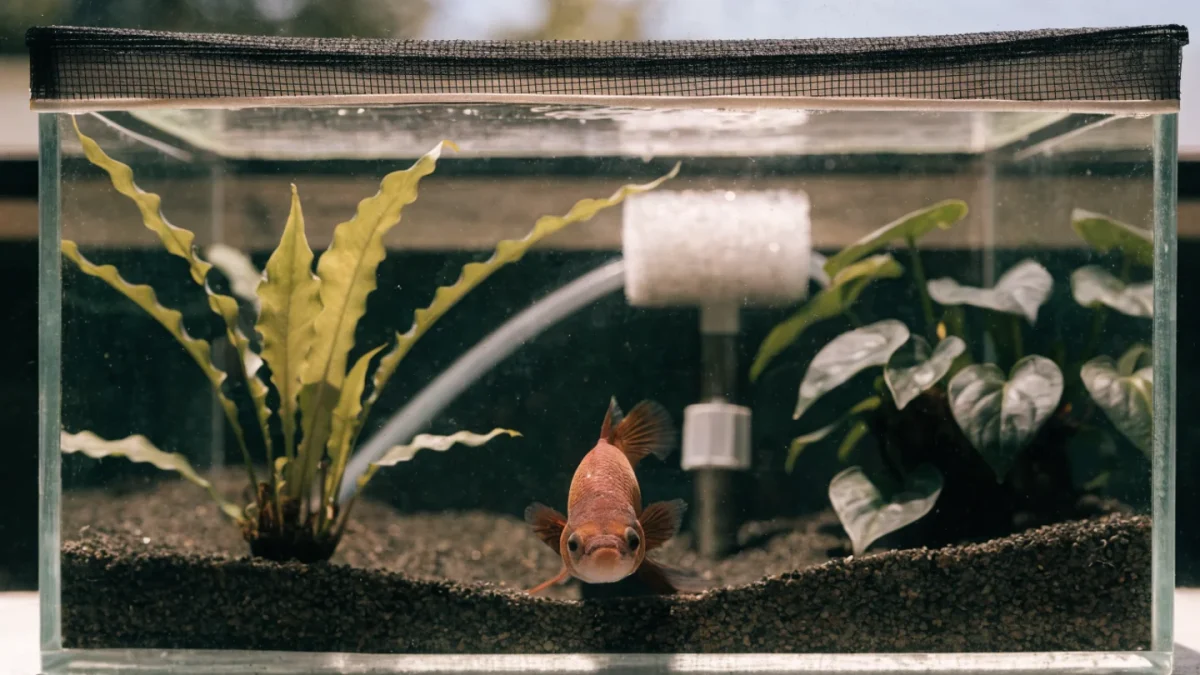
Thirty-seven dollars. That's what the whole "betta starter kit" cost at a pet store I walked through last month — a 1-gallon plastic cube, a packet of gravel, a tiny bottle of water conditioner, and some freeze-dried food. No heater. No filter. No mention of cycling. Everything a new keeper needs to kill a fish slowly over three months while thinking they're doing it right.
A real betta fish tank setup requires a heated, filtered, cycled aquarium of at least 5 gallons. The fish needs stable tropical temperatures, biological filtration that processes waste without creating strong currents, and plants or decor that provide shelter. None of that fits in a plastic cube.
I'm going to walk through this step by step — the same way I'd set up a tank if I were starting from scratch today. The whole process takes about 30-45 minutes of hands-on work, plus 4-6 weeks of patience while the tank cycles before a fish goes anywhere near it.
Step 1: Choose the Right Tank Size
Five gallons is the minimum. I keep my bettas in 10-gallon tanks and I'll tell you why: a 10-gallon is barely more expensive than a 5, it's more stable in terms of water chemistry (more water = slower parameter swings), and it gives you room for live plants and possibly tankmates down the road.
A 10-gallon also makes maintenance easier. Sounds counterintuitive, but smaller tanks are harder to keep clean because waste concentrations spike faster. A single missed water change in a 3-gallon can push ammonia into dangerous territory. In a 10-gallon, you have more buffer.
Avoid tall, narrow tanks. Bettas are surface breathers — they gulp air from the surface using their labyrinth organ. A tank that's 20 inches tall but only 8 inches across forces them to make long vertical trips constantly. Go for a standard rectangular tank with more horizontal swimming space.
Step 2: Filtration That Won't Push Them Around
Bettas have long, flowing fins that act like parachutes in a current. A filter meant for a community tank will blow a halfmoon betta around like a leaf in a storm. I've seen bettas in strong currents wedge themselves behind decorations just to rest — that's stress, not preference.
Sponge filters are my go-to for betta tanks. They run on an air pump, provide excellent biological filtration, create almost no current, and double as a surface for beneficial bacteria. The gentle bubbling is enough to keep the water moving without creating flow.
Hang-on-back filters work if you baffle the output. A piece of filter sponge rubber-banded over the outflow, or a water bottle cut and positioned as a diffuser, slows the current to a manageable level. I've used this approach on a few of my tanks and it works fine.
Internal filters with adjustable flow are another option. Turn them to the lowest setting and point the output toward the glass wall so the flow disperses.
Whatever you choose, the filter needs to house beneficial bacteria for the nitrogen cycle. That's its primary job — not mechanical clarity. A crystal-clear tank with no biological filtration is a death trap.
Step 3: Heating
I'm going to keep beating this drum because it matters: bettas need 76-82°F. An adjustable heater with a built-in thermostat is the right equipment. Preset heaters locked at a single temperature can't be tuned if they run high or low, and in my experience, a good number of them do.
For a 5-gallon tank, a 25-watt adjustable heater is sufficient. For a 10-gallon, go with 50 watts. Place it near the filter output or in an area with water movement so heat distributes evenly.
Use a separate thermometer to verify the heater's accuracy — don't trust the heater dial alone. Stick-on strip thermometers are cheap but imprecise. A digital probe thermometer with a suction cup is more reliable and costs very little more.
One mistake I see: placing the heater too close to the substrate or decorations. It needs clearance for water circulation around the heating element. Follow the manufacturer's minimum clearance. A heater resting against gravel in a dead-flow zone can create a localized hot spot.
Step 4: Substrate and Hardscape
Dark substrates make betta colors pop and seem to reduce stress behavior — I've compared bettas on white gravel versus dark sand in my own tanks and the dark-substrate fish consistently show more vibrant coloring and less glass surfing. Fine sand or smooth gravel both work. Avoid rough-edged gravel that could tear fins if the betta rests on the bottom.
Rinse your substrate thoroughly before adding it. And I mean thoroughly — run water through it until it's clear. Unrinsed gravel or sand will cloud your water for days.
Decorations should have no sharp edges. Run a piece of pantyhose over every decoration — if it snags, it'll snag betta fins. I've lost a beautiful crown tail to a plastic castle with a rough seam inside one of the windows. Not worth it.
Driftwood is excellent if you don't mind the initial tannin staining (the water turns tea-colored). The tannins actually lower pH slightly and have mild antifungal properties. Many betta keepers seek this out deliberately. Boiling the driftwood first reduces the color leaching.
Step 5: Plants
Live plants are worth the effort. They consume nitrate, provide hiding spots, offer resting places near the surface (betta leaf hammocks are a thing), and make the tank look worlds better.
For your first betta tank setup, I'd recommend the basics as covered in our guide to habitat setup fundamentals for exotic pets — start with hardy, low-light species:
- Java fern — attach to driftwood or rock, don't bury the rhizome
- Anubias — same deal, rhizome above substrate
- Java moss — tie to hardscape, grows in almost anything
- Floating plants — water lettuce, frogbit, or salvinia provide surface cover that bettas love
You don't need CO2 injection or high-intensity lighting for these. A basic LED aquarium light on a timer (8-10 hours per day) is enough.
If plants aren't your thing, silk plants are the acceptable alternative. Never plastic with sharp edges.
Step 6: Cycle the Tank Before Adding the Fish
This is where patience saves lives. The nitrogen cycle — ammonia → nitrite → nitrate — needs 4-6 weeks to establish in a new tank. During this time, beneficial bacteria colonize your filter media and substrate.
Fishless cycling method:
- Set up the full tank — substrate, filter, heater, plants, everything running
- Add pure ammonia (no surfactants or additives) to bring ammonia to 2-4 ppm
- Test daily with a liquid test kit
- After 1-2 weeks, nitrite will appear as bacteria begin converting ammonia
- Continue dosing ammonia to keep feeding the bacteria
- When ammonia and nitrite both read 0 ppm within 24 hours of dosing, and nitrate is present — the cycle is complete
- Do a large water change (50-75%) to bring nitrate down, then add your betta
I know six weeks feels like an eternity when there's an empty tank on your desk. But I've fielded too many panicked messages from people who added a betta to an uncycled tank and are now watching it struggle. An ammonia burn is a miserable way for a fish to live. The wait is worth it.
Bottled bacteria products can accelerate the process, and some keepers report full cycles in 2-3 weeks with them. Results are inconsistent in my experience, but they're worth trying alongside the traditional method.
Step 7: Acclimation
Once your tank is cycled and parameters are stable, it's time to bring the fish home. Don't just dump the betta in.
Float the sealed bag or cup in the tank for 15-20 minutes to equalize temperature. Then add small amounts of tank water to the bag every five minutes over 30-45 minutes. This lets the fish adjust to your water chemistry gradually. Finally, net the fish out and release it into the tank — don't pour the store water in, it's often polluted.
Dim the lights for the first few hours. Let the betta explore on its own terms. Most will hide briefly, then start investigating. By the next morning, they're usually patrolling their new territory with full confidence.
For the full picture on water chemistry, diet, and ongoing maintenance, the complete betta care overview covers everything beyond the initial setup.
Frequently Asked Questions
Can I use a tank smaller than 5 gallons?
You can, but you're making everything harder on yourself and the fish. Water parameters swing faster in small volumes, temperature is harder to maintain, and the fish has less room for natural behavior. I've seen bettas survive in 2.5-gallon tanks with diligent maintenance, but "survive" is different from "thrive." If space is genuinely limited, 5 gallons is the smallest I'd recommend. Below that, you're working against the physics of a small water volume constantly.
How long should I run the tank before adding a betta?
Four to six weeks for a fishless cycle. You're waiting for beneficial bacteria to colonize, which can't be rushed reliably. Some people use established filter media from another tank to seed bacteria — that can cut the time to 1-2 weeks. But verify with a test kit. The cycle is done when ammonia and nitrite both read zero within 24 hours of dosing ammonia, not before.
Do I need a light?
Bettas don't strictly need intense lighting, but a basic LED on a timer mimics a natural day/night cycle, which matters for their circadian rhythm. Eight to ten hours on, fourteen to sixteen hours off. If you have live plants, the light feeds them too. Avoid leaving lights on 24/7 — bettas rest at night and constant light stresses them.