

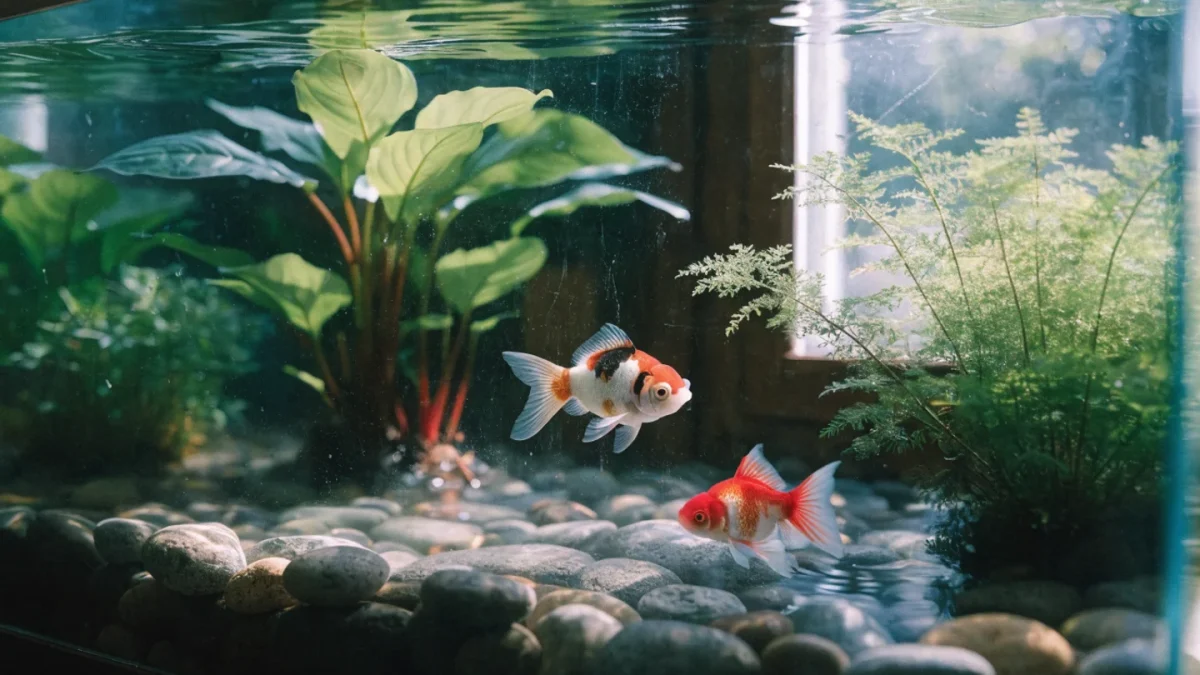
The calico oranda I rescued from a pet store clearance bin in 2014 is still alive. She's about the size of my fist now, lives in a 200-liter planted tank, and has survived two moves and one close call with ammonia after a filter failure. Most people hear that and don't believe me — because most people's goldfish die within a year.
Proper goldfish care requires a spacious tank (at least 75 liters for one fish), robust filtration rated for double your tank volume, weekly partial water changes, and a varied diet that goes beyond flake food. When goldfish die young, the cause is almost always an undersized container with no filtration and no water changes. Get those basics right, and you're looking at a pet that can live 10 to 25 years.
That gap between "what people assume" and "what goldfish actually need" is what this guide covers.
They Aren't Starter Fish
I've lost count of the messages I get from parents who bought their kid a goldfish at a fair, put it in a bowl, and now want to know why it's floating sideways three weeks later. The problem starts with the framing. Goldfish got labeled as beginner pets because they're cheap to buy — but cheap to buy and cheap to keep are very different things.
A single fancy goldfish needs at minimum 75 liters of water. A common or comet goldfish, the kind you win at carnivals, is actually a pond fish that can reach 30 centimeters and needs 150 liters or more. That's not an opinion I'm pushing. It's the biological reality of how much waste these fish produce and how much dissolved oxygen they require.
I used to think 40 liters was fine for one fancy. I kept my first ranchu in a tank that size for about eight months before the chronic fin rot forced me to upgrade. Within three weeks of moving her to a larger tank, the fin rot cleared up without medication. The water volume itself was the treatment.
Goldfish Types at a Glance
There are over 200 recognized goldfish varieties, but they fall into two practical categories: single-tail and fancy (double-tail).
Single-tail goldfish — commons, comets, shubunkins — are the athletes. Fast swimmers, massive appetite, enormous growth potential. These belong in ponds or very large tanks (200+ liters). They're also the ones most often sold at fairs and pet stores to people with 10-liter tanks. The mismatch is brutal.
Fancy goldfish — orandas, ryukins, telescopes, ranchus, pearlscales — are the slower, rounder varieties bred for appearance. Their compressed body shape makes them less efficient swimmers and more prone to swim bladder issues, but they're better suited to indoor aquariums. Most fancies do well in 75-150 liters per fish, depending on variety.
Never mix singles and fancies in the same tank. Single-tails are faster and will outcompete fancies for food. I've seen telescopes slowly starve in tanks with comets because they simply couldn't reach the food in time.
Tank Setup Fundamentals
Size
I already mentioned the minimums, but bigger genuinely is better here. Goldfish are messy. They produce more ammonia per body weight than most tropical fish, and they grow continuously throughout their lives if given adequate space. A tank that seems spacious for a 5-centimeter juvenile will feel cramped within a year.
My recommendation for a first goldfish tank: 110-150 liters for one or two fancies. That gives you a genuine margin for error on water quality, which matters enormously when you're learning.
Filtration
This is where goldfish keeping either works or falls apart. You need a filter rated for at least 1.5 to 2 times your actual tank volume. A 100-liter tank needs filtration rated for 150-200 liters. Goldfish produce heavy bioload — partially digested food, constant waste, and they love to uproot plants and stir up sediment.
Hang-on-back filters work for smaller setups. Canister filters are better for anything over 100 liters. Whatever you choose, look for adjustable flow — fancies in particular struggle with strong currents because of their body shape.
Substrate and Decor
Bare-bottom tanks are easiest to clean. Sand is the next best option. Avoid small gravel — goldfish forage by sucking up substrate and spitting it out, and they can choke on pieces between 3-8 millimeters. I've had to help extract gravel from a goldfish's mouth more than once. It's stressful for everyone involved.
Live plants add oxygen and help absorb nitrates, but goldfish eat most plant species. Anubias, java fern, and java moss survive reasonably well because goldfish find them unpalatable. Everything else is an expensive salad.
Temperature
Goldfish are coldwater fish — 18 to 22°C is the comfortable range for fancies, and single-tails tolerate down to about 10°C in ponds. They don't need heaters in most homes, but they do need consistency. Temperature swings of more than 2-3 degrees in a day stress them, and stress opens the door to disease.
One thing that surprises people: goldfish can overheat. Anything above 26°C for extended periods is dangerous. If your house runs warm in summer, a small fan blowing across the water surface drops temperature by a couple of degrees through evaporative cooling.
Water Quality: The Thing That Kills Most Goldfish
If I could only teach one concept to every new goldfish keeper, it would be the nitrogen cycle. Fish produce ammonia. Beneficial bacteria in your filter convert ammonia to nitrite, then nitrite to nitrate. Ammonia and nitrite are toxic at any detectable level. Nitrate is tolerable up to about 40 ppm but ideally stays below 20.
A new tank has no beneficial bacteria. This is why "cycling" a tank before adding fish is critical — you're building that bacterial colony so it can process waste from day one. Cycling takes 4-6 weeks. Yes, that means setting up a tank with no fish in it for over a month. I know. Nobody wants to hear that.
Water Changes
Weekly water changes of 25-30% are the baseline. I do closer to 40% on my heavily stocked tank. Use a dechlorinator — chlorine and chloramine in tap water kill beneficial bacteria and damage fish gills. Match the temperature of new water to within a degree or two of the tank water before adding it.
Testing
Get a liquid test kit, not strips. Test for ammonia, nitrite, nitrate, and pH weekly for the first three months, then biweekly once things stabilize. Ideal parameters:
- Ammonia: 0 ppm
- Nitrite: 0 ppm
- Nitrate: under 20 ppm (under 40 ppm acceptable)
- pH: 7.0 to 8.4 (stability matters more than hitting an exact number)
Diet: More Than Flakes
Goldfish are omnivores with a long digestive tract and no stomach. That "no stomach" part matters — they can't process large meals efficiently, so small feedings two to three times daily work better than one big dump of food.
A good base diet is a sinking pellet formulated for goldfish. Sinking matters because goldfish that gulp food from the surface often swallow air, which contributes to buoyancy problems. Soak pellets for a few minutes before feeding to soften them and reduce air content.
Beyond pellets, variety keeps goldfish healthy:
- Blanched peas (skinned) — the classic swim bladder remedy, but also a solid regular food. I feed peas twice a week.
- Blanched leafy greens — spinach, romaine, zucchini slices. Clip them to the tank wall and let fish graze.
- Frozen bloodworms or brine shrimp — once or twice a week as a protein boost. Not daily, or you risk fatty liver issues.
- Duckweed or other floating plants — goldfish love grazing on these, and they're basically free if you grow them in a separate container.
Skip the dried tubifex worms. The processing often doesn't eliminate pathogens completely, and the risk isn't worth it when safer alternatives exist.
How Much to Feed
The "as much as they can eat in two minutes" rule is a decent starting point, but I find it too generous for most keepers. A better guideline: feed an amount roughly equal to the size of one of the fish's eyes, two to three times per day. Goldfish will always act hungry. Always. They are not a reliable indicator of whether they've had enough food.
Common Diseases
Most goldfish diseases stem from poor water quality. Fix the water, and you prevent 80% of health issues before they start.
Ich (white spot disease) shows up as tiny white dots covering the body and fins, like grains of salt. The fish will flash — rub against surfaces — before spots appear. Raising temperature to 25°C (for fancies only; do this gradually over 24 hours) speeds up the parasite's life cycle so it reaches the free-swimming stage where treatment is effective. Adding aquarium salt at 1 tablespoon per 20 liters reduces osmotic stress on the fish and supports recovery, though research — including a 2001 study by Tieman and Goodwin — suggests salt alone is less effective than medication. For stubborn cases, malachite green-based treatments are more reliable.
Fin rot starts as ragged, whitish edges on fins and progresses inward. Almost always a water quality issue. Clean water and frequent water changes are the first treatment. If it doesn't improve within a week, an antibacterial medication may be needed — see an aquatic vet.
Swim bladder disorder is so common in fancies that it deserves its own discussion. The fish floats sideways, nose-down, or can't maintain its position in the water column. Overfeeding, constipation, and the compressed body shape of fancies all contribute. Fasting for 24-48 hours followed by skinned peas often helps, but chronic cases can indicate a deeper anatomical issue.
Dropsy — where the body swells and scales stick out like a pinecone — is usually a symptom of organ failure rather than a disease itself. By the time scales are pineconing, the prognosis is poor. Prevention through excellent water quality is genuinely the only reliable approach.
The Myths That Harm Goldfish
I hear these constantly, and each one contributes to premature goldfish deaths.
"Goldfish only grow to fit their tank." No. Their external growth may slow in cramped conditions, but their internal organs continue growing, leading to organ compression and failure. A goldfish in a bowl isn't "adapting" — it's being slowly crushed from the inside.
"Goldfish have a three-second memory." Research has demolished this one repeatedly. Studies — including maze-learning experiments documented by the American Museum of Natural History — have shown goldfish retain spatial memory for months, learn to associate sounds with feeding, and navigate complex environments. The science debunking the three-second myth has been around for over 60 years.
"Goldfish are fine without a filter." They produce too much waste to survive long-term without biological and mechanical filtration. Bowls without filters become ammonia traps.
"They're disposable pets." A properly cared-for goldfish lives 10-25 years. Some have reached 40+. They're a genuine long-term commitment.
Tank Maintenance Routine
Weekly:
- 25-30% water change with temperature-matched, dechlorinated water
- Gravel vacuum or substrate siphon
- Rinse filter media in removed tank water (never tap water — chlorine kills beneficial bacteria)
- Test water parameters
Monthly:
- Clean the inside glass with an algae pad
- Trim dead plant material
- Check equipment — heater (if used), filter impeller, air stone
Every 6-12 months:
- Replace filter media gradually — never all at once, or you'll crash your nitrogen cycle
- Inspect tubing and seals for wear
Choosing Your Goldfish
Buy from a reputable source — someone who keeps their goldfish in filtered, appropriately sized tanks. At a store, look for:
- Active swimming, not hovering in corners or near the surface
- Clear eyes, no cloudiness
- Intact fins with no ragged edges or red streaks
- No white spots, fuzzy patches, or visible sores
- A full body shape without sunken belly or pineconing scales
I'd also recommend watching the fish eat before buying if the store allows it. A fish that won't eat in a store environment may already be sick.
If you're drawn to fancy varieties, start with something hardy. Orandas and ryukins are more forgiving of beginner mistakes than telescope eyes or bubble eyes, which have additional vulnerability due to their exaggerated features. And if you like betta fish care, know that bettas and goldfish shouldn't share a tank — bettas need warmer water and calmer environments.
Frequently Asked Questions
Can goldfish live in a bowl?
Technically, a goldfish can survive in a bowl for a while — the way you could survive in a closet for a while. The ammonia builds up within hours without filtration, oxygen levels drop, and the fish's growth becomes stunted. Bowls are a slow death sentence. I've never seen a bowl-kept goldfish that looked genuinely healthy.
Do goldfish need a heater?
Most of the time, no. They're coldwater fish comfortable between 18-22°C. But if your room temperature drops below 15°C regularly — a garage setup in winter, for instance — a low-wattage heater set to 18°C prevents dangerous temperature crashes. Consistency matters more than a specific number.
How many goldfish can I keep together?
For fancies, one fish per 75 liters as a starting point, then add 40 liters per additional fish. So a 150-liter tank comfortably holds two to three fancies. Single-tails need significantly more space. And always account for adult size, not the size at purchase — that 3-centimeter fish at the store will be 15 centimeters within two years.
Can goldfish live with tropical fish?
Not well. Goldfish need cooler water than most tropical species, they're messy enough to overwhelm filtration in community setups, and some tropicals will nip at goldfish fins (especially long-finned fancies). White cloud mountain minnows and weather loaches are two of the few compatible tankmates.
My goldfish is turning white — is it sick?
Not necessarily. Goldfish change color throughout their lives, and losing orange or red pigment is common, especially in fish that don't get much natural or full-spectrum light. Some varieties are genetically prone to color changes. As long as the fish is eating, active, and has no other symptoms, color loss alone isn't a health concern.