

Someone emailed me photos of their 29-gallon tank last fall — a tiger barb, a male betta, an angelfish, and two neon tetras. They wanted to know why the betta's fins looked "ragged." I didn't even need to answer. The tiger barb had been treating those flowing fins like a buffet, and the angelfish was probably finishing off whatever the barb missed. Two neon tetras in that mix were just living on borrowed time.
A community tank setup that actually works depends on matching species by water temperature, pH, tank level, and temperament. Stock schooling fish in groups of six or more, introduce fish gradually over weeks rather than all at once, and always verify adult size before purchasing. The goal isn't cramming the most species into one tank — it's creating a system where every fish behaves normally.
Tank Size Sets the Rules
Bigger tanks aren't just "nicer to have." They're more stable. Water chemistry shifts more slowly in 40 gallons than in 10, which means your mistakes have a longer correction window. A pH swing that happens over twelve hours in a 10-gallon might take three days in a 55-gallon, giving you time to notice and respond.
For a proper community — multiple species, multiple tank levels, reasonable stocking density — I wouldn't go smaller than 20 gallons. A 20-gallon long (30 x 12 x 12 inches) gives you more horizontal swimming space than a 20-gallon tall, and most community fish are horizontal swimmers. They don't care about vertical space the way an arboreal reptile would.
That said, I've helped people build surprisingly good communities in 10-gallon tanks. It's just harder. Your species choices shrink dramatically, your margin for error is thinner, and overstocking happens fast. If you're starting your first community, a 29-gallon or larger saves you from yourself.
The Three-Layer Approach
Think of your tank as an apartment building.
Top floor: surface dwellers. Hatchetfish, some killifish, endlers. These fish hang at or near the waterline and often jump, so a tight-fitting lid matters.
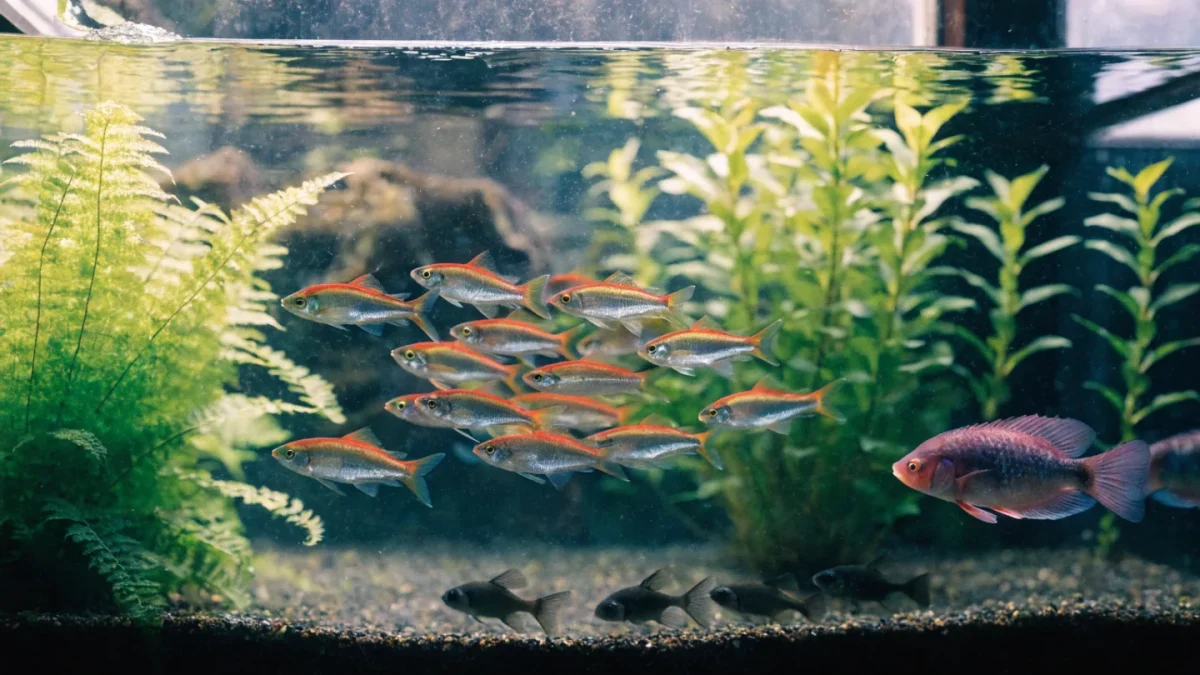
Middle floors: your main visual attraction. Tetras, rasboras, dwarf gouramis, smaller barbs. This is where the schooling action happens and what draws people's eyes when they look at your tank.
Ground floor: bottom feeders. Corydoras, kuhli loaches, small bristlenose plecos, shrimp. These fish scavenge missed food, sift through substrate, and add life to a zone that otherwise looks empty.
A tank stocked across all three layers looks fuller and more dynamic than one where every fish occupies the same space. It also distributes territorial pressure. Mid-level fish rarely bother bottom feeders, and surface dwellers mostly ignore both.
One thing I've noticed after years of building community tanks — the bottom layer is where beginners underinvest. They'll have twelve tetras swimming in the middle and nothing on the substrate. Adding a group of corydoras transforms the tank from "fish in water" to something that feels like a living ecosystem. The tropical freshwater fish hobby clicks for most people when their tank has activity at every level.
Compatibility Beyond "Peaceful"
Every fish at the store gets labeled "peaceful" or "semi-aggressive." Those labels are almost useless. A tiger barb is labeled semi-aggressive, but in a group of twelve, they mostly harass each other and leave other species alone. Keep three tiger barbs and they redirect that energy at everything else in the tank.
What actually matters:
Fin shape. Long-finned species — male bettas, fancy guppies, angelfish — attract fin-nippers. Tiger barbs, serpae tetras, and Buenos Aires tetras will shred those fins. Keep them separate.
Size at maturity. A fish that fits in another fish's mouth will eventually end up there. That angelfish you bought as a cute quarter-sized juvenile will grow to six inches and start looking at your neon tetras as snacks rather than neighbors.
Breeding behavior. Cichlids — even "peaceful" ones like kribensis — turn territorial when breeding. A pair of kribs guarding eggs in a community tank will terrorize fish three times their size. It's amazing to watch but brutal on the tankmates.
Activity level. Fast, darting fish stress slow-moving species. Giant danios zipping around a tank will make a pearl gourami hide permanently. Match energy levels, not just aggression levels.
Stocking Order Matters
Add the most timid species first. Let them establish territories and feeding patterns before introducing bolder fish. If you add a dominant species first, they'll claim the entire tank as theirs, and every fish added afterward is an intruder in their territory.
I stock community tanks in this sequence: bottom feeders first, then schooling mid-level fish, then the centerpiece species last. Each group gets at least a week to settle before the next addition. That means a fully stocked community tank takes a month to build out. Patience feels slow. Ammonia poisoning feels worse.
Quarantine every new addition. A bare 10-gallon with a sponge filter, a heater, and a hiding spot is enough. Two weeks minimum — observe for signs of disease before exposing your established community. The fish store's tank has been cycling through stock from multiple suppliers. Whatever disease is floating around their system comes home with your purchase. Understanding the broader habitat setup fundamentals applies here too — quarantine tanks follow the same heating and filtration principles as display tanks.
Filtration and Flow
Community tanks need filtration rated for at least the tank's full volume per hour. A 30-gallon tank wants a filter that pushes at least 30 gallons per hour. More is usually better, up to a point — heavy flow stresses fish that come from still or slow-moving water.
Hang-on-back filters work for most community setups. Canister filters are overkill for small tanks but become worthwhile at 40 gallons and above. Sponge filters are gentle, inexpensive, and perfect for tanks with fry or shrimp. I run sponge filters in every quarantine and breeding tank I own.
Surface agitation — the ripple effect from your filter output — drives gas exchange. Oxygen in, CO2 out. Without adequate surface agitation, a heavily stocked tank can develop oxygen-poor zones near the substrate where your bottom feeders live. That's a problem you don't notice until a corydoras starts swimming to the surface to gulp air more often than normal.
Putting It Together: A Sample 29-Gallon Community
This is one combination I've used and recommended dozens of times:
- 10 neon tetras (mid-level schooling)
- 8 harlequin rasboras (mid-level schooling, different visual from the neons)
- 6 bronze corydoras (bottom)
- 1 honey gourami (centerpiece)
- A colony of cherry shrimp (bottom/clean-up, optional)
Temperature: 76-78°F. pH: 6.5-7.2. Weekly 25% water changes. Moderate planting. That tank practically runs itself once it's cycled, and it's visually layered from top to bottom.
Is it exciting? Not like a reef tank or a massive cichlid setup. But nobody in that tank is stressed, nobody is getting eaten, and the gourami drifting through a school of tetras under the light of a planted canopy is one of the most relaxing things I've ever built.
FAQ
Can I add a pleco to my community tank?
It depends entirely on the species. A bristlenose pleco stays around five inches and works well in a 29-gallon or larger community tank. A common pleco grows to 18-24 inches and belongs in a pond or a very large aquarium. The word "pleco" covers hundreds of species with wildly different adult sizes. Look up the specific species — not just the common name on the store label.
How do I stop fish from fighting in a community tank?
First, identify whether it's actual aggression or normal behavior. Many species chase briefly during feeding or establish brief dominance displays — that's normal. Persistent chasing, torn fins, a fish hiding constantly, or one individual always excluded from the group signals a real problem. Remove the aggressor to a quarantine tank for a few days and rearrange decorations before reintroducing them — this disrupts established territories. If it happens again, that fish isn't community-compatible.
Should I add all my fish at the same time?
No. Adding fish in groups over several weeks lets your biological filter adjust to increasing waste load. Dumping your entire stocking list into the tank on day one will spike ammonia, stress every fish, and likely trigger a disease outbreak. Even in a fully cycled tank, a sudden doubling of bioload can overwhelm the bacteria colony temporarily.
How many species is too many for a community tank?
There's no hard number, but I'd rather see three species in proper group sizes than eight species with two of each. Schooling fish need six or more to behave naturally. If fitting proper school sizes means cutting species count, cut species count. A tank with twelve neon tetras schooling beautifully looks far better than a tank with two tetras, two rasboras, two barbs, and two corydoras — all looking lost and stressed.