

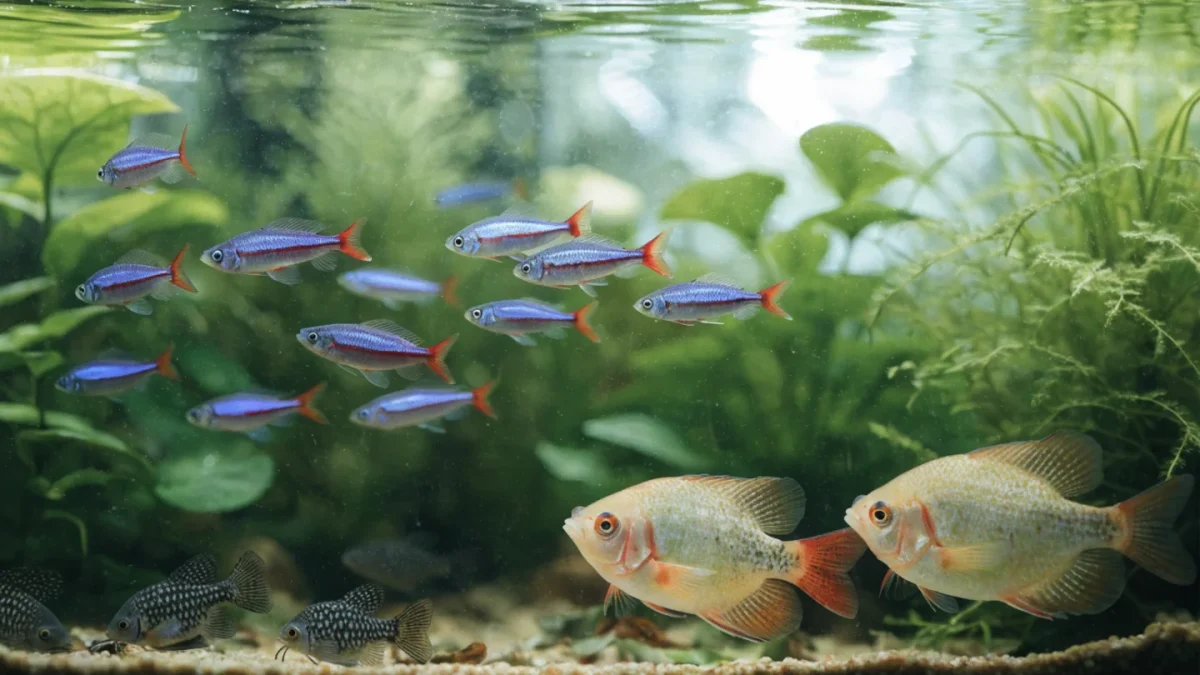
I watched a guy at a reptile expo — wrong venue, I know — buy a bag of assorted tropical fish because the vendor told him they'd "all get along." Six species, three different pH preferences, two that would outgrow his 20-gallon tank within a year, and an African cichlid mixed in with tetras. That bag was a disaster waiting for water.
The best tropical freshwater fish for community tanks are species that share similar water parameters, occupy different tank levels, and won't eat or harass each other. Neon tetras, corydoras catfish, harlequin rasboras, guppies, and dwarf gouramis form the classic core — but success depends on understanding why these fish work together, not just copying a stocking list from a forum.
Choosing Species That Actually Coexist
Compatibility isn't just about aggression. Temperature overlap, pH tolerance, activity level, and tank layer preference all matter. A peaceful fish that needs 78°F and soft water will stress silently next to a peaceful fish that thrives at 72°F in hard water. You won't see fighting. You'll see a fish that fades, stops eating, and dies in three months while you blame genetics.
I think of community tanks in three layers. Top dwellers like hatchetfish and some killifish. Mid-level swimmers like tetras, rasboras, and gouramis. And bottom feeders — corydoras, kuhli loaches, small plecos. Stock at least two of the three layers and your tank looks alive from every angle.
The single biggest mistake? Mixing shoaling fish without giving them proper numbers. Six neon tetras is a school. Two neon tetras is a stress experiment. These fish evolved to move in groups because there's safety in numbers, and when you keep three of them in a tank with larger species, they spend their lives in hiding mode. Their color washes out, their immune system drops, and ich finds them first.
The Reliable Starters
Some species have earned their reputation for good reason.
Neon tetras (Paracheirodon innesi) sit at the top of every beginner list because they tolerate a pH range from about 5.5 to 7.5, stay under two inches, and their iridescent blue-and-red stripe makes even a basic tank look expensive. They need groups of at least eight, ideally twelve or more. A properly schooling group of neons moving through a planted tank is one of the best things in the hobby.
Corydoras catfish are the bottom-dwelling workhorses. Over 170 described species exist, but bronze and peppered corydoras are the most widely available. They need soft substrate — sand or smooth fine gravel — because they sift food with their barbels. Sharp gravel erodes those barbels down to nubs. I've seen rescue corydoras with no barbels left, just flat faces. Keep them in groups of six minimum. They're social in a way that surprises people who think of catfish as loners.
Guppies (Poecilia reticulata) breed so readily that your stocking problem might become an overstocking problem. Males display those spectacular tails, and they'll pursue females relentlessly — so either keep all males, or keep at least two females per male to spread the attention. Mixed-sex groups in a community tank can produce fry every month. Some get eaten. Some don't. Plan for that.
Harlequin rasboras (Trigonostigma heteromorpha) are the fish I recommend when someone tells me they want "something easy but not boring." That metallic copper body with the black triangular patch — understated and striking. They school tightly, tolerate a range of water conditions, and don't bother anyone. Eight or more in a planted tank and they practically arrange themselves into a photography composition.
The Centerpiece Question
Every community tank benefits from a focal species — one or two individuals that draw the eye. Dwarf gouramis (Trichogaster lalius) fill this role with their brilliant blue-and-orange stripes and a slow, deliberate swimming pattern that contrasts with the darting tetras around them.
But I've changed my mind on dwarf gouramis over the years. The commercially bred stock has a disease problem. Dwarf gourami iridovirus (DGIV) runs through breeding facilities, and there's no treatment. You can buy a perfect-looking fish that dies within six months from an infection it carried from the farm. Honey gouramis (Trichogaster chuna) are less flashy but hardier, and I've had individual honeys live past five years. If you want a gourami centerpiece, consider honeys first.
For betta fish care, a single male betta can serve as a centerpiece in a community tank — but tankmate selection becomes much more restrictive. Fin-nipping species are out, fast swimmers that trigger aggression are out, and anything with long flowing fins that a betta might mistake for a rival is out. It's doable but not the free-form community stocking that most beginners envision.
Water Parameters: The Non-Negotiable Foundation
Most tropical community fish thrive between 75-80°F, pH 6.5-7.5, and moderate hardness. That's convenient because it describes the tap water in a lot of places. But "most" isn't "all," and the fish that fall outside this window are the ones that cause problems when mixed in.
Get a liquid test kit — not strips. Strips give you a vague direction. A liquid kit gives you numbers you can act on. Test ammonia, nitrite, nitrate, and pH weekly for the first three months, then biweekly once the tank is stable.
Ammonia and nitrite should always read zero in a cycled tank. If they don't, you have a cycling problem, an overstocking problem, or a dead fish decomposing somewhere you can't see. Nitrate under 20 ppm is the target for most community fish. Weekly water changes of 25-30% keep that manageable.
Temperature consistency matters more than hitting an exact number. A tank that holds steady at 77°F is healthier than one that swings between 74°F and 80°F because the heater is undersized or the room temperature fluctuates. Use a heater rated for your tank volume and verify with a separate thermometer — don't trust the heater's built-in dial.
Stocking Density: The Math and the Reality
The old "one inch of fish per gallon" rule is a rough starting point that falls apart fast. A ten-inch-long common pleco does not belong in a ten-gallon tank. Body mass, waste output, swimming space requirements, and oxygen demand all scale differently with fish size.
A more practical approach: stock conservatively, observe for a month, test water parameters, and add fish only when ammonia and nitrite stay at zero without extra water changes. For a standard 20-gallon community, something like ten neon tetras, six corydoras, and a single centerpiece fish gives you a balanced, visually interesting tank without pushing biological filtration to its limit.
Overstocking is the most common killer in community tanks. Not because the fish fight — because the nitrogen cycle can't keep up. Ammonia spikes overnight, nitrite follows, and by the time you notice the fish gasping at the surface, organ damage is already done.
Feeding a Mixed Community
Different species eat at different speeds and in different places. Drop flake food on the surface and your tetras and guppies will demolish it before a single crumb reaches your corydoras on the bottom. That's how bottom-feeders starve in a "well-fed" community tank.
I feed in layers. Flake or micro-pellet food at the surface for the mid-to-top dwellers. Sinking pellets or wafers dropped directly to the substrate for bottom feeders — and I drop them after lights-out since corydoras are more active at night. Once or twice a week, frozen bloodworms or daphnia for the whole tank. The frenzy during frozen food feeding is the closest thing to wildlife television in my living room.
Don't overfeed. Two minutes is the rule — if food is still floating or sinking uneaten after two minutes, you used too much. Uneaten food decays, spikes ammonia, and feeds algae. New fishkeepers almost always overfeed. I did it for my entire first year.
Plants Change Everything
Live plants aren't just decoration. They absorb nitrate, oxygenate water, provide hiding spots that reduce aggression, and give fry a chance to survive in a community tank. A heavily planted tank is more stable, more forgiving of minor overfeeding, and looks dramatically better than plastic decorations.
Start with low-tech species if you don't want to deal with CO2 injection: java fern, anubias, cryptocoryne, and floating plants like water sprite or frogbit. These grow in moderate light without supplemental CO2 and tolerate the same parameters your community fish prefer.
I've run planted community tanks for over a decade and the difference between a bare tank with plastic plants and a tank with live vegetation isn't cosmetic — it's biological. Ammonia spikes that would crash a bare tank get buffered by plant uptake. Fish display better color and more natural behavior when they have real cover. And when you sit down in front of a mature planted community tank in the evening, the light filtering through the leaves while schools of fish drift through the stems — that's the reason people get into this hobby.
Common Mistakes That Kill Community Tanks
Adding all your fish at once overloads the biological filter. Stock in groups over several weeks, giving the bacteria colony time to catch up.
Skipping quarantine introduces disease. A new fish carrying ich will infect your entire community within days. A cheap 10-gallon quarantine tank with a sponge filter pays for itself the first time it saves your display tank from an outbreak.
Ignoring aggression until it's obvious. By the time you see torn fins, the stress has been building for weeks. Watch for subtle signs: one fish always hiding in the same corner, color fading on a specific individual, a fish that eats eagerly when alone but won't approach food when a tankmate is near. Rehome the aggressor before it becomes a bigger problem.
Not researching adult size. That cute two-inch "algae eater" at the store might be a common pleco that grows to eighteen inches and produces waste like a small dog. Or a Chinese algae eater that turns aggressive at maturity. Always look up the adult size and temperament before buying. The fish you see in the store is a juvenile.
FAQ
How many fish can I put in a 20-gallon community tank?
For a 20-gallon, a reasonable community is around 10-12 small schooling fish (like neon tetras), 6 corydoras, and 1-2 centerpiece fish. That puts you at roughly 18-20 fish, which is comfortable if your filtration is adequate and you maintain weekly water changes. I'd rather see a tank with fewer fish that all look healthy than a packed tank where half of them are clamped and hiding.
Can I mix tropical fish with goldfish?
No. Goldfish are coldwater fish that prefer 65-72°F and produce enormous amounts of waste relative to their size. Tropical community fish need 75-80°F. Beyond the temperature mismatch, a single goldfish in a tropical community tank will foul the water faster than most filters can handle, stressing every other fish in the system.
How long before I can add fish to a new tank?
A fishless cycle takes 4-8 weeks using an ammonia source. You're waiting for beneficial bacteria to establish colonies that convert ammonia to nitrite and nitrite to nitrate. Some people use bottled bacteria products to speed this up — results vary. I've seen them cut cycling time in half, and I've seen them do nothing. Test your water. When ammonia and nitrite both read zero within 24 hours of dosing ammonia to 2 ppm, your cycle is complete.
Do I need a heater for tropical fish?
Yes. Unless you live somewhere with stable room temperatures above 76°F year-round, your tank needs a heater with a thermostat. Even in warm climates, air conditioning can drop room temperature enough to stress tropical fish. An undersized heater that can't maintain temperature during a cold snap is worse than no heater at all — get one rated for your tank volume or slightly above.
What's the easiest tropical fish to keep alive?
Guppies and endlers are probably the most tolerant of beginner mistakes. They handle a pH range from 6.5 to 8.0, eat anything, breed readily, and recover from minor water quality issues that would kill more sensitive species. But "easiest to keep alive" shouldn't be the only question. Ask what you're willing to maintain. A fish that survives your neglect isn't thriving — it's enduring.