

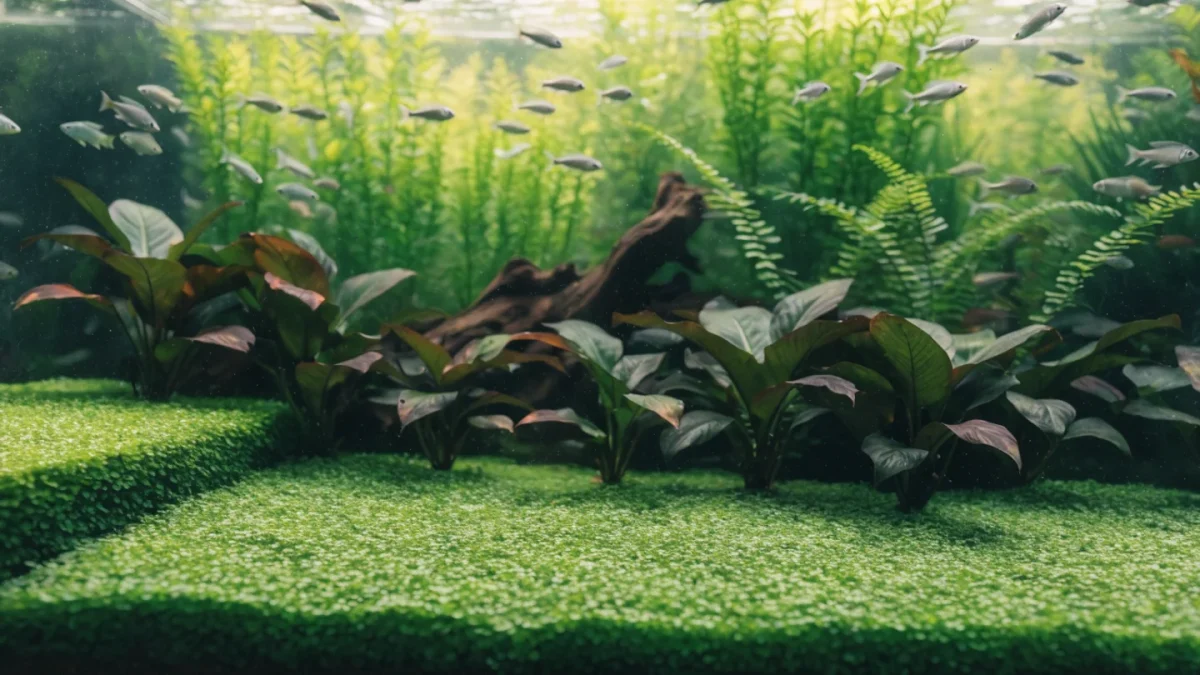
Six years ago I filled a 20-gallon tank with gravel, shoved in a handful of plants from a pet store bargain bin, and blasted them with whatever light fixture came bundled with the tank. Two weeks later the water looked like pea soup and every plant was dissolving into brown mush. I blamed the plants. The plants weren't the problem.
A planted aquarium needs the right substrate for root-feeding species, lighting matched to the plants you're growing, and a decision about CO2 — injected or not — that shapes everything else in the tank. Low-tech setups with hardy species like Java fern (Microsorum pteropus) and Anubias can look stunning without CO2 injection. High-tech tanks with pressurized CO2 unlock carpeting plants, intense reds, and faster growth, but they demand more attention and a bigger budget.
That failed first tank taught me what no care sheet bothered to mention: a planted aquarium is an ecosystem, not a decoration. Get the balance right and the tank practically maintains itself. Get it wrong and you're fighting algae, melting leaves, and cloudy water every week.
Substrate: The Foundation Nobody Thinks About Enough
Plants need to eat. Some feed through their roots, some through their leaves, and many do both. Your substrate choice determines which species you can grow successfully.
Inert substrates — plain gravel, sand — don't provide nutrients on their own. You can grow rhizome plants like Anubias and Java fern on them because those species attach to hardscape and feed from the water column. But stem plants and carpet species starve in plain gravel unless you're dosing liquid fertilizers heavily and consistently.
Active substrates change the game. Aqua soils (baked clay substrates enriched with nutrients) buffer pH downward, provide root-zone nutrition, and give carpeting plants something to actually grip. I switched to an active substrate on my second attempt and the difference was immediate — stems that had been limping along in gravel put out roots in three days and doubled their height in two weeks.
The catch: active substrates cloud the water during setup, they can crash your pH if you aren't expecting it, and they exhaust their nutrients after 12-18 months. Budget for root tab supplements down the road.
A capped soil approach — organic potting soil under a gravel or sand cap — works on a budget but it's messy. I've done it. The first water change was terrifying. If you go this route, expect tannins, floating debris, and a tank that looks apocalyptic for the first few days. It settles. Usually.
Lighting: More Than Just "On" or "Off"
Plants photosynthesize. Obviously. But the intensity, spectrum, and duration of your light determine whether photosynthesis actually happens at a rate that outpaces decay.
Low light means roughly 15-30 PAR (photosynthetically active radiation) at substrate level. That's enough for Anubias, Java fern, Cryptocoryne species, and a handful of slow growers. Medium light — 30-60 PAR — opens up most stem plants, some ground covers, and a wider palette of textures and colors. High light — 60+ PAR — is where demanding species like Hemianthus callitrichoides (dwarf baby tears) and Glossostigma actually carpet.
I run my planted tanks on a 7-hour photoperiod. Not 12. Not 10. Seven. And I fought fewer algae blooms the moment I cut those hours down. New keepers almost always run lights too long, assuming more light equals more growth. More light with the same nutrient and CO2 levels just equals more algae.
Full-spectrum LED fixtures with a color temperature around 6500K mimic daylight and support broad plant growth. Avoid fixtures marketed as "color enhancing" for fish — they boost blue and red diodes for visual pop but often lack the full spectrum plants want.
A timer isn't optional. Plants respond to photoperiod consistency the way fish respond to temperature consistency. Manual switching leads to drift, and drift leads to problems.
CO2: The Fork in the Road
Every planted tank reaches a decision point: inject CO2 or don't. Neither answer is wrong, but they lead to very different tanks.
Without CO2 injection — a "low-tech" tank — you're limited to plants that tolerate ambient CO2 levels (roughly 2-4 ppm dissolved in most tap water). Growth is slower, color is less intense on red species, and carpeting plants mostly won't cooperate. But maintenance is simpler, cheaper, and the margin for error is wider.
With pressurized CO2, you're adding 20-30 ppm of dissolved carbon during the photoperiod. Plants grow faster, colors intensify, and species that would melt in a low-tech tank suddenly thrive. The downside: CO2 injection requires a regulator, a solenoid valve, a diffuser or reactor, and a drop checker to monitor levels. Overdosing CO2 drops pH rapidly and can suffocate fish. It's not hard to get right, but it's not forgiving if you get it wrong.
I ran low-tech tanks for my first three years. Honestly? They looked great. The shift to high-tech was driven by wanting to grow Rotala rotundifolia in its red form and attempting a carpet of Monte Carlo (Micranthemum tweediei). Those species needed more than ambient CO2 could provide. If your plant list doesn't include demanding species, save the money.
DIY CO2 — yeast-and-sugar reactors — exists but I don't recommend it for anything beyond a small experimental tank. Output is inconsistent, you can't shut it off at night, and the cost savings disappear once you factor in the hassle and the inevitable replacement of a sugar bottle that's been fermenting under your desk for three weeks. Ask me how I know.
Choosing Plants: Match the Species to Your Setup
This is where most guides hand you a list of fifty plants ranked by difficulty. I'll spare you.
Pick your light level and CO2 commitment first. Then choose plants that fit.
Low light, no CO2: Java fern, Anubias (any variety), Java moss (Taxiphyllum barbieri), Cryptocoryne wendtii, Marimo moss balls. These plants are close to indestructible in stable water. They grow slowly but they grow.
Medium light, no CO2: Add Pogostemon stellatus 'Octopus,' Vallisneria, Bacopa caroliniana, and certain Echinodorus species. Growth picks up noticeably. You'll start pruning instead of waiting.
High light with CO2: The full palette. Rotala species, Ludwigia species, carpeting plants like Monte Carlo and dwarf hairgrass (Eleocharis acicularis), and demanding foreground species. Red plants get truly red. Growth is measured in inches per week, not inches per month.
One principle that took me too long to learn: plant heavily from day one. A sparse tank with six stems and a lot of empty substrate is an invitation for algae to colonize every available surface. Dense planting from the start means plants outcompete algae for nutrients and light. I aim for at least 70% of the substrate covered at planting.
Buy more plants than you think you need. You'll thank yourself in three weeks when the tank is filling in instead of fighting green film on every surface.
Layout and Hardscape: Making It Look Intentional
A pile of plants in water isn't an aquascape. Layout matters — not for arbitrary aesthetic reasons, but because a well-designed layout creates depth, varying light zones, and a more natural environment for fish.
The rule of thirds applies underwater the same way it applies in photography. Place your focal hardscape — a main stone or piece of driftwood — roughly one-third from either side, not dead center. Center placement reads as artificial, even to people who can't articulate why.
Three broad layout styles dominate planted aquascaping: Nature style uses driftwood, rocks, and plants to mimic a river bank or forest floor. Iwagumi strips everything down to stones and a single carpeting plant. Dutch style skips hardscape entirely and arranges plants in dense, color-coordinated rows like an underwater garden. Each style has its own demands, and the one that appeals to you visually may not match your current skill level — and that's fine. Start with what you can maintain.
Tall plants go in the back. Short plants go in the front. Seems obvious, but I've seen tanks where someone planted Vallisneria in the foreground and couldn't figure out why the front of the tank was a wall of grass within a month.
Driftwood takes weeks to waterlog and stop floating. Either boil it, soak it in a bucket for a week, or anchor it with stones. I've used stainless steel screws into slate bases for stubborn pieces — it works and it's invisible once plants fill in around it.
Water Parameters and Maintenance
Most planted aquarium species are flexible on water chemistry, but there's a sweet spot: pH 6.5-7.2, GH 4-8 dGH, KH 3-6 dKH. Soft, slightly acidic water is where the majority of aquarium plants evolved. If your tap water runs hard and alkaline, you can still grow plants — just stick to species that handle it, like Vallisneria and Anubias.
Water changes matter. I do 30-50% weekly on high-tech tanks, 20-30% on low-tech. Consistency beats volume — a tank that gets a 50% change one week and nothing for three weeks is worse off than one getting 25% every week.
Fertilization fills gaps that fish waste and substrate can't cover. Low-tech tanks usually get by with a modest liquid fertilizer once or twice a week. High-tech tanks need a structured dosing regimen — either Estimative Index (EI) dosing or a lean dosing approach — to keep up with the accelerated growth rate. Underfertilized high-light tanks are algae factories, because the plants can't use all that light energy without the nutrients to match.
Trim aggressively. Stem plants that reach the surface and start growing horizontally shade everything beneath them. Cut them back to mid-tank height, replant the tops, and discard the leggy bottoms. It feels wasteful at first. It's not. Dense, bushy growth comes from regular trimming.
I lost my favorite stand of Rotala macrandra because I let it overgrow for six weeks while I was busy. The lower portions went bald, the roots deteriorated, and the entire colony collapsed. Fifteen minutes of trimming every Sunday would have prevented it.
Cycling a Planted Tank
A planted tank still needs to cycle. Beneficial bacteria colonies in the filter and substrate convert ammonia to nitrite to nitrate — the nitrogen cycle. Plants absorb some ammonia and nitrate directly, which helps, but they don't replace the bacterial colony entirely, especially in a tank with fish.
Plant the tank, run the filter, and wait. Fishless cycling with ammonia dosing works, but in a heavily planted tank, the plants often consume ammonia fast enough that the cycle is harder to track with test kits. I've started fish-in cycling planted tanks with hardy species and careful monitoring — not ideal in an unplanted tank, but the plant mass provides a buffer that pure glass-and-gravel tanks don't have.
Don't add your full fish stock on day one regardless. Start with a few hardy species, let the bacterial colony establish over 4-6 weeks, and add more gradually. The tank's biology needs time to match the bioload.
When you're choosing community tank fish selection, think about what lives well among plants. Small rasboras, cardinal tetras, and Corydoras catfish are planted-tank staples for a reason — they don't uproot plants, they don't eat them, and their waste provides mild fertilization.
Common Mistakes I Still See
Overfeeding fish. Extra food decays, spikes ammonia, feeds algae. Feed once a day, only what fish consume in two minutes.
Skipping the timer. Running lights manually leads to 14-hour photoperiods on days you forget, which feeds algae and stresses plants adapted to a shorter cycle.
Buying plants without researching their needs. That gorgeous red plant at the store probably needs high light and CO2. In your low-tech tank, it'll be brown in a week and dead in three.
Not testing water. A basic liquid test kit (ammonia, nitrite, nitrate, pH) costs less than one dead fish. Use it weekly until you know your tank's patterns. The same monitoring principles apply across every type of exotic pet enclosure — I lay out the universal approach in habitat setup fundamentals.
Giving up too early. Every planted tank goes through an ugly phase — usually weeks 2-4, when initial algae blooms hit and new plants are still adjusting. If the fundamentals are right (light duration, nutrients, CO2 matched to plant demand), the tank stabilizes. Mine always have. Sometimes it just takes patience and ugly water.
FAQ
Do I need CO2 for a planted aquarium?
No. Plenty of beautiful planted tanks run without CO2 injection. The species list is smaller and growth is slower, but low-tech tanks are genuinely easier to maintain. CO2 becomes worth considering when you want to grow demanding species — carpeting plants, intense reds, or fast-growing stem forests.
How long should I leave aquarium lights on for plants?
Six to eight hours is the working range. I run seven. Longer photoperiods don't proportionally increase growth — they increase algae. Use a timer. Every day, same schedule. Plants and algae compete for the same resources, and a consistent short photoperiod tips the balance toward plants.
Can I use regular soil in a planted aquarium?
Organic potting soil with no added fertilizers or pesticides can work as a substrate capped with sand or gravel. It's called the Walstad method and it genuinely produces lush tanks on a budget. But expect messy water for the first week, possible anaerobic pockets if the cap is too thick, and tannin-stained water for months. I've done it twice — once successfully, once disastrously. The disaster involved soil with perlite that kept floating up through the cap for eight weeks.
Why are my aquarium plants melting?
New plants often melt back their emersed-grown leaves (the leaves grown above water at the nursery) and replace them with submersed-grown leaves adapted to underwater life. This transition looks alarming but it's normal for Cryptocorynes, some stem plants, and tissue-cultured specimens. If melting continues past three weeks, check your lighting intensity, nutrient levels, and whether the plant species actually matches your tank's parameters.