

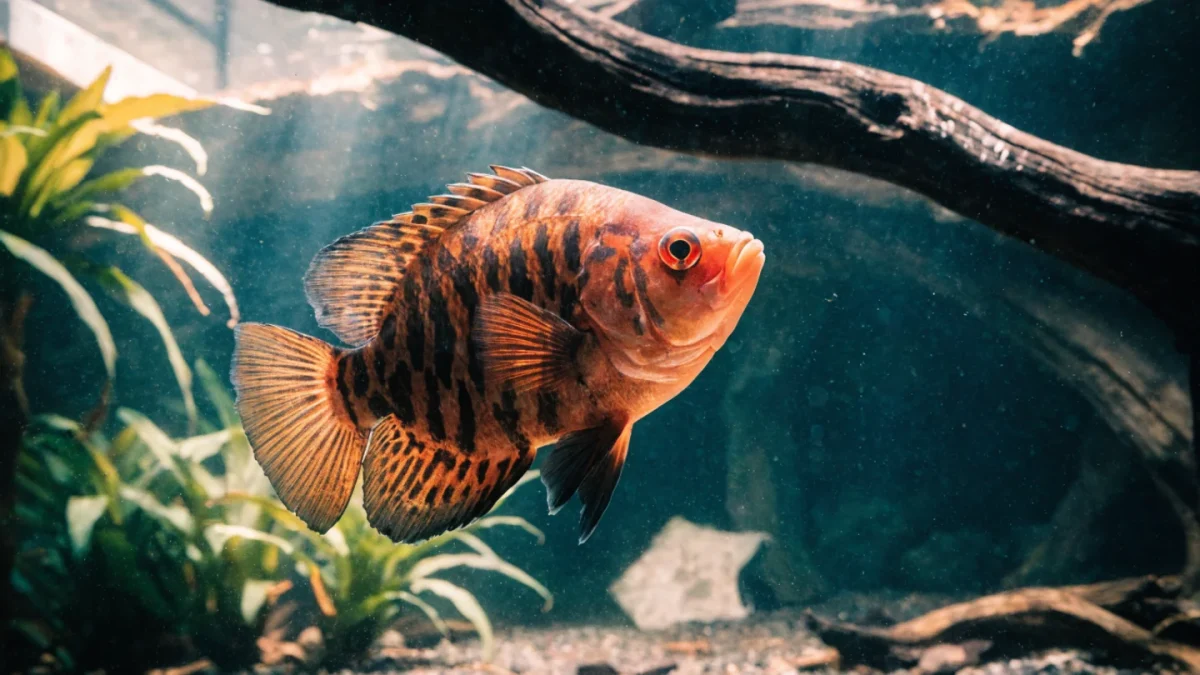
A breeder I visited a few years back had a fish room with three walls of tanks. One wall was all African cichlids — bright, chaotic, constantly sparring. The opposite wall held South American species. The energy was completely different. An oscar in a 400-liter tank tracked our movement across the room like a dog following its owner. A pair of discus hovered behind a curtain of plants, barely moving, colors shifting as they angled toward the light. An angelfish drifted upward through a thicket of amazon swords like a sail catching wind.
South American cichlids occupy a different emotional register than their African relatives. Where African species tend toward hyperactivity and relentless territorial conflict, many South American cichlids are more deliberate, more interactive with their keepers, and in some cases, more demanding of precise water conditions. They reward patience with behavior that borders on personality.
The Big Three: Oscar, Angelfish, Discus
These three species dominate the South American cichlid hobby, and each attracts a different type of keeper.
Oscars (Astronotus ocellatus) are the dogs of the fish world. They recognize their owners, beg for food, rearrange tank decor to suit themselves, and grow to 30-35 cm (12-14 inches). They need 300+ liters per fish and produce staggering amounts of waste. An oscar tank is a commitment to heavy filtration, frequent water changes, and an animal that will outlive most houseplants — 15-20 years in good conditions.
I kept my first oscar in a 200-liter tank, which I quickly realized was undersized when the fish hit 25 cm and could barely turn around. Upgraded to a 400-liter and the behavior transformed — active, exploratory, interactive. Tank size isn't a suggestion with oscars; it's a biological requirement.
Angelfish (Pterophyllum scalare) are the elegant middle ground. They reach 15 cm body length and 20 cm tall, need a minimum 100-liter tall tank, and coexist with peaceful community fish (as long as those fish are too large to eat). They come in dozens of color varieties — silver, marble, koi, black, platinum.
Discus (Symphysodon spp.) are the pinnacle of South American cichlid keeping. Stunning, disc-shaped, available in extraordinary color morphs, and notoriously demanding. They need pristine water, high temperatures (28-30°C / 82-86°F), and small group sizes of five or more. Discus aren't a beginner fish. They're a destination species that experienced keepers work toward.
The complete cichlid care overview covers how all three fit into the broader cichlid family.
Dwarf Cichlids: Rams and Apistos
Not all South American cichlids are large or difficult. German blue rams (Mikrogeophagus ramirezi) and Apistogramma species are dwarf cichlids — adults under 8 cm — that fit community tanks of 60+ liters.
Rams are gorgeous but fragile. They need warm water (27-30°C), soft and acidic conditions, and impeccable water quality. I've kept rams that thrived for three years and rams that died within weeks despite identical conditions. They seem to be highly variable in genetic robustness, likely due to extensive line breeding for color.
Apistogramma species — cacatuoides, borellii, agassizii — are hardier than rams and display fascinating breeding behavior. A male will maintain a harem of females in a well-decorated tank, and the females become fiercely protective of their fry. Watching an Apistogramma female defend her babies against fish three times her size is remarkable.
Acaras and Other Medium Species
Electric blue acaras (Andinoacara pulcher hybrid), green terrors (Andinoacara rivulatus), and severums (Heros severus) occupy the middle ground between dwarfs and the big three. They're robust, moderately sized (15-25 cm), and manageable in tanks of 200+ liters.
Electric blue acaras have become enormously popular for their color — an electric blue sheen across the entire body. They're also one of the more peaceful medium cichlids, coexisting with many community species. Green terrors live up to their name and are significantly more aggressive — beautiful but demanding of space and careful tankmate selection.
Water Parameters Across the Group
Most South American cichlids evolved in Amazonian tributaries — soft, acidic, warm, and tannin-stained. The general parameter profile:
- pH: 6.0-7.5 (lower for discus and apistos, broader for oscars)
- GH: 3-12 dGH (soft to moderate)
- Temperature: 24-30°C (75-86°F) depending on species
- Substrate: sand preferred, replicating river bottoms
This contrasts sharply with African cichlid counterpart requirements — hard, alkaline water mimicking rift lakes. Don't mix the two groups.
The one exception to the soft water rule is oscars, which tolerate a surprisingly wide parameter range. I've kept oscars in water at pH 7.8 and GH 15 without issues. They're far more adaptable than discus or rams.
Common Mistakes
Mixing African and South American cichlids. Different water chemistry, different aggression styles, and different social structures. It doesn't work.
Underestimating adult size. That adorable 5 cm oscar at the store will be 30 cm in two years. Plan for adult size from day one.
Keeping discus without experience. Discus require a level of husbandry — daily water changes during grow-out, precise temperature, and group dynamics management — that overwhelms beginners. Build skills with angelfish or rams first.
Ignoring breeding aggression. Even "peaceful" South American cichlids become territorial when spawning. A pair of angelfish guarding eggs will attack every other fish in a 100-liter tank. Have a plan for separating breeding pairs.
FAQ
What's the easiest South American cichlid for beginners?
Angelfish or electric blue acaras. Both tolerate moderate water parameters, eat readily available foods, and are hardy enough to handle the minor mistakes beginners make. Convict cichlids are technically Central American but often grouped with South Americans — they're indestructible but extremely aggressive and prolific breeders.
Can South American cichlids go in a community tank?
Dwarf species (rams, apistos) fit in peaceful community tanks with tetras, corydoras, and rasboras. Medium and large species need carefully planned communities with size-appropriate tankmates. An oscar in a community tank is really an oscar tank with very brave, very large companions.
How long do South American cichlids live?
Oscars: 15-20 years. Angelfish: 10-12 years. Discus: 10-15 years. Rams: 3-4 years. Apistogramma: 3-5 years. These are long-lived fish — especially the larger species — and the commitment should be taken seriously.