

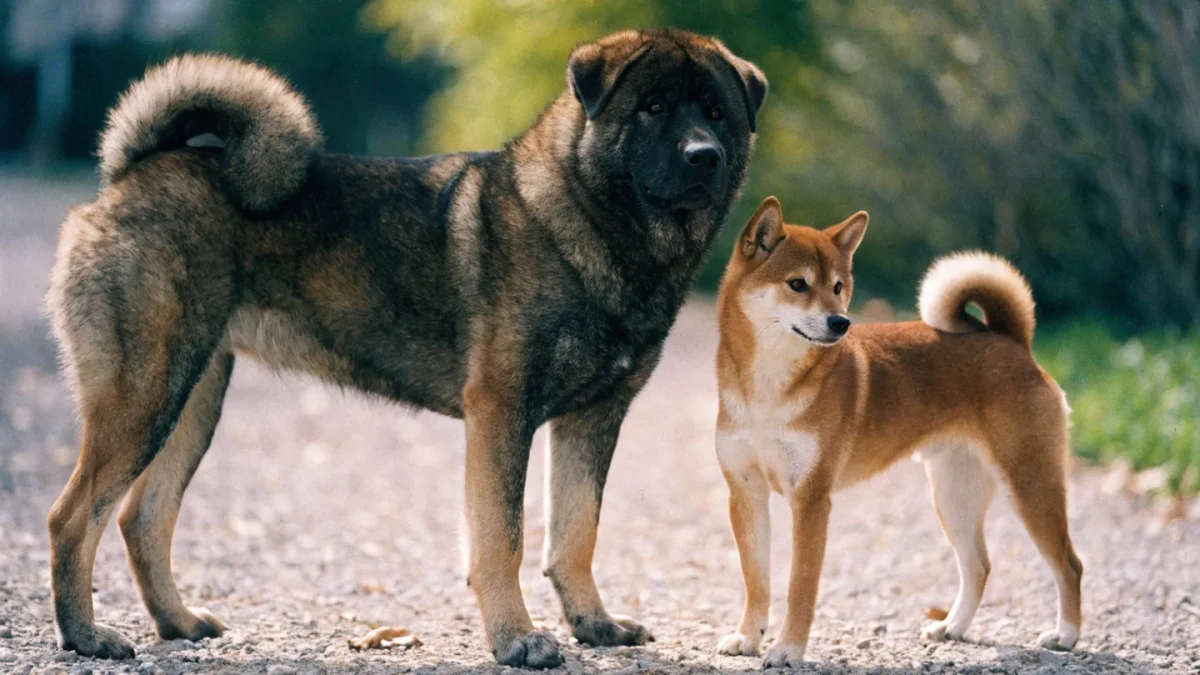
Both the Akita and the Shiba Inu are designated natural monuments in Japan — the Akita since 1931 and the Shiba Inu since 1936. Both nearly went extinct during World War II and were rebuilt from small surviving populations. They share a national heritage, a spitz-type appearance, and a reputation for independence that borders on feline. But the size difference alone — the Akita can weigh five to six times what a Shiba weighs — should tell you these are fundamentally different dogs for fundamentally different situations.
For the full framework on comparing breeds, see the breed comparisons guide.
Size and Build
| Trait | Akita | Shiba Inu |
|---|---|---|
| Height (male) | 64–70 cm | 37–40 cm |
| Height (female) | 58–64 cm | 34–37 cm |
| Weight (male) | 34–59 kg | 9–11 kg |
| Weight (female) | 32–45 kg | 8–9 kg |
| Build | Large, powerful, heavy-boned | Small, compact, agile |
The scale difference is dramatic. An Akita is a large, dominant, physically powerful dog. A Shiba Inu fits in your lap (though it may not want to). Both have the classic spitz profile — curled tail, erect triangular ears, wedge-shaped head — but at completely different scales.
Temperament
Both breeds share a reserved, dignified temperament that people often describe as "cat-like." They're clean, quiet (mostly), and not particularly interested in pleasing you for the sake of pleasing you. This is not Golden Retriever territory. Neither breed is biddable in the conventional sense.
The Akita takes independence further. Akitas are deeply loyal to their family but can be overtly suspicious of strangers and frequently aggressive toward other dogs, particularly same-sex dogs. The breed has a strong guarding instinct and a dominant personality that requires experienced, consistent handling. An Akita that hasn't been properly socialized is a genuinely dangerous animal due to its size and bite force.
The Shiba Inu is independent and stubborn but rarely dangerous — the breed's small size limits the consequences of behavioral issues. Shibas are known for the "Shiba scream" — a dramatic, high-pitched vocalization they produce when upset, excited, or simply because they feel like it. They're possessive about their things, can be selective about other dogs, and have strong prey drive toward small animals.
Both breeds bond with their families on their own terms. If you want a dog that lives to please you, look elsewhere.
Exercise
Akitas need 60 to 90 minutes of daily exercise — moderate walks, structured play, and activities that engage their mind. They're not endurance athletes and overheat in warm weather due to their thick double coat. They prefer purposeful activity over repetitive fetch games.
Shiba Inus need 45 to 60 minutes. They're surprisingly energetic and agile, with quick bursts of speed and a love of exploring on walks. Both breeds are escape risks — Akitas can power through inadequate fencing, and Shibas are creative climbers and diggers. Secure fencing is mandatory for both.
Neither breed should be trusted off-leash in unfenced areas. Recall is unreliable in both breeds, and both have prey drive that overrides training in the moment.
Grooming
Both have dense double coats that blow out twice a year. The Akita produces significantly more fur simply due to body size. Regular brushing two to three times per week (daily during blowouts) handles both breeds.
Neither requires professional grooming. Both are naturally clean dogs that groom themselves in a cat-like fashion and rarely develop the "doggy smell" common in many breeds.
Health
| Health Factor | Akita | Shiba Inu |
|---|---|---|
| Top concern | Hip dysplasia, autoimmune disorders | Luxating patella, allergies |
| Lifespan | 10–13 years | 12–15 years |
| Autoimmune | Sebaceous adenitis, VKH syndrome | Less common |
| Joint issues | Hip dysplasia (common) | Luxating patella |
| Eye issues | PRA, entropion | Glaucoma, cataracts |
| Bloat risk | Moderate to high | Low |
The Akita faces more serious and varied health concerns, including autoimmune disorders that are disproportionately common in the breed. Vogt-Koyanagi-Harada (VKH) syndrome — an autoimmune condition affecting the eyes, skin, and nervous system — is particularly notable in Akitas. The Shiba is a generally healthier breed with fewer breed-specific serious conditions and a longer lifespan.
Which Fits Your Life?
Choose the Akita if you're an experienced large-dog owner, have a secure property, can provide firm and consistent leadership, and want a loyal, protective companion that doesn't seek attention from everyone it meets. Akitas are not suitable for first-time dog owners or households with multiple dogs.
Choose the Shiba Inu if you want the independent Japanese-breed temperament in a manageable size, can tolerate the stubbornness and the screaming, and appreciate a dog that behaves more like a roommate than a follower. Shibas work in apartments if exercise needs are met.
For another comparison involving large, independent breeds, see the Siberian Husky vs Alaskan Malamute matchup. For a deeper account of the Akita's history — including Hachiko, the breed's near-extinction in World War II, and its recovery — see Akita history and Hachiko origins. For the full breed profile covering the Akita's temperament, autoimmune predispositions, and ownership requirements, the Akita complete breed guide covers everything in depth.