

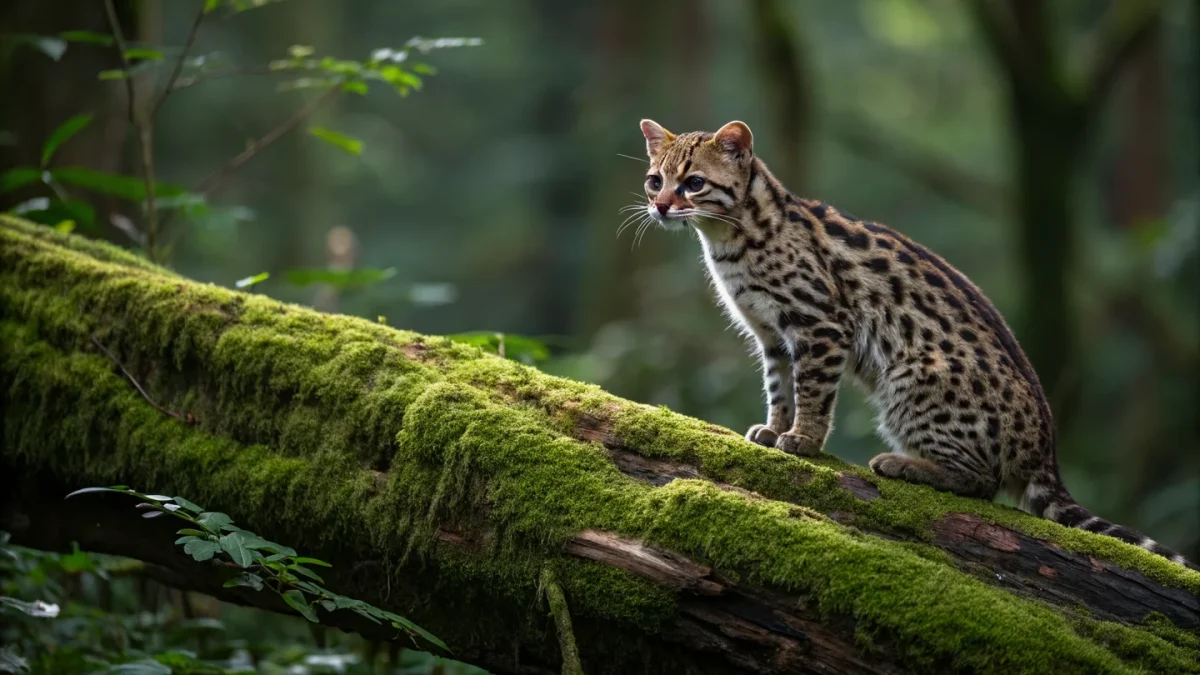
The generation system for Bengals exists because the breed began with a genuinely wild cat. When Jean Mill crossed a female Asian leopard cat (ALC) with a domestic male in the 1960s, and then resumed that work in the 1980s, the immediate offspring were genuinely hybrid animals — not domestic cats in any functional sense. The generation labeling developed to track how far subsequent breeding moved from that wild foundation.
Understanding the F-generation system matters both for anyone considering a Bengal and for understanding why "Bengal" covers a surprisingly wide range of animals, from essentially wild cats to fully domestic companions.
What "F" Numbers Mean
The F in F1, F2, F3, etc. stands for filial — from the Latin for "son" or "offspring." It is a standard notation in hybrid genetics describing how many generations separate the hybrid from the purebred wild ancestor.
F1 Bengal: One parent is an Asian leopard cat. The other is a domestic cat (or occasionally an early-generation Bengal). The F1 kitten has 50% ALC ancestry.
F2 Bengal: One grandparent is an ALC. F1 Bengal crossed with a domestic or SBT Bengal. The F2 has approximately 25% ALC ancestry.
F3 Bengal: One great-grandparent is an ALC. Approximately 12.5% ALC ancestry.
F4 and beyond: Four or more generations from any ALC ancestor. The percentage of wild ancestry is low enough — below 10% — that these cats are classified as domestic by most registries. The SBT (studbook tradition) designation applies from F4 onward.
The SBT designation has an additional requirement: both parents and at least one grandparent must also be registered SBT Bengals (not hybrids with ALC ancestry). This ensures that the domestic status is genuine and documentable rather than being asserted without verification.
How Temperament Changes Across Generations
The temperament shift from F1 to F4 is substantial, and it's worth describing honestly because the early generations are sometimes marketed as "more authentic" or "more wild-looking" in ways that obscure the genuine difficulty of keeping them.
F1 Bengals are deeply challenging companion animals. They bond with specific humans in isolated conditions but are unpredictable, territorial, frequently fearful, and carry instinctive wild behaviors that cannot be trained away. They spray — persistently and markedly — as a territorial behavior. They can be dangerous when frightened. They don't adapt to normal domestic life in the way that any F4+ Bengal does. Keeping an F1 Bengal requires specialist facilities, knowledge, and in many places, legal permission.
F2 Bengals vary more than F1s, but are still substantially difficult. Some F2s with extraordinary early socialization become manageable. Most are not suitable as typical household pets. The spraying behavior is still present in many F2s.
F3 Bengals are increasingly variable. Some are relatively tractable. Some retain strong wild behaviors. Socialization history matters enormously at this stage. Many jurisdictions still restrict F3 ownership.
F4 and SBT Bengals are the domestic Bengal. The wild behaviors that characterize earlier generations are gone. These cats are affectionate, playful, energetic domestic animals. They retain the high activity level and prey drive that characterize the Bengal breed overview, but in a range compatible with household life. These are the cats sold by responsible breeders as pets.
Why Early Generations Are Rarely Appropriate as Pets
The appeal of early-generation Bengals is understandable — the visual impact of a cat that is genuinely close to a wild ancestor is striking. But the appeal conflicts with the welfare of the animal.
F1 and F2 Bengals that are placed in typical household environments are typically stressed animals. Their instincts — spatial territory requirements, flight responses to confinement, complex social needs that don't map to typical human household patterns — conflict with domestic life. The result is an animal that is difficult to manage and frequently unhappy.
The Bengal breeders who work with early generations are, for the most part, doing conservation or research work, not producing pets. The early-generation hybrids that reach the pet market are frequently the product of sellers without the knowledge or ethics required to manage them appropriately.
SBT: What the Documentation Should Show
When purchasing a Bengal, SBT documentation should be straightforward to produce. What you're looking for:
- Both parents are registered SBT Bengals (not F1-F3 hybrids)
- At least one grandparent is also registered SBT
- The breeder can provide pedigrees showing the chain of registered SBT ancestors
If a seller cannot provide this documentation or describes their cats with generation numbers without registry documentation, the generation status — and therefore the temperament and legal status of the cat — is unverifiable.
The generation number is not just a formality. It has direct consequences for what the animal will be like to live with and, in many jurisdictions, whether it is legal to keep.
The SBT Bengal as a Breed in Its Own Right
Modern SBT Bengals are sufficiently removed from their ALC ancestors that the generation discussion is primarily historical context. An F10 Bengal, bred from ten generations of SBT parents, still carries the aesthetic heritage — the wild coat, the athletic build, the intense eyes — but is a domestic animal in every behavioral and legal sense.
The early-generation work was the foundation. What was built on that foundation, through decades of deliberate breeding toward both beauty and temperament, is a domestic breed that stands on its own merits. The ALC ancestry explains the coat and some of the behavioral traits, but it's not the operating reality of the SBT Bengal in 2026. These are domestic cats that happen to look like they belong in a forest. The closest parallel in terms of hybrid structure is the Savannah cat, which follows the same F-generation system using serval ancestry — a useful comparison for anyone interested in how hybrid breeds are developed and regulated.