

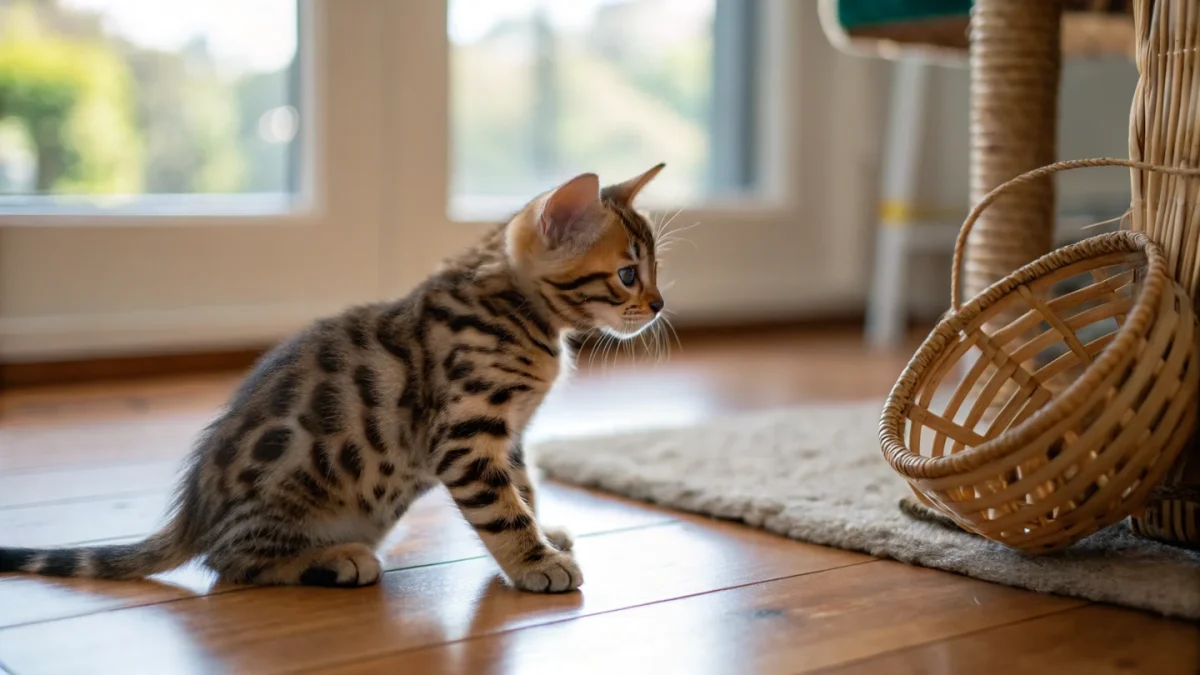
Bengal kittens go through something called the "fuzzy" stage, and no photograph prepares new owners for it. Around 3–5 weeks of age, a Bengal kitten's coat pattern becomes indistinct — the sharp spots or marbling that characterizes the breed blurs into a kind of ticked, unclear overlay that makes the kitten look like a slightly smudgy gray tabby. Experienced breeders know this stage will resolve. First-time Bengal buyers who see their kitten at this stage sometimes wonder if they've been sold the wrong cat.
They haven't. The fuzzy stage is a camouflage mechanism that likely evolved in the Asian leopard cat ancestor to protect kittens from predators by disrupting their outline. It clears. By 12–16 weeks, the adult pattern begins to emerge, sharpening and clarifying over the following months until the full rosettes or marbling is visible. The timing varies by individual — some Bengals don't fully resolve until a year or more.
Before Your Kitten Arrives
Verify the generation. A responsible Bengal breeder can provide SBT documentation — proof that both parents and at least one grandparent are registered domestic (SBT) Bengals. Generation matters for both temperament and, in some jurisdictions, legality.
Understand what socialization the breeder has done. The kitten's behavior in its first home is shaped significantly by the first 12 weeks with the breeder. Ask whether the kittens were handled daily by multiple people, exposed to household sounds, and had access to enrichment. A kitten from an isolated cattery arrives at your home with a deficit.
Prepare vertical infrastructure before day one. The Bengal breed is an athlete from the start. A tall, stable cat tree (or wall-mounted shelving) should be in place when your kitten arrives. A Bengal kitten attempting to climb something unsuitable and falling is an injury risk.
Set up the introduction room. A single safe room with food, water, litter, hiding spots, and climbing opportunity lets the kitten establish confidence before encountering the full household. Move to the rest of the house over days, not hours.
The Fuzzy Stage and Coat Development
Once you've accepted that the fuzzy stage is normal, the developmental arc is interesting to watch. The camouflage ticking recedes, the background color clarifies, and the pattern begins to emerge with definition.
The pattern type — spotted/rosetted versus marbled — is set genetically. A rosetted Bengal won't develop marbling, and vice versa. The rosettes, if present, will develop in degrees of complexity: some Bengals have simple solid spots, others develop the full multi-toned arrowhead or paw-print rosette shapes. The more complex rosette types typically become fully clear by 18–24 months.
The glitter effect — if your kitten has it — isn't usually visible until the adult coat comes in. It's worth knowing that glitter is genetically distinct from the spotted/marbled pattern and not all Bengals carry it. If the kitten's parent was glitter, there's a meaningful probability the kitten will be. Without genetics documentation, you wait and see.
Socialization in the Critical Window
The socialization window for kittens — approximately 2–12 weeks — is partially complete by the time you receive your kitten at 8–12 weeks. What the breeder did in those early weeks matters. What you do in the weeks following arrival also matters significantly, particularly for the Bengal breed's high-drive temperament.
Handle regularly. Paws, ears, mouth — daily, brief, gentle. Building touch tolerance early makes every future interaction with the cat (nail trims, grooming, vet exams) dramatically easier.
Introduce varied stimuli. Visitors, household sounds, different surfaces, the carrier (used positively, not just for vet trips). A Bengal kitten exposed to variety adapts readily. One raised in a single quiet environment can become reactive to change.
Introduce play structure from day one. Interactive wand toys establish the prey-drive play pattern that Bengal adults thrive on. Kittens that learn appropriate play (with toys, not hands or feet) are adults that don't use their owners as prey objects.
Begin Bengal grooming habits immediately. Brief handling sessions that include paw touching, lip lifting, and acclimatization to a rubber brush build the acceptance you need for adult grooming routines.
Managing Bengal Kitten Energy
This is the aspect that surprises new owners most. Bengal kittens are not merely active — they are relentlessly, ambitiously active for extended periods. The physical stamina of a Bengal kitten in a play session is genuinely impressive.
This energy needs direction. Play sessions of 15–20 minutes at a time, two or more times daily, are the correct response — not because the kitten can't play longer, but because structured sessions with clear endpoints teach the kitten that play happens in defined ways rather than being a constant state of hunting everything in the environment.
Do not encourage hand or foot play. A Bengal kitten that has been taught that hands are prey objects becomes an adult with a habit that's hard to break and genuinely painful at adult size and strength.
Puzzle feeders and rotating toys extend enrichment between active sessions. The cognitive engagement supplements the physical activity.
The Foundation You're Building
Bengal kittens are shaped powerfully by their early experiences. The adult cat that greets visitors calmly, accepts handling without resistance, plays interactively without aggression, and manages alone time without destruction — that cat is built primarily in the first six months.
The temperament potential of the Bengal is genuinely extraordinary. The initial commitment to socialization and structured experience is what unlocks it.